Washington Strategic Objectives in Post Maduro Venezuela
Source:Indian Express ↗
Why It Matters
The Venezuela crisis is a classic case study of how energy security, migration, and great power rivalry (US vs Russia/China) intersect in modern geopolitics. For UPSC aspirants, understanding US sanctions policy on Venezuela provides essential context for global oil price volatility and its cascading effects on India's energy import bill.
Summary
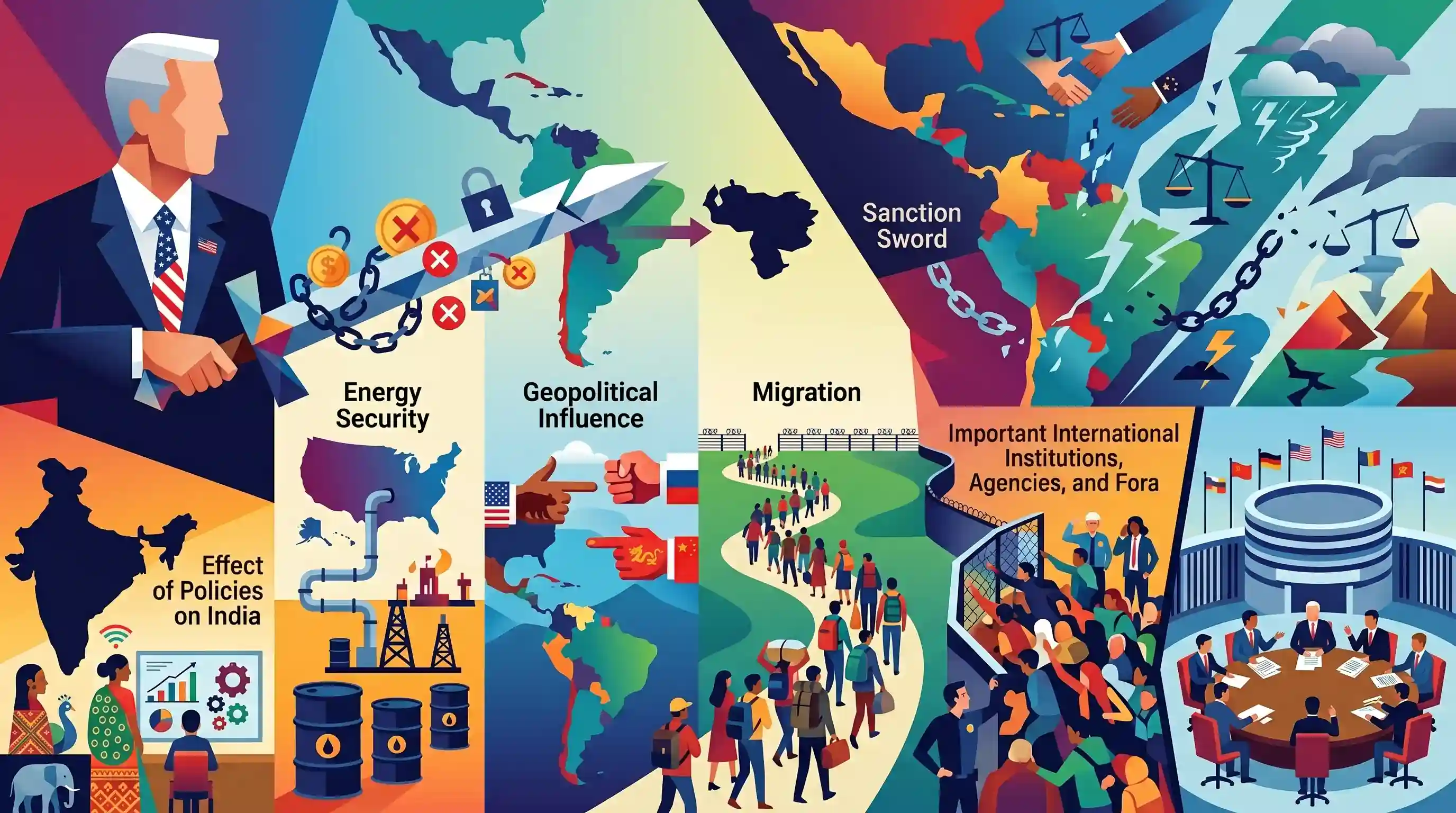
The article examines the complex motivations behind Washington's foreign policy toward Venezuela in the aftermath of Nicolas Maduro's controversial election victory. Beyond the rhetoric of restoring democracy, the United States' core strategic interests are driven by energy security, the need to counter Russian and Chinese influence in Latin America, and the urgency of halting the unprecedented wave of Venezuelan migrants arriving at the US southern border. The analysis highlights how economic sanctions serve as a double-edged sword, complicating US efforts to secure a stable and friendly Western Hemisphere while managing domestic border crises.
Key Points
- Following Nicolas Maduro's disputed re-election, Washington is recalibrating its policy toward Venezuela, balancing democracy promotion with pragmatic geopolitical interests.
- With the world's largest proven oil reserves, Venezuela remains critical to US energy security, particularly as the US seeks alternative supplies amidst the Ukraine war and Middle East tensions.
- A major driver of US policy is to curb the growing strategic footprint of rival powers like Russia, China, and Iran in the Western Hemisphere.
- The economic collapse of Venezuela, exacerbated by heavy US sanctions, has created a massive refugee crisis that places severe political and logistical strain on the US southern border.
- Washington faces a policy dilemma: lifting sanctions could empower an authoritarian regime, while tightening them worsens the migrant crisis and pushes Caracas further into the Sino-Russian axis.
Important Terms
US Sanctions Program (Venezuela)

Comprehensive economic measures, primarily targeting Venezuela's oil sector (PDVSA) and banking, intended to pressure the Maduro regime by restricting its access to international financial markets and revenue.
UPSC context
GS Paper II: Effect of policies of developed countries on India's interests; tests understanding of economic diplomacy and secondary sanctions.
OPEC
A permanent intergovernmental organization of 12 oil-exporting nations (including Venezuela) that coordinates petroleum policies to stabilize global markets and ensure steady income for producer nations.
UPSC context
GS Paper II & III: Important international institutions and Energy Security; critical for India's 85% crude import dependency.
Monroe Doctrine
A 19th-century US foreign policy principle—recently revived—asserting that any intervention by external powers in the politics of the Americas is a potentially hostile act against the United States.
UPSC context
GS Paper II: International Relations; tests knowledge of historical frameworks governing modern US-Latin America geopolitics.
Geopolitics of Energy
The study of how geographical factors and the distribution of energy resources (like Venezuela's world-leading oil reserves) influence international power dynamics and strategic conflicts.
UPSC context
GS Paper II: Global groupings and agreements; focuses on how resource competition drives foreign policy and regional stability.
Narco-terrorism
A legal and political label used by the US to describe the alleged nexus between the Venezuelan government and illegal drug trafficking to justify 'maximum pressure' and military-led law enforcement.
UPSC context
GS Paper II: International Relations and GS Paper III: Internal Security; tests the intersection of security threats and diplomatic justification.
Sovereignty vs. Unilateralism
The principle that a state has supreme authority over its territory, which is challenged by unilateral interventions or 'regime change' actions conducted without UN Security Council authorization.
UPSC context
GS Paper II: Important International institutions; examines the rules-based international order and the UN Charter's relevance in modern crises.
Prelims Trap
"Venezuela is the world's largest producer and exporter of crude oil."
While Venezuela holds the world's largest *proven crude oil reserves*, its actual production and exports are negligible due to under-investment and US sanctions.
Static Concepts Connected
What is "Dutch Disease" in macroeconomic terms?
- Definition: An economic phenomenon where a boom in one sector (usually natural resources like oil) causes a decline in other sectors (manufacturing/agriculture).
- Currency Appreciation: Massive resource export revenues appreciate the local currency artificially, making domestic non-oil exports uncompetitive globally.
- Resource Curse Link: It explains the "Resource Curse" where resource-rich nations like Venezuela struggle with long-term structural economic stability and diversification.
How do Secondary Sanctions operate in International Relations?
- Mechanism: Penalties imposed by a country (like the US) on third-party entities for trading with a sanctioned nation (e.g., Venezuela, Iran).
- Collateral Impact: They force third nations to halt trade to protect their domestic companies from losing access to the sanctioning country's financial systems.
- Strategic Autonomy: They heavily constrain India's strategic autonomy and force it to continually realign its crude oil procurement strategies.
Cross-Topic Patterns
Secondary Sanctions & India's Energy Math
Just as with Iran, US secondary sanctions on Venezuela forced India to halt cheap oil imports, highlighting the vulnerability of India's energy security to dollar weaponization.
Economics of Forced Displacement
Venezuela’s crisis mirrors broader global patterns where hyperinflation and economic collapse—rather than active war zones—create massive refugee influxes, straining neighboring states' resources.

Expect a 2026 Prelims statement testing the difference between 'proven oil reserves' (Venezuela leads) and actual production/exports.
Linked PYQs · 4
Linked PYQs · 4
- 2025MainsGS2
"Energy security constitutes the dominant kingpin of India's foreign policy, and is linked with India's overarching influence in Middle Eastern countries.” How would you integrate energy security with India's foreign policy trajectories in the coming years?
- 2025MainsGS2
"The reform process in the United Nations remains unresolved, because of the delicate imbalance of East and West and entanglement of the USA vs. Russo-Chinese alliance.” Examine and critically evaluate the East-West policy confrontations in this regard.
- 2018PrelimsGS1
Very recently, in which of the following countries have lakhs of people either suffered from severe famine/acute malnutrition or died due to starvation caused by war/ethnic conflicts?
- 2025PrelimsGS1
Consider the following countries : I. Bolivia II. Brazil III. Colombia IV. Ecuador V. Paraguay VI. Venezuela Andes mountains pass through how many of the above countries?
