Velugonda project phase one set to resolve Prakasam district drought
Source:the-hans-india ↗
Why It Matters
The Velugonda project is a critical AP geography and economy topic for APPSC Prelims. It highlights the state's efforts in managing water resources (Krishna River, Srisailam), addressing regional disparities (drought and fluoride in Prakasam/Rayalaseema), and integrating agricultural development with infrastructure (Ramayapatnam Port).
Summary
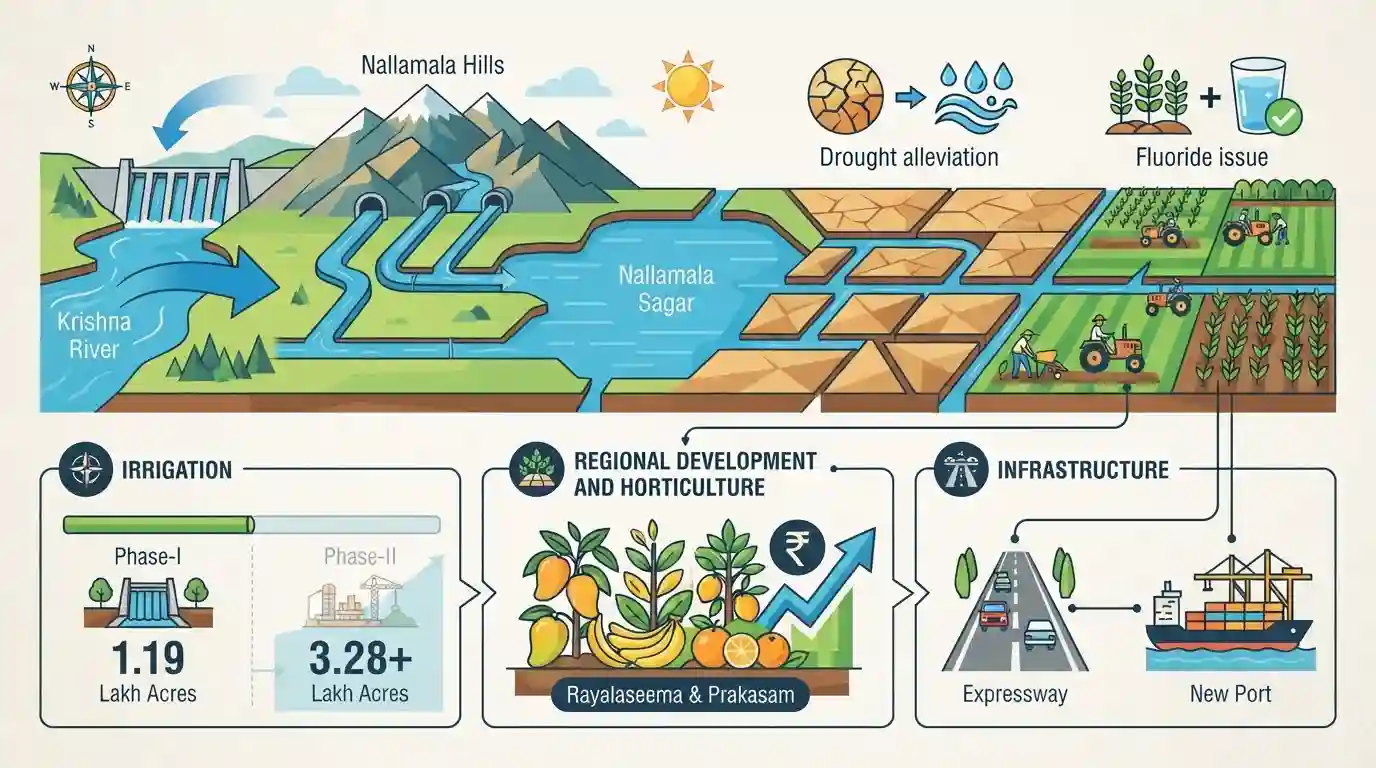
The completion of Phase-I of the Velugonda project in Andhra Pradesh marks a significant milestone in addressing the chronic drought and fluoride issues of the erstwhile Prakasam district. By channeling Krishna river water from Srisailam to the Nallamala Sagar reservoir, the project will initially irrigate 1.19 lakh acres, with Phase-II expanding coverage to over 3.28 lakh acres. Alongside this irrigation initiative, the state government announced a Rs 1 lakh crore plan to develop Rayalaseema and Prakasam into a horticulture hub, supported by strategic infrastructure like the Ramayapatnam Port and the Bengaluru-Amaravati highway.
Key Points
- The completion of Phase-I of the Velugonda project aims to resolve severe drought and fluoride contamination issues in the western parts of erstwhile Prakasam district.
- Phase-I involves drawing Krishna river water from Srisailam into the Nallamala Sagar reservoir, holding 10.7 tmc ft of water to irrigate 1.19 lakh acres.
- Phase-II of the project will further expand irrigation to 3.28 lakh acres and provide vital drinking water to the region.
- The state government plans a Rs 1 lakh crore investment to transform the Rayalaseema and Prakasam regions into a major horticulture hub.
- Regional economic growth will be bolstered by infrastructure projects like the Ramayapatnam Port and the upcoming Bengaluru-Amaravati highway.
Important Terms
Velugonda Project

An irrigation initiative diverting Krishna River floodwaters from the Srisailam reservoir to drought-prone and fluoride-affected regions of Prakasam, Nellore, and Kadapa districts via twin tunnels.
UPSC context
Crucial for AP Geography and Irrigation; highlights state strategies for drought mitigation and fluorosis eradication.
Nallamala Sagar Reservoir
A storage reservoir formed by closing three gaps in the Nallamala Hill ranges. It acts as the primary holding point for Krishna waters diverted under the Velugonda project.
UPSC context
Tests AP Geography and Water Resources. Key to understanding the technical execution of regional irrigation networks.
Ramayapatnam Port
A greenfield deep-sea port being developed by the AP Maritime Board on the state's eastern coast, designed to handle bulk cargo and drive industrial growth in Rayalaseema.
UPSC context
Important for AP Economy and Infrastructure. Highlights the state's coastal development and maritime logistics network.
Bengaluru-Amaravati Highway
An upcoming national highway economic corridor designed to enhance connectivity between Karnataka and Andhra Pradesh's capital region, spurring trade, logistics, and regional horticulture hubs.
UPSC context
Tests Regional Development and Infrastructure topics, emphasizing inter-state connectivity and economic corridor growth.
Prelims Trap
"Velugonda project draws water from the Penna River to serve Prakasam district."
Aspirants associate southern AP drought projects with the Penna basin, but Velugonda explicitly draws floodwaters from the Krishna River at the Srisailam foreshore.
Static Concepts Connected
What is the structural mechanism of the Velugonda Project?
- Source: Draws Krishna River floodwaters from the foreshore of the Srisailam reservoir.
- Conduit: Transports water via massive twin tunnels drilled through the Nallamala hills.
- Storage: Feeds the Nallamala Sagar, which acts as the central balancing reservoir for distribution.
What causes endemic fluorosis in the erstwhile Prakasam region?
- Geology: High presence of fluoride-bearing minerals in the region's underlying granite and gneiss rocks.
- Groundwater dependence: Over-reliance on deep borewells in drought-prone areas draws up highly concentrated dissolved fluoride.
- Low calcium: The local groundwater typically has low calcium content, a condition that exacerbates fluoride toxicity in humans.
Cross-Topic Patterns
Irrigation as a Public Health Measure
Beyond agriculture, the APPSC frequently tests major irrigation projects (like Velugonda) on their demographic impact, specifically mitigating endemic fluorosis by replacing toxic groundwater with safe surface water.
Export-Oriented Arid Agriculture
The integration of Rayalaseema's horticulture hub with Ramayapatnam Port and the Bengaluru-Amaravati highway reflects a strategic shift from subsistence dryland farming to export-focused agri-corridors.

Expect a multi-statement question matching Velugonda's source (Krishna), target issue (Fluorosis), and Ramayapatnam's location (Nellore).
Linked PYQs · 2
Linked PYQs · 2
- 2024APPSC_PRELIMSGS1
In connection with transport and infrastructure in Andhra Pradesh, which of the following statement/statements is/are valid? I. Andhra Pradesh's first riverine project has been proposed between Muktayala and Madipadu on Krishna river. II. The Bhogapuram Greenfield International Airport had been started with a corpus fund that is sourced from National Investment and Infrastructure Fund (NIIF). III. Infrastructure investments in Andhra Pradesh are strictly implemented only with reference to strategic investments like ports and industrial corridors, but not with reference to community assets. IV. Rail Over Bridges (ROBs) are being developed in Andhra Pradesh under the Setu Bandhan Scheme. Select the correct answer using the codes given below :
- 2023APPSC_PRELIMSGS1
Match the following Irrigation Projects and their States (location): | Irrigation Projects | States | |---|---| | a. Parwan Multipurpose Project | I. Madhya Pradesh | | b. Renukaji Dam Project | II. Uttarakhand | | c. Lakhwar | III. Himachal Pradesh | | d. Ken-Betwa Link Project | IV. Rajasthan | Choose the correct answer using the codes given below: Code: a b c d
