Velampeta Slum Redevelopment Model Selected for Urban Housing in AP
Source:The Hindu ↗
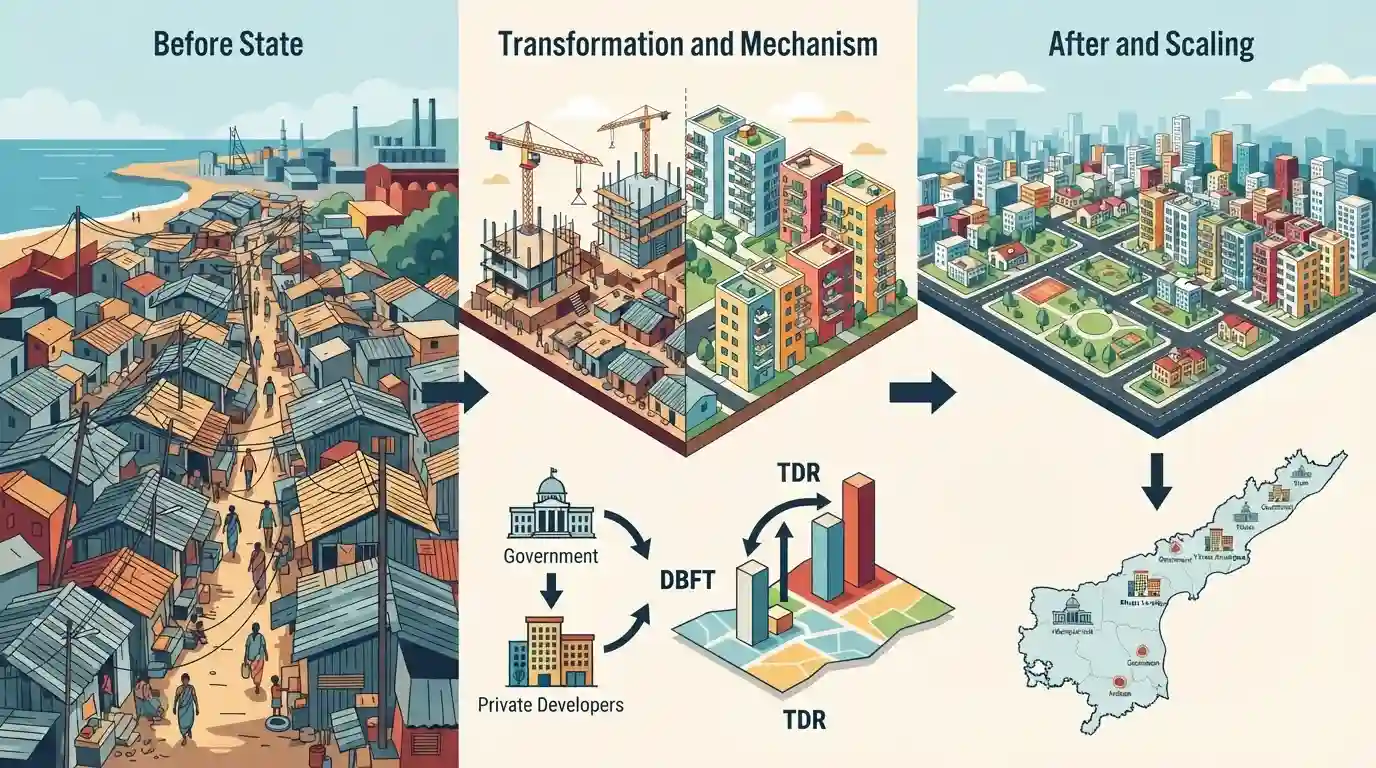
Why It Matters
Urbanization and housing policies are core syllabus topics. The DBFT model and Transferable Development Rights (TDR) represent key instruments of asset monetization and urban infrastructure financing, making them highly relevant for both GS1 (Urbanization) and GS3 (Infrastructure/Investment Models).
Summary
Andhra Pradesh has initiated a state-wide slum redevelopment blueprint modeled on the 'Dharavi' approach, starting with a pilot project in Velampeta, Visakhapatnam. Executed by the Greater Visakhapatnam Municipal Corporation (GVMC) under the Visakhapatnam Economic Region (VER) programme, the project utilizes the Design, Build, Finance and Transfer (DBFT) model alongside Transferable Development Rights (TDR). This strategic use of public-private partnerships aims to construct modern housing for slum residents while minimizing the fiscal strain on the government. Once successfully implemented, the Velampeta framework will be scaled to address slum redevelopment across other urban centers in the state.
Key Points
- The Andhra Pradesh government is piloting a new slum redevelopment scheme starting with Velampeta in Visakhapatnam, modeled after the 'Dharavi' redevelopment strategy.
- The initiative is managed by the Greater Visakhapatnam Municipal Corporation (GVMC) under the broader Visakhapatnam Economic Region (VER) programme.
- The redevelopment leverages Transferable Development Rights (TDR) within a Design, Build, Finance and Transfer (DBFT) public-private partnership framework.
- By using the DBFT model and TDR, the state government aims to provide modern housing to slum dwellers while significantly reducing direct financial expenditure.
- Following the pilot's success in Velampeta, this framework will serve as a statewide blueprint for urban slum rehabilitation in Andhra Pradesh.
Prelims Trap
Transferable Development Rights (TDR) can only be utilized on the exact physical plot of land where the redevelopment is occurring.
TDR explicitly permits development rights to be unbundled and transferred/sold for use in receiving zones elsewhere in the city, preventing local over-congestion.
Static Concepts Connected
What are Transferable Development Rights (TDR) and Floor Space Index (FSI)?
- Floor Space Index: FSI is the ratio of the total built-up area to the total size of the plot on which it is built, regulating urban density.
- Development Rights Transfer: TDR certificates allow developers to build beyond standard FSI limits in designated areas, or trade these rights to other developers.
- Fiscal Alternative: Compensates landowners non-monetarily for land surrendered for public infrastructure, conservation, or slum rehabilitation projects.
How does the DBFT model operate in Public-Private Partnerships?
- Lifecycle Responsibility: A private entity designs, constructs, finances, and temporarily operates/transfers the project, bearing the primary financial risk.
- Cost Recovery: Commonly used in social infrastructure (like housing) where developers recoup costs through commercial land-use or TDRs instead of direct government payments.
Cross-Topic Patterns
TDR + Municipal Fiscal Federalism
Innovative instruments like TDR bypass traditional municipal fiscal constraints caused by delayed financial devolution, reflecting a shift toward self-financing local urban bodies.
Urban Sociology + In-situ Regeneration
The policy transition from slum eviction to in-situ redevelopment (Dharavi model) recognizes slums as vital informal economic hubs rather than mere spatial anomalies.

State-led TDR and DBFT models for slum redevelopment will likely feature in GS3 as case studies for non-fiscal municipal financing tools.
Linked PYQs · 3
Linked PYQs · 3
- 2024APPSC_PRELIMSGS1
The strategic objective of Asset Monetization Programme may be explained as :
- 2024APPSC_PRELIMSGS1
In connection with the Urban Infrastructure Development Fund (UIDF), which of the following statement/statements is/are valid? I. The fund will be established through reserved bonds taken from the G-Sec market. II. The fund is to be exclusively availed by private agencies to create urban infrastructure in Tier 2 and Tier 3 cities. III. Eligible activities for UIDF shall be connected to the Missions and Programmes of the Ministry of Housing | Urban Affairs (MoHUA). IV. The fund will be collectively managed by a cluster of Municipal Cooperative Banks. Select the correct answer using the codes given below:
- 2023APPSC_PRELIMSGS1
One of the following welfare programmes implemented by Government of Andhra Pradesh is not part of Navaratnalu.
