Inter state river disputes and riparian rights in southern India
Source:The Hindu ↗
Why It Matters
Inter-state river water disputes (like the Cauvery and Mekedatu issues) are recurring themes in Indian polity and federalism. Understanding the constitutional mechanisms (Article 262), tribunal structures, and the socio-economic impact of such projects on lower riparian states is crucial for GS-2 (Polity and Governance) and GS-1 (Geography).
Summary
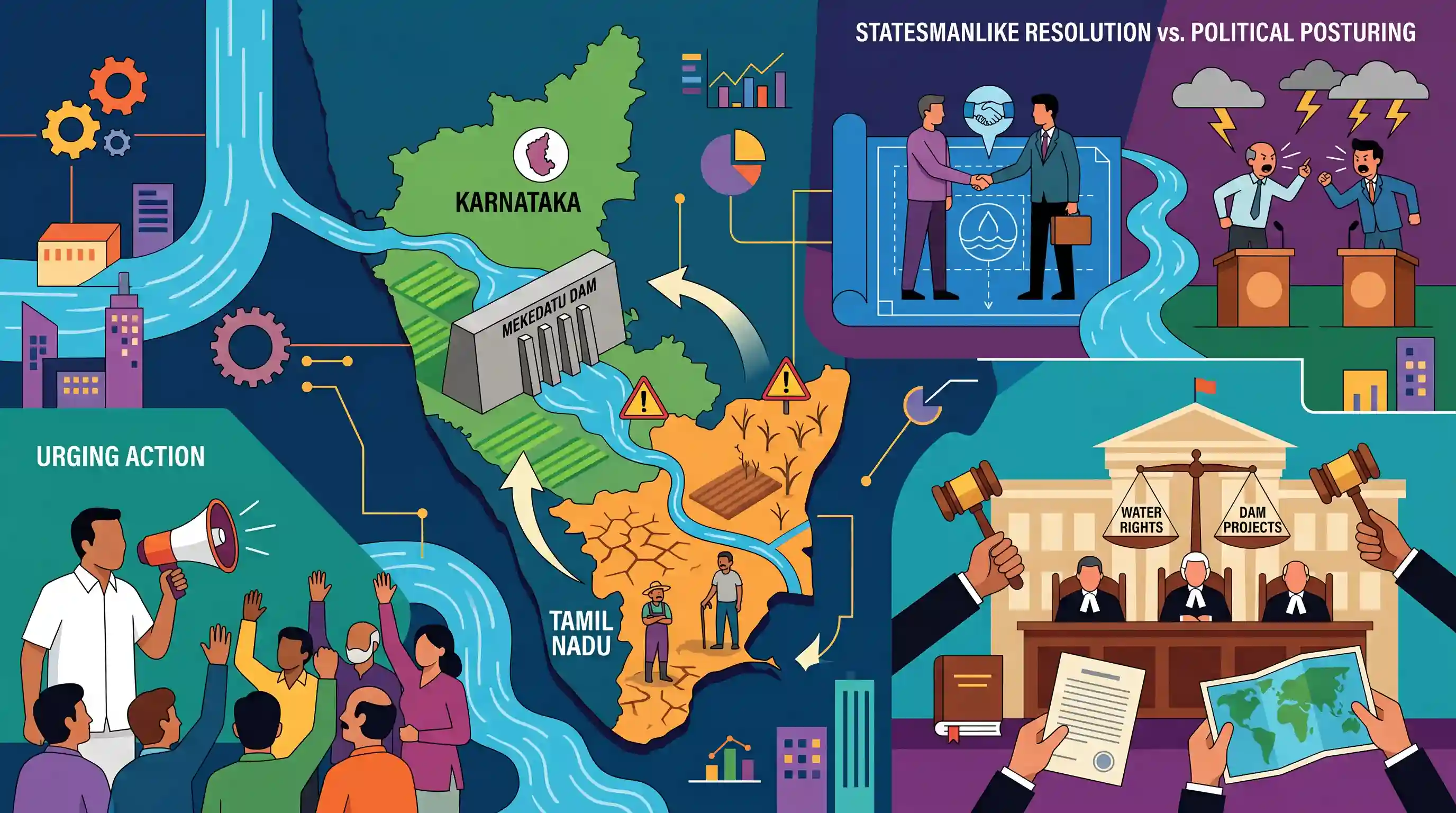
Dravidar Kazhagam president K. Veeramani has urged the Tamil Nadu government to approach the courts and convene an all-party meeting to oppose Karnataka's proposed Mekedatu dam project across the Cauvery river. He argued that the project threatens the livelihood of Tamil Nadu farmers and undermines the state's rightful share of water. Veeramani emphasized that inter-state water disputes require statesman-like resolution rather than political posturing, drawing a parallel to the need for a unified approach.
Key Points
- Dravidar Kazhagam president K. Veeramani has called on the Tamil Nadu government to move the courts to halt Karnataka's Mekedatu dam project.
- He warned that the proposed dam across the Cauvery river would severely impact the livelihood rights and agricultural activities of Tamil Nadu farmers.
- Veeramani urged the Chief Minister to convene an all-party meeting to present a unified front and mobilize public opinion against the project.
- He stressed that inter-state water disputes should be handled with statesmanship rather than political maneuvering.
Important Terms
Mekedatu Project

A proposed multipurpose balancing reservoir at the Cauvery-Arkavathi confluence in Karnataka. Intended for Bengaluru's drinking water and 400 MW hydropower, it is contested by Tamil Nadu over downstream water flow concerns.
UPSC context
GS Paper 2: Inter-state relations. Tests knowledge of transboundary water conflicts and federal resource management.
Cauvery Water Management Authority (CWMA)
A quasi-judicial statutory body established in 2018 to implement the Supreme Court-modified Cauvery Water Disputes Tribunal award. It regulates water release and manages distress-sharing among Karnataka, Tamil Nadu, Kerala, and Puducherry.
UPSC context
GS Paper 2: Statutory bodies. Tests understanding of institutional mechanisms for resolving federal water disputes.
Article 262
A constitutional provision empowering Parliament to adjudicate disputes concerning the use, distribution, or control of inter-state river waters. It allows for the exclusion of Supreme Court jurisdiction in such specific matters.
UPSC context
GS Paper 2: Constitutional Provisions. Essential for understanding the legal framework governing center-state water relations.
Inter-State River Water Disputes Act, 1956
Legislation enacted under Article 262 providing for the adjudication of inter-state river disputes through ad-hoc tribunals. It remains the primary statutory tool for resolving water sharing when negotiations fail.
UPSC context
GS Paper 2: Governance/Legislation. Tests knowledge of the legal process for resolving long-standing state resource conflicts.
Riparian Rights
A legal doctrine granting landowners or states bordering a watercourse the right to "reasonable use" of its water. It forms the basis for legal claims in inter-state river water sharing.
UPSC context
GS Paper 2: Federalism. Important for analyzing the legal principles behind state-level water entitlement claims.
Dravidar Kazhagam
A social movement and political organization founded by E.V. Ramaswamy (Periyar) in Tamil Nadu. It promotes Dravidian identity, social reform, and regional autonomy, frequently intervening in state-specific water rights issues.
UPSC context
GS Paper 1/2: Social movements and regionalism. Tests awareness of political actors influencing inter-state resource diplomacy.
Prelims Trap
The Supreme Court has absolutely no jurisdiction over inter-state river water disputes once a Tribunal is formed.
While Article 262 allows Parliament to bar SC jurisdiction over the dispute itself, the SC regularly intervenes via Special Leave Petitions (Article 136) to interpret and enforce Tribunal awards.
Static Concepts Connected
What are the Constitutional provisions governing inter-state rivers in India?
- Article 262: Empowers Parliament to provide for the adjudication of any dispute or complaint regarding inter-state rivers or river valleys.
- State List (Entry 17): Grants states legislative control over water supply, irrigation, and canals, subject to the provisions of Entry 56 of the Union List.
- Union List (Entry 56): Allows the Centre to regulate and develop inter-state rivers to the extent declared expedient in the public interest by Parliament.
What are the geographical features and primary conflicts surrounding the Mekedatu project?
- Location: Proposed as a deep gorge multi-purpose balancing reservoir located at the confluence of the Cauvery River and its tributary Arkavathi in Karnataka.
- Lower Riparian Conflict: Tamil Nadu contends it will impound natural flows, violating lower riparian rights and the final water allocation judgment of the Cauvery Water Disputes Tribunal (CWDT).
Cross-Topic Patterns
Inter-State Council vs. Tribunals
While tribunals handle legal water adjudication under Article 262, the Inter-State Council (Article 263) provides a political forum to resolve broader inter-state friction, reflecting cooperative federalism mechanisms.
EIA and ecological river flows
Large balancing reservoirs like Mekedatu connect to the environment syllabus, highlighting the necessity of Environmental Impact Assessments (EIA) and the maintenance of minimum ecological flows in distressed river basins.

Expect a multi-statement prelims question combining Article 262, the SC's appellate jurisdiction (Art 136), and Cauvery river geography.
Linked PYQs · 4
Linked PYQs · 4
- 2022PrelimsGS1
Gandikota canyon of South India was created by which one of the following rivers ?
- 2019PrelimsGS1
Consider the following pairs: Wildlife Naturally found in 1. Blue-finned Mahseer : Cauvery River 2. Irrawaddy Dolphin : Chambal River 3. Rusty-spotted Cat : Eastern Ghats Which of the pairs given above are correctly matched?
- 2020MainsGS1
The interlinking of rivers can provide viable solutions to the multi-dimensional inter-related problems of droughts, floods and interrupted navigation. Critically examine.
- 2018MainsGS2
How far do you agree with the view that tribunals curtail the jurisdiction of ordinary courts? In view of the above, discuss the constitutional validity and competency of the tribunals in India.
