Employment Generation Trends Under VB G RAM G Rural Job Scheme
Source:Indian Express ↗
ఇది ఎందుకు ముఖ్యం
The replacement of India's iconic two-decade-old rural employment scheme is a monumental policy shift. The dynamics of the new VB-G RAM G scheme—particularly the tension between its expanded 125-day guarantee and the restrictive 60-day agricultural 'pause'—illustrate the complex trade-offs in welfare administration. It highlights critical concerns regarding the resilience of the rural safety net during erratic monsoons, the impact on rural consumption and demand, and ongoing debates over mandatory tech-based welfare delivery mechanisms like face authentication.
సారాంశం
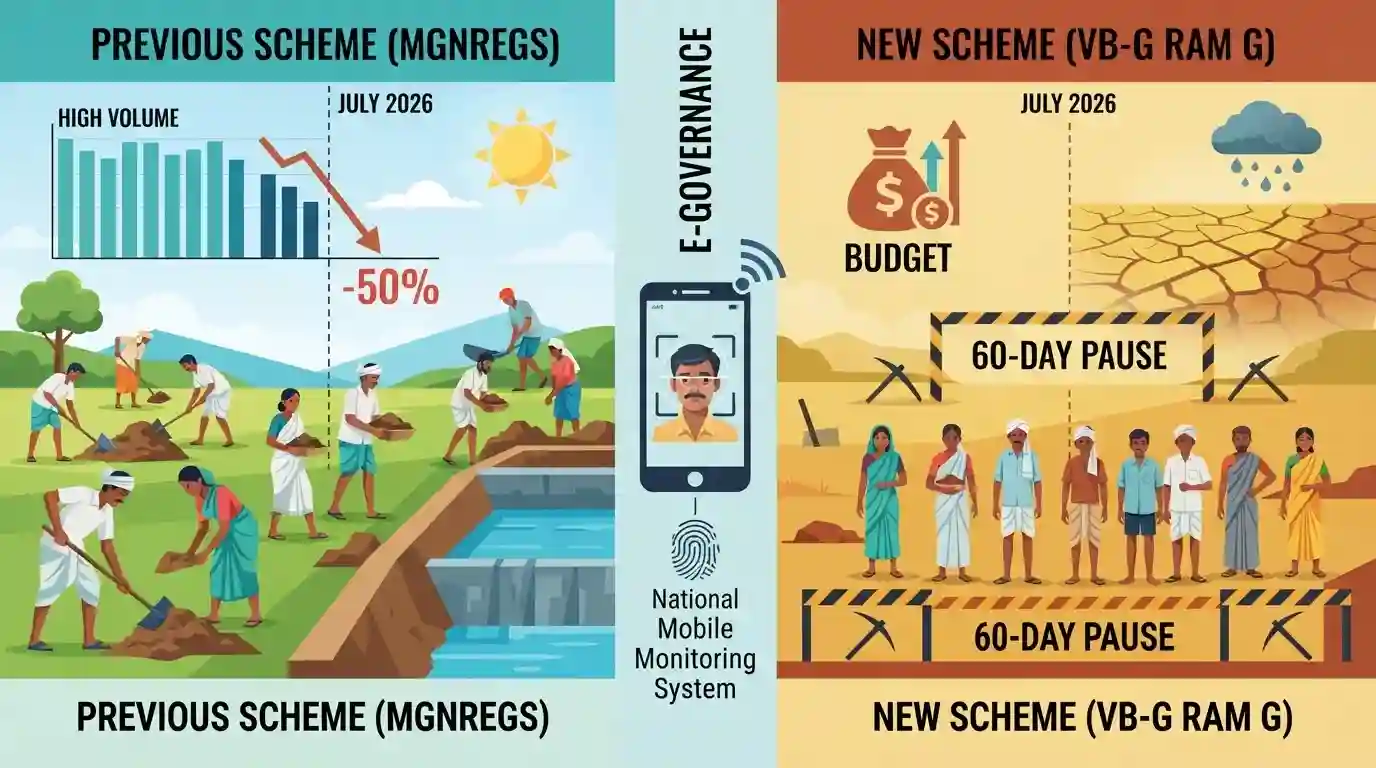
The transition from the Mahatma Gandhi National Rural Employment Guarantee Scheme (MGNREGS) to the new Viksit Bharat – Guarantee for Rozgar and Ajeevika Mission (Gramin) (VB-G RAM G) resulted in a massive 50% year-on-year drop in rural employment generation during its launch month of July 2026. Although the new scheme increases the annual job guarantee to 125 days and boasts a record ₹95,692 crore budget, it introduces a mandatory 60-day 'pause' during peak agricultural seasons to ease farm labor shortages. This pause coincided with widespread monsoon deficits and delayed Kharif sowing, severely curtailing the scheme's function as a rural safety net during a time of agricultural distress. The scheme also mandates the use of the National Mobile Monitoring System (NMMS) and face authentication, highlighting the ongoing push for technology-driven welfare administration.
ముఖ్య అంశాలు
- India's flagship rural job guarantee scheme, MGNREGS, was replaced by the Viksit Bharat – Guarantee for Rozgar and Ajeevika Mission (Gramin) or VB-G RAM G on July 1, 2026.
- The new scheme's first month saw a nearly 50% year-on-year drop in employment generation, falling from 15.33 crore person-days in July 2025 to 7.67 crore person-days in July 2026.
- A major cause for the decline is a new provision mandating a 60-day 'pause' in the employment guarantee during peak agricultural seasons (sowing and harvesting) to prevent farm labor shortages.
- The scheme increases total guaranteed wage employment from 100 days to 125 days per financial year and received a record budget allocation of ₹95,692 crore for FY 2026-27.
- The sharp drop in job provision occurred despite an erratic monsoon (deficit rainfall in 50% of districts) impacting Kharif sowing, a period when demand for distress rural employment typically peaks.
- Technological integration continues with the mandatory use of the National Mobile Monitoring System (NMMS) app and face authentication for capturing worker attendance.
ముఖ్యమైన పదాలు
Viksit Bharat – Guarantee for Rozgar and Ajeevika Mission (Gramin) (VB-G RAM G)

A statutory rural livelihood scheme launched in July 2026 to replace MGNREGS, guaranteeing 125 days of unskilled manual wage employment annually per household to enhance rural incomes and build durable infrastructure.
UPSC context
GS Paper II (Welfare Schemes); tests understanding of rural livelihood programs and structural transitions in social safety nets.
Mahatma Gandhi National Rural Employment Guarantee Scheme (MGNREGS)
A landmark social security program enacted in 2005 guaranteeing 100 days of manual wage employment per year to rural households. It was officially replaced by VB-G RAM G in July 2026.
UPSC context
GS Paper II (Welfare Schemes) and GS Paper III (Indian Economy); crucial for rights-based safety nets and rural development analysis.
National Mobile Monitoring System (NMMS)
A digital mobile application designed to capture real-time, geo-tagged, and time-stamped attendance of rural work program labourers twice daily to enhance transparency and prevent ghost beneficiaries.
UPSC context
GS Paper II (Governance and E-governance); evaluates technology-led transparency vs. inclusion challenges in welfare administration.
Ministry of Rural Development (MoRD)
The apex ministry of the Government of India responsible for the socio-economic development, infrastructure creation, housing, and social security programs of rural India.
UPSC context
GS Paper II (Government Policies); key nodal administrative body implementing major rural poverty alleviation and welfare schemes.
ప్రిలిమ్స్ ఉచ్చు
"The Centre funds 100% of the unskilled wage cost under the VB-G RAM G scheme."
Unlike MGNREGA's 100% Central wage subsidy, VB-G RAM G shifts to a 60:40 (Centre:State) ratio for ALL expenses, ending the total Central funding for unskilled labor.
అనుసంధానమైన స్థిర భావనలు
What is the constitutional basis for rural employment guarantee schemes?
- Article 41: Directs the State to secure the right to work, education, and public assistance in cases of unemployment or economic distress.
- Article 43: Requires the State to endeavor to secure a living wage, conditions of work ensuring a decent standard of life, and full enjoyment of leisure.
- Article 40: Mandates the organization of village panchayats, which act as the primary planning and implementation units for these grassroots public works.
How do Centrally Sponsored Schemes (CSS) differ from Central Sector Schemes?
- Funding Pattern: Central Sector schemes are 100% funded by the Union; CSS are jointly funded by the Centre and States (often 60:40 or 90:10).
- Implementation: Central Sector schemes are directly implemented by Union ministries/agencies, whereas CSS are implemented by State governments and their respective apparatuses.
అంతర-అంశ నమూనాలు
Fiscal Federalism and Normative Ceilings
Replacing an open-ended, demand-driven scheme with 'Normative Allocation' ceilings shifts the financial burden of surplus rural distress to State governments, exacerbating Centre-State fiscal tensions.
Agrarian Distress vs Labor Markets
The 60-day 'pause' to prevent farm labor shortages conflicts with erratic monsoons, highlighting the tension between securing agricultural labor and providing a reliable distress safety net.
E-governance vs Digital Exclusion
Mandatory NMMS app usage and facial authentication for attendance links rural welfare administration directly to ongoing debates about the digital divide and biometric exclusion errors.

Expect a complex Prelims question contrasting MGNREGA and VB-G RAM G on wage sharing (60:40), guaranteed days (125), and the farm pause.
అనుసంధాన PYQలు · 3
అనుసంధాన PYQలు · 3
- 2019MainsGS2
Performance of welfare schemes that are implemented for vulnerable sections is not so effective due to absence of their awareness and active involvement at all stages of policy process. Discuss.
- 2023MainsGS2
“Development and welfare schemes for the vulnerable, by its nature, are discriminatory in approach.” Do you agree? Give reasons for your answer.
- 2023MainsGS2
e-governance, as a critical tool of governance, has ushered in effectiveness, transparency and accountability in governments. What inadequacies hamper the enhancement of these features ?
