VB-G-RAM-G Act comes into effect repealing MGNREGA across the country
Source:The Hindu ↗
Why It Matters
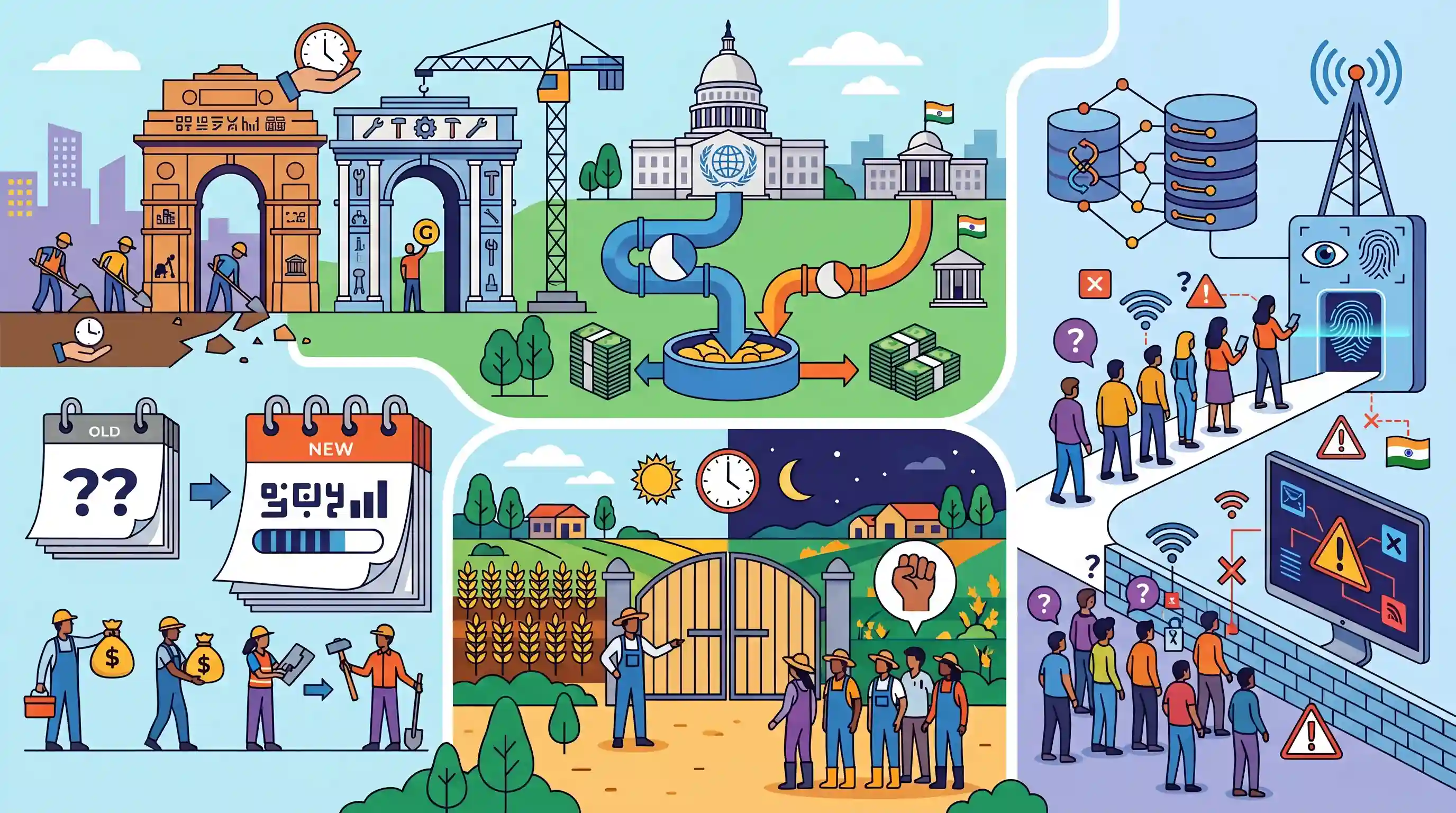
The repeal of MGNREGA, a cornerstone of India's rural welfare architecture, represents a major shift in public policy. The new VB-G RAM G Act alters the fiscal dynamics of cooperative federalism via its 60:40 funding ratio, introduces critical changes to labour rights through 'blackout periods', and highlights ongoing debates regarding the digital divide in e-governance welfare delivery.
Summary
The Central Government has announced the rollout of the Viksit Bharat – Guarantee for Rozgar and Ajeevika Mission (Gramin) (VB-G RAM G) Act starting July 1, 2026, marking the repeal of the landmark MGNREGA. The new framework introduces significant structural changes, notably increasing guaranteed employment from 100 to 125 days annually, while shifting the wage funding model from 100% central backing to a 60:40 Centre-State split. The Act also permits States to enforce 'blackout periods' of up to 60 days during peak sowing and harvesting seasons to ensure the availability of agricultural labor—a clause criticized for potentially undercutting workers' bargaining power. Furthermore, heavy reliance on digital infrastructure like mandatory e-KYC and the National Mobile Monitoring System (NMMS) poses implementation challenges, given the millions of unverified workers facing potential exclusion.
Key Points
- The VB-G RAM G Act will come into effect nationwide on July 1, 2026, officially repealing MGNREGA.
- The new scheme increases the statutory employment guarantee from 100 days to 125 days per financial year.
- Wage expenditure will transition from 100% Central funding to a 60:40 cost-sharing ratio between the Centre and most States.
- States can notify a 'blackout period' of up to 60 days during peak agricultural seasons, a move critics argue reduces laborers' bargaining power.
- Significant e-KYC backlogs remain, with over 11.58 crore registered workers yet to complete verification, raising concerns about technology-induced exclusion errors alongside mandatory NMMS attendance.
Important Terms
Mahatma Gandhi National Rural Employment Guarantee Act (MGNREGA)

A 2005 social security law guaranteeing 100 days of unskilled wage employment annually to rural households. It featured demand-driven funding and was repealed by the VB-G RAM G Act.
UPSC context
GS Paper II & III: Welfare schemes, poverty, and rights-based legislation. Tests understanding of social safety nets and legislative transitions.
VB-G RAM G Act
The 2025 legislation replacing MGNREGA, providing 125 days of guaranteed rural employment. It aligns with the 'Viksit Bharat @2047' vision and introduces a shared Centre-State funding model.
UPSC context
GS Paper II: Government policies and interventions. Tests knowledge of new statutory frameworks and structural reforms in rural development.
National Mobile Monitoring System (NMMS)
A digital application for real-time monitoring of rural labor attendance. It captures geo-tagged and time-stamped photographs at worksites to enhance transparency and reduce leakages.
UPSC context
GS Paper II: E-governance and transparency. Tests knowledge of digital tools for accountability and challenges of technological exclusion in welfare.
Blackout Period (Agricultural Pause)
A provision allowing States to suspend public works for up to 60 days during peak sowing and harvesting to ensure agricultural labor availability.
UPSC context
GS Paper II & III: Issues in agricultural labor and employment. Tests understanding of the trade-off between social security and farm productivity.
60:40 Funding Model
The fiscal sharing arrangement under the VB-G RAM G Act where the Centre and States split costs 60:40, shifting from the previous 100% central unskilled wage funding.
UPSC context
GS Paper II: Federal structure and devolution of finances. Tests understanding of fiscal federalism and financial burdens on States.
Gramin Rozgar Guarantee Cards
Statutory identification documents issued to rural households under the VB-G RAM G Act, replacing MGNREGA Job Cards for tracking employment and wage entitlements.
UPSC context
GS Paper II: Governance and implementation. Tests familiarity with practical mechanisms of social welfare delivery during administrative transitions.
Prelims Trap
"The Central Government bears 100% of the wage cost under the new VB-G-RAM-G Act."
Aspirants might assume wages are still 100% centrally funded like under MGNREGA. The new VB-G-RAM-G Act shifts wage funding to a 60:40 Centre-State split.
Static Concepts Connected
What is the difference between Centrally Sponsored and Central Sector Schemes?
- Funding Split: CSS are jointly funded by the Centre and States (e.g., 60:40), whereas Central Sector Schemes are 100% funded by the Union government.
- Implementation: CSS are typically implemented by State Governments, while Central Sector schemes are directly implemented by the Central Government machinery.
- Subject Matter: CSS usually pertain to subjects in the State List, aiming to supplement State efforts and ensure minimum national standards.
How is the 'Right to Work' enshrined in the Indian Constitution?
- Article 41: Article 41 directs the State, within its economic capacity, to make effective provision for securing the right to work, education, and public assistance.
- DPSP Nature: As a Directive Principle of State Policy (DPSP) under Part IV, it is not directly justiciable in a court of law.
- Statutory Backing: Statutory acts like the former MGNREGA (and now VB-G-RAM-G) provide legally enforceable, statutory backing to this constitutional directive.
Cross-Topic Patterns
Fiscal Federalism & Welfare Burden
The shift to a 60:40 wage funding ratio strains State finances, linking this welfare scheme directly to broader debates on fiscal federalism, devolution of funds, and state borrowing limits.
Digital Exclusion in Governance
Mandatory e-KYC and NMMS (app-based attendance) connect this rural employment transition to the digital divide and DBT exclusion errors previously scrutinized in the Public Distribution System (PDS).
Agricultural Labour vs. Welfare Leverage
The 60-day 'blackout period' during sowing highlights the perennial friction between agrarian employer interests (seeking accessible labor) and the bargaining power of landless rural workers.

Expect a multi-statement Prelims question comparing VB-G-RAM-G's 60:40 funding ratio and 60-day blackout periods with the repealed MGNREGA.
Linked PYQs · 5
Linked PYQs · 5
- 2011PrelimsGS1
Among the following who are eligible to benefit from the “Mahatma Gandhi National Rural Employment Guarantee Act”?
- 2025MainsGS2
Examine the evolving pattern of Centre-State financial relations in the context of planned development in India. How far have the recent reforms impacted the fiscal federalism in India?
- 2024MainsGS2
What changes has the Union Government recently introduced in the domain of Centre-State relations ? Suggest measures to be adopted to build the trust between the Centre and the States and for strengthening federalism.
- 2025MainsGS2
e-governance projects have a built-in bias towards technology and back-end integration than user-centric designs. Examine.
- 2023MainsGS2
e-governance, as a critical tool of governance, has ushered in effectiveness, transparency and accountability in governments. What inadequacies hamper the enhancement of these features ?
