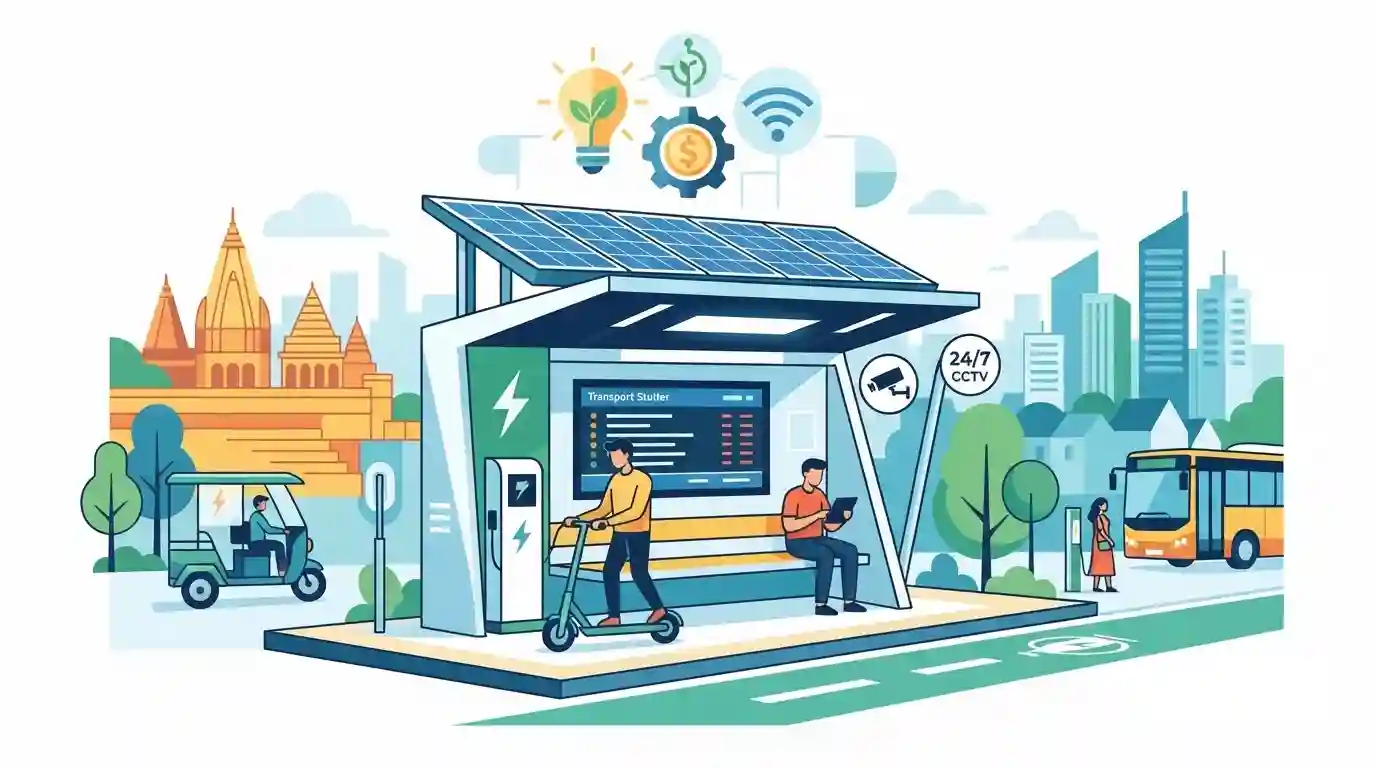
Varanasi smart bus shelters with EV charging and solar integration
Source:eletsonline ↗
Why It Matters
This development showcases localized implementation of smart city infrastructure, clean energy transition (EV charging and solar integration), and self-sustaining PPP models. It is highly relevant for UPPSC GS papers concerning state-specific infrastructure projects and sustainable urban development.
Summary
Varanasi is set to roll out 15 smart bus shelters designed to improve urban mobility and passenger convenience. These shelters will serve as multi-utility hubs featuring electric vehicle (EV) charging stations, solar rooftops, free Wi-Fi, digital displays, and 24/7 CCTV surveillance. Aimed at promoting sustainable urban infrastructure, the project utilizes a self-sustaining financial model where maintenance and operational costs will be recovered through advertising revenue and EV charging fees. This initiative aligns with broader state and national goals for smart city development and the transition to sustainable energy.
Key Points
- Varanasi will establish 15 smart bus shelters equipped with modern public utility features, including electric vehicle (EV) charging stations and free Wi-Fi.
- The smart shelters will integrate solar rooftops for energy generation, reducing dependence on conventional power sources and promoting environmental sustainability.
- Safety and passenger amenities include 24/7 CCTV surveillance, digital passenger information displays, dustbins, and comfortable seating arrangements.
- The project adopts a self-sustaining financial model, utilizing revenue generated from EV charging services and advertising to cover operational and maintenance costs.
Important Terms
Smart Cities Mission

A centrally sponsored scheme launched by the Ministry of Housing and Urban Affairs to drive economic growth and improve quality of life through comprehensive urban modernization, harnessing technology, and developing sustainable public infrastructure.
UPSC context
GS Paper 2 & 3 (Governance & Infrastructure). Evaluates candidates' understanding of urban planning, e-governance, and sustainable urbanization models.
UP Electric Vehicle Policy
Uttar Pradesh’s state-level policy framework designed to promote eco-friendly transportation. It incentivizes the adoption of electric vehicles and the creation of supporting infrastructure, such as charging stations, to reduce carbon emissions.
UPSC context
GS Paper 3 (Environment & Infrastructure). Highlights state-level interventions in climate action, renewable energy transition, and e-mobility.
Varanasi Municipal Corporation
The Urban Local Body (ULB) governing Varanasi, responsible for delivering civic amenities, managing public infrastructure, and executing state and central modernization initiatives like the Smart Cities Mission at the grassroots level.
UPSC context
GS Paper 2 (Polity). Tests knowledge regarding the constitutional mandate, functions, and execution capacity of Urban Local Bodies (74th Amendment).
Self-Sustaining Financial Model
A funding structure for public infrastructure where operational and maintenance expenses are fully recovered through internally generated revenue, such as advertising panels and user fees, reducing reliance on government subsidies.
UPSC context
GS Paper 3 (Economy). Important for understanding infrastructure financing, Public-Private Partnerships (PPP), and the financial autonomy of urban projects.
Prelims Trap
Smart Cities Mission assets must be non-commercial, prohibiting Special Purpose Vehicles from charging user fees or utilizing commercial advertising.
The Smart Cities Mission actively encourages Special Purpose Vehicles (SPVs) to leverage private investment, user fees, and advertising revenues to ensure long-term asset sustainability.
Static Concepts Connected
What is the Special Purpose Vehicle (SPV) model under the Smart Cities Mission?
- Corporate structure: Incorporated as a limited company under the Companies Act, 2013, with 50:50 equity shareholding between the State/UT and the Urban Local Body.
- Operational autonomy: Possesses operational independence to plan, approve, release funds, and implement smart infrastructure projects, bypassing standard bureaucratic municipal delays.
What are the regulatory guidelines for Public EV Charging Stations in India?
- De-licensed activity: Setting up a public charging station is a de-licensed activity, allowing any individual or entity to establish them if technical standards are met.
- Open access power: Permits charging station operators to source clean electricity from any generation company through open access power procurement channels.
Cross-Topic Patterns
Fiscal federalism + green infrastructure
Decentralized green projects show how the 74th Amendment's devolution of powers enables Urban Local Bodies to pioneer self-sustaining climate action and local resource mobilization.
Solar transit + EV grid integration
Deploying solar-powered public transit shelters addresses the dual challenge of expanding urban EV charging networks while minimizing direct load strain on centralized distribution grids.

UPSC may frame a 2026 question linking municipal financial autonomy, SPV structures under Smart Cities, and localized EV infrastructure.
Linked PYQs · 4
Linked PYQs · 4
- 2020UPPSC_PRELIMSGS1
Which of the following cities of Uttar Pradesh is/are covered under the 'Heritage City Development and Augmentation Yojana (HRIDAY)' ? 1. Varanasi 2. Mathura 3. Prayagraj 4. Ayodhya Select the correct answer from the codes given below.
- 2016UPPSC_PRELIMSGS1
Which one of the following is not a new scheme announced for the development of urban infrastructure?
- 2022UPPSC_PRELIMSGS1
Solar energy is converted into electric energy through
- 2023UPPSC_PRELIMSGS1
Natural resources should be used by the present generation in such a way that if there is minimum degradation of natural resources, then what kind of development would it be called?
