Varanasi Announces Sustainable Cities Challenge Winners
Source:thecsruniverse ↗
Why It Matters
Urban development initiatives in Uttar Pradesh (like Smart City schemes and HRIDAY) are recurring themes in UPPSC Prelims. The integration of AI and big data in local governance provides current affairs fodder for both objective questions on state initiatives and topics related to technological applications in municipal management.
Summary
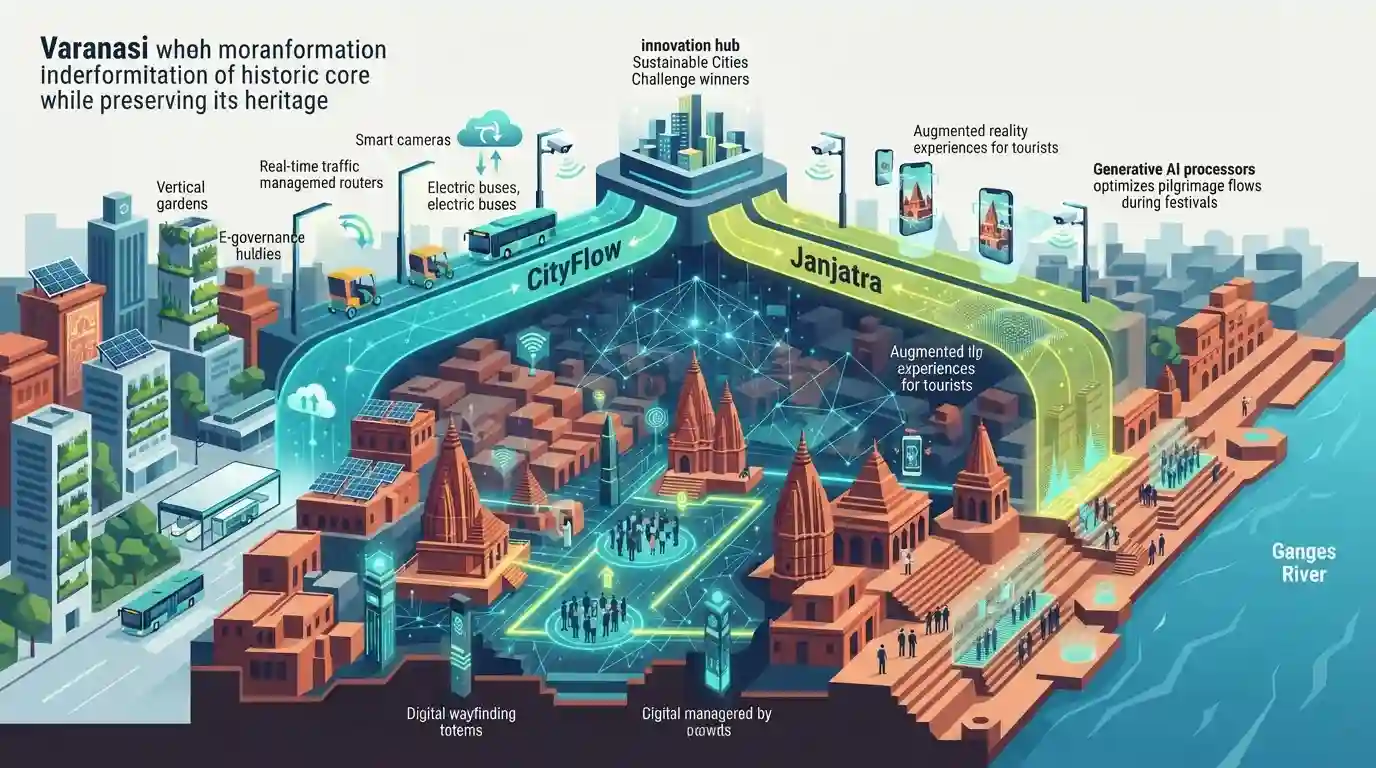
Varanasi has announced the winners of the Sustainable Cities Challenge, an initiative led by Varanasi Nagar Nigam, Toyota Mobility Foundation, Challenge Works, and WRI India. The challenge focuses on integrating technology and sustainable practices to solve crowd management and mobility issues in the historic core of Kashi. Winning projects such as 'CityFlow' and 'Janjatra' employ advanced tools like big data, computer vision, generative AI, and digital wayfinding. This development highlights Uttar Pradesh's growing emphasis on smart urban infrastructure, e-governance, and heritage preservation under broader frameworks like the Smart Cities Mission.
Key Points
- The Varanasi Sustainable Cities Challenge, supported by Toyota Mobility Foundation and WRI India, aims to improve crowd management and mobility in the historic Kashi region.
- Two winning solutions, 'CityFlow' and 'Janjatra', will receive a share of a $900,000 grant to scale their implementations in Varanasi.
- 'CityFlow' leverages big data, computer vision, and Generative AI for real-time crowd movement analysis.
- 'Janjatra' uses digital signage and dynamic colour-coded wayfinding to guide pedestrians and reduce congestion.
- The initiative underscores the integration of advanced technologies (ICT/AI) into local e-governance and sustainable urban development in Uttar Pradesh.
Important Terms
Smart Cities Mission

A flagship urban renewal program launched by MoHUA in 2015 to develop 100 sustainable, citizen-friendly cities equipped with core infrastructure and tech-driven 'smart' solutions.
UPSC context
GS-1 (Urbanization) & GS-2 (Policies). Evaluates understanding of urban planning, e-governance, and sustainable habitats.
Sustainable Cities Challenge
A global initiative funded by the Toyota Mobility Foundation to develop innovative, data-driven mobility and crowd management solutions for dense, historic urban environments like Varanasi's Kashi.
UPSC context
GS-3 (Infrastructure/Urban Mobility). Highlights public-private partnerships, global innovation challenges, and tech-driven urban problem-solving.
WRI India
An independent research organization (registered as India Resources Trust) that partners with governments to foster environmentally sound, equitable development, specializing in sustainable cities and climate action.
UPSC context
GS-3 (Environment). Important for its role in environmental policy analysis, climate mitigation, and sustainable urban infrastructure planning.
CityFlow
An AI-driven mobility platform that utilizes big data, computer vision, and generative AI to monitor real-time pedestrian density and manage crowd congestion in complex urban areas.
UPSC context
GS-3 (Science & Tech). Illustrates the practical application of Artificial Intelligence and big data in disaster management and crowd control.
Janjatra
An automated wayfinding solution using color-coded navigation, dynamic digital signage, and tactical urban interventions to efficiently guide pedestrians and reduce pressure on historic, heavily congested routes.
UPSC context
GS-1 (Urbanization). Demonstrates behavioral urban design and heritage city management techniques for handling massive floating populations.
Prelims Trap
The Sustainable Cities Challenge in Varanasi is fully funded and implemented by the Ministry of Housing and Urban Affairs (MoHUA).
It is actually a global initiative led by the Toyota Mobility Foundation, Challenge Works, and WRI India, not a direct MoHUA scheme.
Static Concepts Connected
What are the core implementation mechanisms of the Smart Cities Mission (SCM)?
- Core Objective: Promotes cities providing core infrastructure, a clean environment, and decent quality of life through data-driven 'Smart Solutions'.
- Implementation via SPVs: Executed at the city level by dedicated Special Purpose Vehicles (SPVs) promoted by State and Urban Local Bodies.
- Funding Model: Operated primarily as a Centrally Sponsored Scheme (CSS) requiring matching financial contributions from the State or ULB.
Which targets of SDG-11 directly overlap with heritage city initiatives like Varanasi's?
- Sustainable Transport: Providing access to safe, affordable, accessible, and sustainable transport systems for all citizens and tourists.
- Heritage Safeguarding: Strengthening efforts to protect and safeguard cultural and natural heritage without causing destructive physical alterations to historical infrastructure.
Cross-Topic Patterns
AI + Heritage Conservation (GS-3/GS-1)
Using computer vision and digital wayfinding allows massive crowd management without physically altering centuries-old Kashi corridors, balancing tourism growth with architectural preservation.
Global Philanthropy in Urban Governance
The collaboration of Varanasi Nagar Nigam with Toyota Mobility Foundation exemplifies the rising trend of leveraging global private tech-philanthropy to solve hyper-local governance challenges.

AI for heritage crowd management (GS-3) is an ideal Mains case study. Prelims may test SDG-11 or WRI India's role in urban transitions.
Linked PYQs · 4
Linked PYQs · 4
- 2020UPPSC_PRELIMSGS1
No. of cities in U.P. which are covered under the 'Smart City' Scheme
- 2020UPPSC_PRELIMSGS1
Which of the following cities of Uttar Pradesh is/are covered under the 'Heritage City Development and Augmentation Yojana (HRIDAY)' ? 1. Varanasi 2. Mathura 3. Prayagraj 4. Ayodhya Select the correct answer from the codes given below.
- 2024UPPSC_PRELIMSGS1
Which of the following statements are correct with regard to ICT-based e-Governance? 1. e-Governance reduces the transparency of Government. 2. e-Governance reduces the cost of Government. 3. e-Governance increases citizens input into Government. 4. e-Governance increases bureaucratic red tapism. Select the correct answer from the codes given below:
- 2015UPPSC_PRELIMSGS1
The expansion of Urban India is a platform for:
