Public Health Risks Highlight Fallacy of Safe Vaping and Hookah
Source:The Hindu ↗
Why It Matters
The rising popularity of vaping and hookah among the youth poses a significant public health challenge in India. For civil services aspirants, understanding the physiological harm caused by these alternative smoking methods and the regulatory context (e.g., the 2019 e-cigarette ban) is essential for addressing issues related to health policy, the burden of non-communicable diseases, and youth welfare in GS Paper 2.
Summary
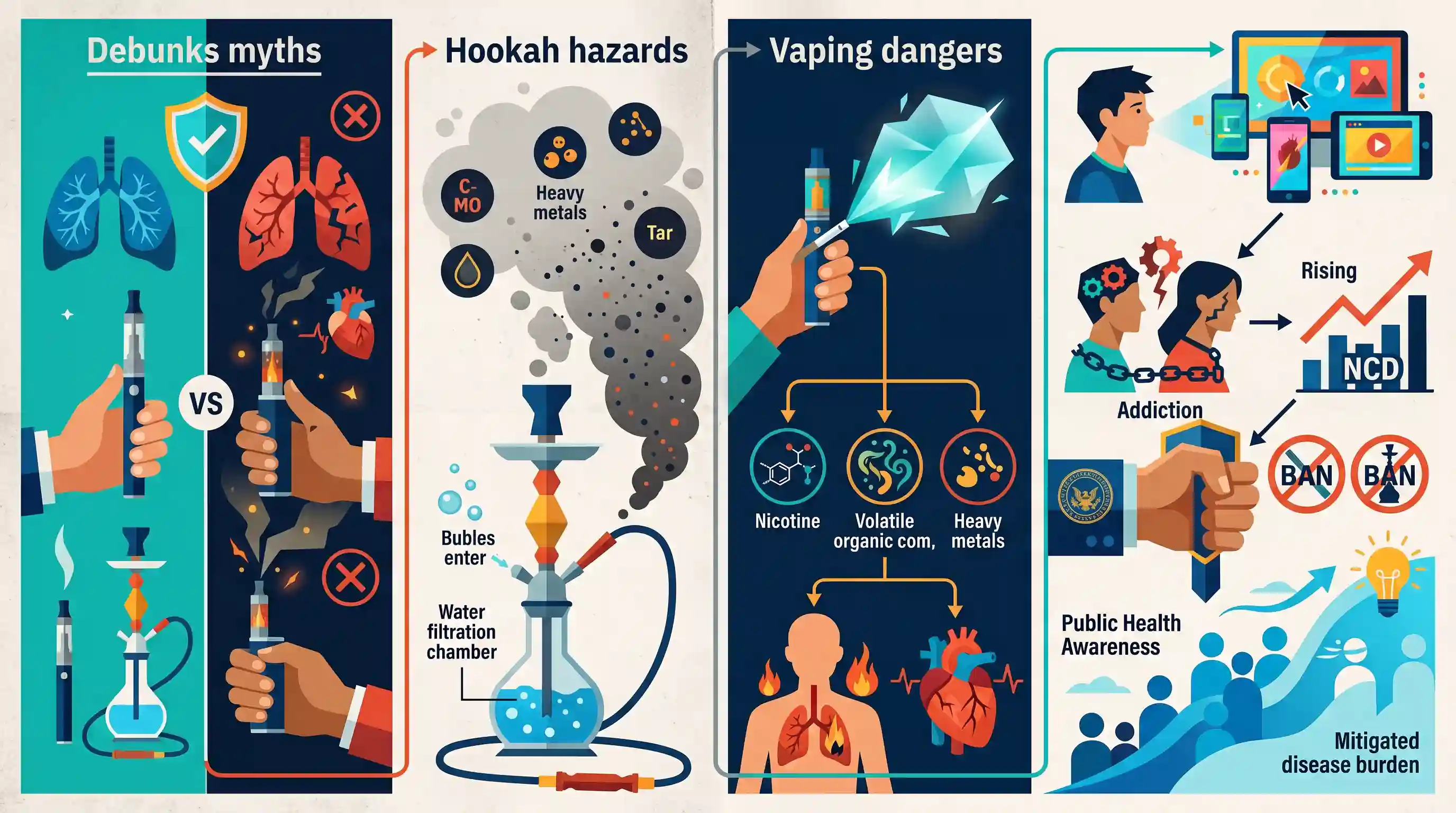
The article debunks the widespread myth that vaping and hookah smoking are safe alternatives to traditional cigarettes. It highlights that hookah sessions expose users to higher volumes of toxic smoke, containing carbon monoxide, heavy metals, and tar, while the water filtration mechanism is ineffective. Similarly, vaping involves inhaling aerosols laden with nicotine, volatile organic compounds, and heavy metals, leading to severe respiratory and cardiovascular issues. Emphasizing the deceptive nature of their marketing, particularly to youth, the article underscores the importance of public health awareness and stringent regulatory frameworks, such as India's 2019 ban on e-cigarettes, to mitigate the growing burden of non-communicable diseases and substance addiction.
Key Points
- Both vaping (e-cigarettes) and hookah are harmful and not safe alternatives to traditional smoking, contrary to popular belief.
- Hookah sessions typically expose users to larger volumes of smoke over a longer period, resulting in high intakes of carbon monoxide, heavy metals, and tar. The water does not filter out toxic substances.
- Vaping involves heating a liquid to produce an aerosol that contains highly addictive nicotine, volatile organic compounds, and heavy metals, causing respiratory and cardiovascular damage.
- Marketing tactics promoting 'clean vapor' and 'water filtration' are deceptive and primarily target youth, exacerbating the burden of non-communicable diseases.
- Stringent government intervention and awareness, such as India's 2019 ban on the production and sale of e-cigarettes, are necessary to curb the rising tide of alternative smoking habits.
Important Terms
Prohibition of Electronic Cigarettes Act (PECA), 2019

A 2019 Indian law prohibiting the production, manufacture, import, export, sale, and advertisement of e-cigarettes to prevent nicotine addiction and protect public health, especially among youth.
UPSC context
GS2: Government Policies. Tests knowledge of legislative interventions to address emerging public health threats and substance abuse.
WHO Framework Convention on Tobacco Control (FCTC)
The first international treaty negotiated under WHO, providing a legal framework for countries to implement tobacco control measures, including price hikes and advertising bans. India ratified it in 2004.
UPSC context
GS2: International Treaties/Health. Tests India's adherence to global health standards and multilateral cooperation on tobacco control.
Electronic Nicotine Delivery Systems (ENDS)
Battery-powered devices (e.g., vapes, e-hookahs) that heat a liquid solution containing nicotine and flavorings to create an aerosol for inhalation, bypassing tobacco combustion but still delivering toxic chemicals.
UPSC context
GS3: Science & Tech. Tests understanding of the technical mechanisms and health hazards of modern nicotine consumption technologies.
Indian Council of Medical Research (ICMR)
India's premier medical research body; its 2019 "White Paper on ENDS" provided the scientific evidence on toxicity and addiction risks that led to the national e-cigarette ban.
UPSC context
GS2: Institutional Roles. Tests the role of scientific advisory bodies in evidence-based policymaking for public health.
Non-Communicable Diseases (NCDs)
Chronic, non-infectious conditions such as cardiovascular diseases, cancers, and respiratory illnesses. They account for a majority of global deaths and are exacerbated by tobacco and nicotine use.
UPSC context
GS2: Health. Fundamental for understanding India's disease burden and efforts toward achieving Sustainable Development Goal (SDG) 3.4.
Prelims Trap
"E-cigarettes are strictly regulated in India under the Cigarettes and Other Tobacco Products Act (COTPA)."
India completely BANNED the production, sale, and import of e-cigarettes under PECA 2019. They are not merely "regulated" under the older COTPA.
Static Concepts Connected
What is the Constitutional and statutory backing for tobacco and nicotine control in India?
- Article 47 (DPSP): Directs the State to improve public health and endeavor to prohibit the consumption of intoxicating drinks and health-injurious drugs.
- COTPA 2003: Regulates the trade, commerce, and advertisement of traditional tobacco products and mandates bans on smoking in public places.
- PECA 2019: Imposes a complete ban on the production, import, sale, and advertisement of Electronic Nicotine Delivery Systems (ENDS) like e-cigarettes.
Why is Carbon Monoxide (CO) from hookah smoke highly toxic to the human body?
- High Affinity: Carbon monoxide binds to hemoglobin roughly 200 times faster than oxygen, forming a stable complex called carboxyhemoglobin.
- Hypoxia: This drastically reduces the blood's oxygen-carrying capacity, depriving vital organs of oxygen (hypoxia) and causing severe cardiovascular strain.
Cross-Topic Patterns
Demographic Dividend & NCD burden
The rising addiction to vaping among youth accelerates non-communicable diseases (NCDs), directly threatening India's demographic dividend and raising long-term out-of-pocket health expenditures.
WHO MPOWER & FCTC compliance
India's PECA 2019 and COTPA align with the WHO Framework Convention on Tobacco Control (FCTC). UPSC often tests international health treaties against their domestic statutory implementations.

A hybrid 2026 question will likely link the aerosol chemistry of ENDS (VOCs, heavy metals) to India's absolute ban under PECA 2019.
Linked PYQs · 4
Linked PYQs · 4
- 2024MainsGS2
In a crucial domain like the public healthcare system the Indian State should play a vital role to contain the adverse impact of marketisation of the system. Suggest some measures through which the State can enhance the reach of public healthcare at the grassroots level.
- 2020MainsGS2
In order to enhance the prospects of social development, sound and adequate health care policies are needed particularly in the fields of geriatric and maternal health care. Discuss.
- 2021PrelimsGS1
Why is there a concern about copper smelting plants? 1. They may release lethal quantities of carbon monoxide into environment. 2. The copper slag can cause the leaching of some heavy metals into environment. 3. They may release sulphur dioxide as a pollutant. Select the correct answer using the code given below.
- 2021PrelimsGS1
'Triclosan', considered harmful when exposed to high levels for a long time, is most likely present in which of the following?
