Historical debate on full rendition of national song Vande Mataram
Source:The Hindu ↗
Why It Matters
The origin, adoption, and historical controversies surrounding India's national song 'Vande Mataram' are significant for Modern Indian History. Bankim Chandra Chattopadhyay and his novel 'Anandamath' frequently appear in UPSC Prelims and Mains concerning the Indian National Movement and cultural awakenings.
Summary
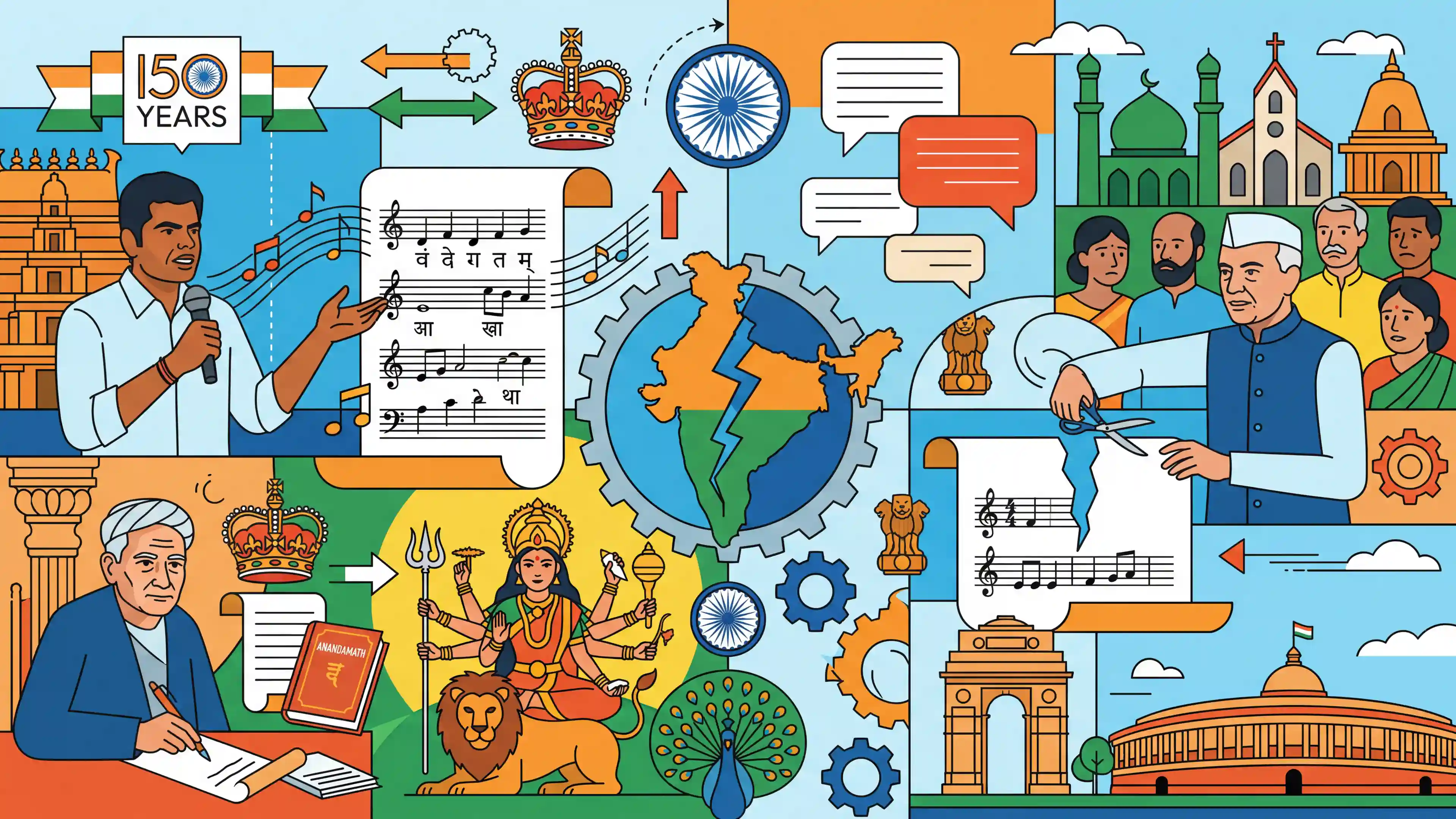
Former BJP State president of Tamil Nadu, K. Annamalai, has advocated for the national song 'Vande Mataram' to be sung in its entirety across the country. Speaking at an awards ceremony, he highlighted the 150th anniversary of the poem composed by Bankim Chandra Chattopadhyay. Annamalai pointed out that currently, only the initial stanzas are sung as the national song, attributing this to post-independence decisions by Jawaharlal Nehru to omit later stanzas—which evoke the Hindu deity Durga—out of concern for minority sentiments. The remarks revive historical debates surrounding cultural nationalism, 'Anandamath', and the adoption of national symbols.
Key Points
- Former Tamil Nadu BJP president K. Annamalai urged that the national song 'Vande Mataram' should be sung in its entirety across India.
- He made the remarks in the context of the 150th anniversary of the poem written by Bankim Chandra Chattopadhyay.
- Currently, only the initial stanzas are adopted as the national song; the later stanzas evoke the Hindu deity Durga.
- Annamalai stated that Jawaharlal Nehru chose to adopt only the first few stanzas post-independence to avoid irritating minority communities.
- The debate touches upon the historical context of India's national song and the themes of cultural nationalism linked to Bankim Chandra's novel 'Anandamath'.
Important Terms
National Song

'Vande Mataram', composed by Bankim Chandra Chattopadhyay, was adopted in 1950. It holds equal status with the National Anthem but has different ceremonial protocols regarding mandatory singing.
UPSC context
GS-II (Polity); tests constitutional understanding of national symbols and the historical compromises made during the Constituent Assembly debates.
Bankim Chandra Chattopadhyay
A 19th-century Bengali novelist and poet who composed 'Vande Mataram'. He was a central figure in the Bengal Renaissance, using literature to foster early Indian nationalism.
UPSC context
GS-I (History); a key personality whose literary works provided the intellectual and emotional foundation for the Indian freedom struggle.
Anandamath
An 1882 political novel by Bankim Chandra Chattopadhyay. Set against the Sannyasi Rebellion, it introduced 'Vande Mataram' and personified India as a divine mother figure to be liberated.
UPSC context
GS-I (Modern History/Literature); relevant for its significant impact on the Swadeshi Movement and its role in defining revolutionary nationalist ideology.
Sannyasi Rebellion
A late-18th-century uprising in Bengal by Hindu ascetics and displaced peasants against the British East India Company. It serves as the historical framework for the novel 'Anandamath'.
UPSC context
GS-I (History); categorized under early anti-colonial peasant and religious resistance movements against British administrative and economic policies.
BJP (Bharatiya Janata Party)
One of India’s major political parties, advocating for 'cultural nationalism' (Hindutva). Its leaders often push for the full official recognition of historical nationalist symbols and traditional heritage.
UPSC context
GS-II (Polity); important for studying political ideologies, their influence on national identity policies, and the role of political parties in governance.
K. Annamalai
A former 2011-batch IPS officer who transitioned into politics, currently serving as the BJP President of Tamil Nadu. He is a prominent voice in regional and nationalistic discourse.
UPSC context
Current Affairs; reflects the trend of civil servants entering politics and their impact on regional leadership and ideological debates in India.
Tamil Perayam
A literary academy established by SRM IST to promote Tamil language and literature. It recognizes scholars and artists through annual awards to preserve regional cultural heritage.
UPSC context
GS-I (Art and Culture); illustrates the role of private educational institutions in patronizing regional languages and promoting Classical Indian literature.
SRM Group
A leading Indian private educational conglomerate, notably the SRM Institute of Science and Technology, which provides platforms for socio-cultural dialogue and the promotion of Indian languages.
UPSC context
General Awareness; represents the intersection of private education and cultural advocacy through the hosting of significant socio-political and literary events.
Prelims Trap
"Vande Mataram was first sung at an INC session during the 1905 Swadeshi Movement."
While it became a mass political rallying cry during the 1905 Swadeshi Movement, it was first sung politically by Rabindranath Tagore at the 1896 Calcutta INC Session.
Static Concepts Connected
What is the historical context of Bankim Chandra's novel 'Anandamath'?
- Sanyasi Rebellion: Set against the backdrop of the Sanyasi uprising (1763–1800) in Bengal, featuring displaced ascetics and peasants.
- Economic Distress: The novel highlights the severe agrarian distress and devastation caused by the Bengal Famine of 1770 alongside exploitative British tax policies.
- Poem Integration: The bilingual (Sanskrit-Bengali) poem 'Vande Mataram', composed earlier in the 1870s, was embedded into this 1882 novel.
How did the Constituent Assembly formalize India's National Song?
- Date of Adoption: Adopted on January 24, 1950, during the final session of the Constituent Assembly by a declaration from President Rajendra Prasad.
- Equal Status: Granted equal constitutional and historical status with "Jana Gana Mana" (the National Anthem).
- Selective Stanzas: Only the first two stanzas were adopted to maintain secularism, as later verses explicitly depicted the nation as Goddess Durga.
Cross-Topic Patterns
Literature fueling Mass Agitations
Just as 'Anandamath' popularized 'Vande Mataram' during Swadeshi, Dinabandhu Mitra's 'Nil Darpan' catalyzed the Indigo Revolt. UPSC frequently links cultural artifacts to their corresponding socio-political mobilizations.
Secularism in National Symbols
The selective adoption of Vande Mataram mirrors the Constituent Assembly's careful balancing act, akin to choosing the Ashokan Chakra over the Charkha for the flag to ensure multi-religious neutrality.

Expect a chronological matching question pairing INC sessions (1896, 1911) with the first political recitations of national songs/anthems.
Linked PYQs · 1
Linked PYQs · 1
- 2003PrelimsGS1
Which one of the following statements is correct?
