History and Constitutional Status of Vande Mataram
Source:The Hindu ↗
Why It Matters
The history of India's national symbols, including the National Flag, Anthem, and Song, is a frequent topic in UPSC Prelims (e.g., the 2003 and 2021 PYQs). Understanding the debates around 'Vande Mataram' provides crucial context for Mains answers on the secular character of the Indian freedom struggle, the accommodative approach of the Congress leadership, and the vision of the Constituent Assembly.
Summary
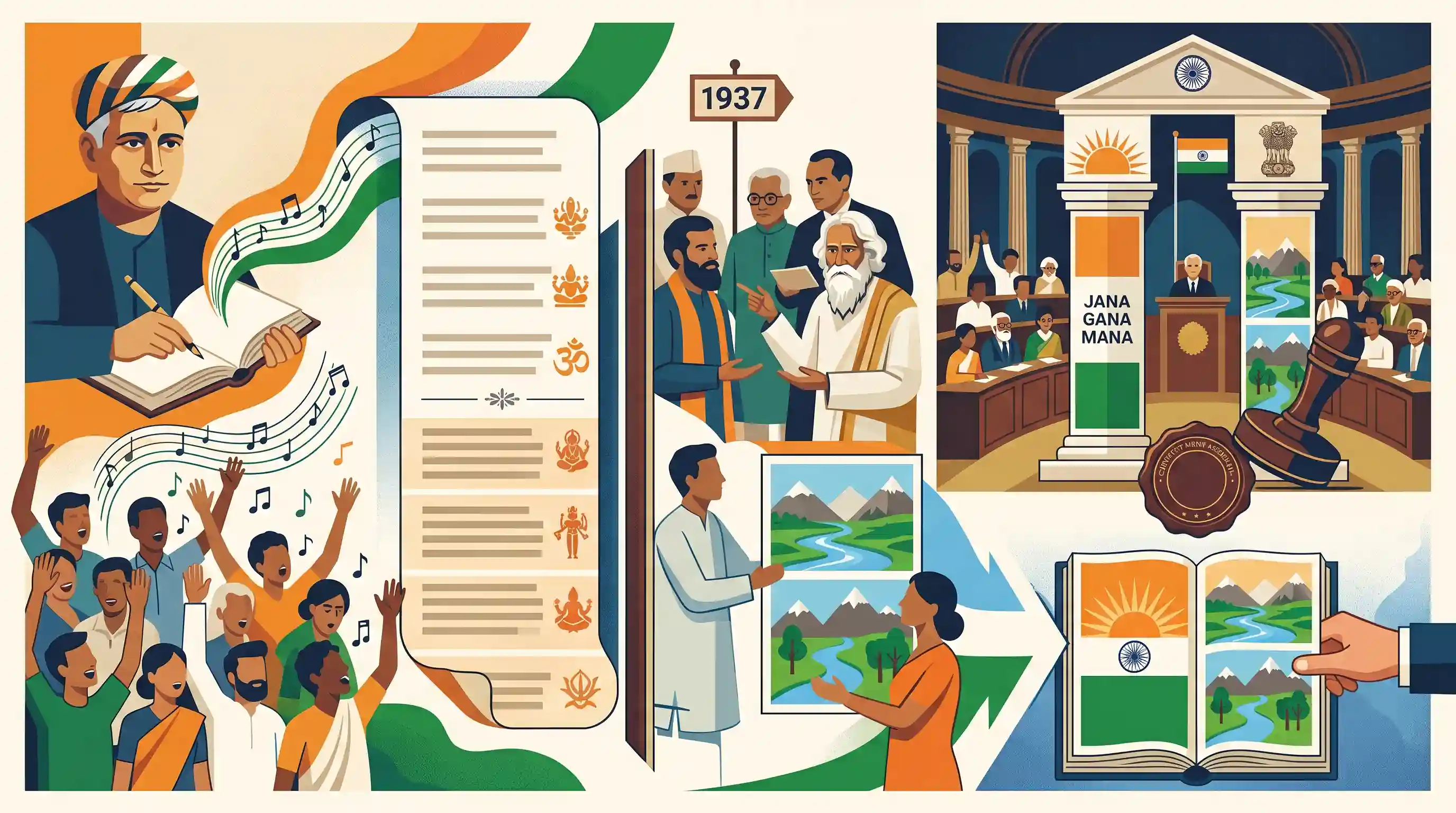
The article traces the historical evolution and constitutional settlement of India's National Song, 'Vande Mataram'. Originally a six-stanza poem in Bankim Chandra Chatterjee's 1882 novel *Anandamath*, the song became immensely popular during the freedom struggle. However, its later stanzas, which explicitly invoked Hindu deities, drew objections from minority leaders. In 1937, an Indian National Congress committee, advised by Rabindranath Tagore, resolved to adopt only the first two stanzas—which poetically describe the motherland's natural beauty—as a secular and inclusive anthem. This consensus was ultimately formalized on January 24, 1950, when the Constituent Assembly granted these two stanzas equal status with 'Jana Gana Mana'. The author argues that recent demands to mandate the singing of the full six stanzas unnecessarily disrupt a carefully negotiated historical and constitutional settlement.
Key Points
- 'Vande Mataram' was originally composed as a six-stanza poem by Bankim Chandra Chatterjee in his 1882 Bengali novel, Anandamath.
- While the song became a powerful rallying cry during the Swadeshi movement, Muslim leaders in the 1930s objected to the later stanzas for their religious imagery invoking Hindu goddesses like Durga and Lakshmi.
- To resolve the conflict, a 1937 Indian National Congress committee—comprising leaders like Nehru, Bose, and Azad—sought the advice of Rabindranath Tagore.
- Tagore recommended adopting only the first two stanzas, which strictly praise the natural beauty and bounty of the motherland, making them secular and universally acceptable.
- On January 24, 1950, the Constituent Assembly formalized this historical consensus by adopting the first two stanzas as the official National Song, giving it equal status with the National Anthem, 'Jana Gana Mana'.
- The article highlights that contemporary political demands to mandate the singing of all six stanzas disregard the carefully negotiated secular settlement established by India's founding figures.
Important Terms
Vande Mataram

A Sanskrit poem by Bankim Chandra Chatterjee, first published in 1882, which served as a rallying cry during the freedom struggle and is now India's National Song.
UPSC context
GS Paper I/II; covers Modern Indian History and National Symbols. Tests knowledge of cultural icons in the freedom movement.
National Song
The status granted to 'Vande Mataram' by the Constituent Assembly in 1950, placing it on equal footing with the National Anthem despite having no explicit mention in Article 51A.
UPSC context
GS Paper II; National Symbols and Polity. Tests understanding of the legal and constitutional status of state symbols.
Anandamath
An 1882 Bengali nationalist novel by Bankim Chandra Chatterjee, set against the 18th-century Sannyasi Rebellion and the Bengal famine of 1770; the source of 'Vande Mataram'.
UPSC context
GS Paper I; Modern Indian History and Literature. Tests knowledge of the 19th-century 'Bengali Renaissance' and nationalist literature.
Constituent Assembly
The sovereign body (1946–1950) responsible for framing the Indian Constitution, which also made key decisions on national symbols like the flag, anthem, and song.
UPSC context
GS Paper II; Constitutional Framework. Tests knowledge of the Assembly’s non-legislative functions and foundational decisions.
1937 INC Resolution
A committee decision led by Nehru and Tagore to adopt only the first two stanzas of 'Vande Mataram' as a secular compromise to ensure national inclusivity.
UPSC context
GS Paper I; Indian Freedom Struggle. Tests understanding of ideological negotiations and secularism within the nationalist movement.
National Anthem (Jana Gana Mana)
The official anthem of India, composed by Rabindranath Tagore, adopted in 1950; unlike the National Song, it is explicitly protected under Article 51A (Fundamental Duties).
UPSC context
GS Paper II; Fundamental Duties. Tests the distinction between national symbols and their respective legal obligations.
Prelims Trap
The Constituent Assembly adopted the complete six-stanza poem 'Vande Mataram' as the National Song of India.
Only the first two stanzas were adopted as the National Song in 1950. The later verses were deliberately excluded to maintain secular inclusivity.
Static Concepts Connected
What are the key adoption dates of India's National Symbols?
- National Flag: Adopted by the Constituent Assembly on July 22, 1947.
- Anthem & Song: Both adopted on January 24, 1950, during the final session of the Constituent Assembly.
- State Emblem: Adapted from the Lion Capital of Ashoka, officially adopted on January 26, 1950.
What is the historical significance of Bankim Chandra's Anandamath?
- Historical Backdrop: Set during the Sanyasi Rebellion of the late 18th century and the devastating Bengal Famine of 1770.
- Swadeshi Anthem: Introduced 'Vande Mataram', which subsequently became the defining revolutionary anthem of the 1905 Swadeshi Movement.
- Congress Debut: The song was first sung at a political event by Rabindranath Tagore at the 1896 Calcutta INC session.
Cross-Topic Patterns
Literature to Constitutional Secularism
The evolution from a Hindu-imagery-laden 1882 novel to a sanitized, secular two-stanza constitutional adoption mirrors India’s broader journey toward a secular republic.
1930s Congress Identity Debates
The 1937 Congress committee's mediation of cultural flashpoints (Nehru, Bose, Azad) parallels the 1931 Karachi Resolution's role in defining fundamental rights and socio-economic identity.

Expect a 2026 Prelims question mixing Anandamath's Sanyasi Rebellion context with the exact constitutional adoption date of Vande Mataram.
Linked PYQs · 2
Linked PYQs · 2
- 2003PrelimsGS1
Which one of the following statements is correct?
- 2021PrelimsGS1
With reference to Madanapalle of Andhra Pradesh, which one of the following statements is correct?
