Parliamentary Debate on Vande Mataram Marks 150 Years
Source:The Hindu ↗
Why It Matters
The article serves as a crucial reminder for UPSC aspirants about key historical facts related to India's national symbols. Specifically, it reiterates the authorship of 'Vande Mataram' (Bankim Chandra Chattopadhyay, from the novel 'Anandamath', associated with the Sanyasi Rebellion) and the national anthem (Rabindranath Tagore), which are frequently tested in Prelims. It also touches upon the dynamics of parliamentary debates and regional identity in modern polity.
Summary
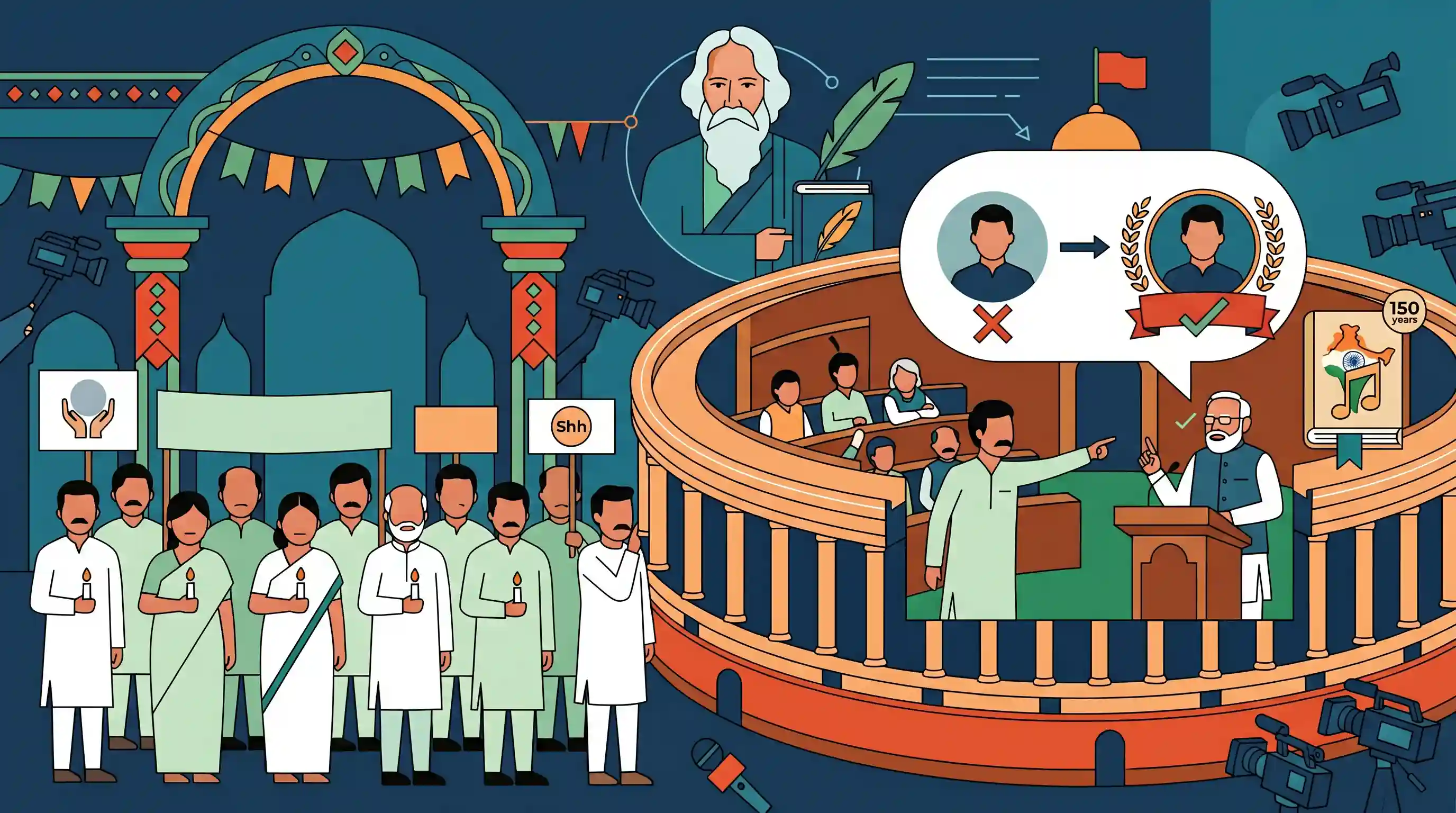
Trinamool Congress (TMC) MPs held a silent protest in the Parliament complex over what they perceived as an insult to Bengal's cultural icons by Prime Minister Narendra Modi. During a Lok Sabha debate commemorating 150 years of the national song "Vande Mataram", the PM referred to its author, Bankim Chandra Chattopadhyay, as "Bankim Da". TMC MPs objected, stating he should respectfully be called "Bankim Babu", a correction the PM subsequently accepted. The debate also touched upon Rabindranath Tagore, the author of the national anthem. The protest underscores the political sensitivity surrounding the legacy and representation of regional historical figures in national political discourse.
Key Points
- The Lok Sabha held a debate to commemorate 150 years of the national song "Vande Mataram".
- TMC MPs staged a silent protest in Parliament, objecting to the Prime Minister referring to Bankim Chandra Chattopadhyay as "Bankim Da" instead of the culturally appropriate "Bankim Babu".
- The Prime Minister accepted the correction after TMC MP Saugata Roy raised an objection during the debate.
- The incident highlights the ongoing political contestation between regional parties and national parties over the legacy and respectful representation of historical and cultural icons.
- Bankim Chandra Chattopadhyay is the author of the novel 'Anandamath', from which "Vande Mataram" is taken, while Rabindranath Tagore composed India's national anthem.
Important Terms
Bankim Chandra Chattopadhyay

A 19th-century intellectual and novelist known as the "Father of the Bengali Novel." He authored "Vande Mataram" and is a key figure of the Bengal Renaissance and early nationalism.
UPSC context
GS Paper I (Modern History/Personalities). Tests intellectual contributors to the freedom struggle and the evolution of nationalist literature.
Vande Mataram
India's National Song, written by Bankim Chandra Chattopadhyay in Sanskritised Bengali. Adopted in 1950, it was a central rallying cry during the Swadeshi Movement and freedom struggle.
UPSC context
GS Paper I & II (Freedom Movement/National Symbols). Tests the history, constitutional status, and cultural impact of national icons.
Bengal Renaissance
A 19th-century socio-cultural awakening in Bengal that blended Western rationalism with Indian traditions, fostering social reforms and the birth of modern Indian nationalism.
UPSC context
GS Paper I (Modern History/Reform Movements). Tests understanding of socio-cultural shifts and key reformers who shaped modern India.
Anandamath
A seminal 1882 political novel by Bankim Chandra Chattopadhyay. Set against the Sanyasi Rebellion, it popularized "Vande Mataram" and depicted the motherland as a sacred entity.
UPSC context
GS Paper I (Modern History/Literature). Tests familiarity with literary works that provided ideological inspiration for the nationalist movement.
Sanyasi Rebellion
Late 18th-century uprisings in Bengal led by ascetics and fakirs against British revenue policies and famine. It provides the historical setting for the novel "Anandamath."
UPSC context
GS Paper I (Modern History/Peasant Revolts). Tests knowledge of early organized resistance against colonial economic exploitation.
Rabindranath Tagore
A Nobel laureate polymath who composed the National Anthem ("Jana Gana Mana") and first sang "Vande Mataram" at the 1896 Congress session.
UPSC context
GS Paper I (Modern History/Culture). Tests contributions to literature, education (Visva-Bharati), and anti-colonial protests (renouncing knighthood).
Prelims Trap
"Vande Mataram was first sung at the 1911 Calcutta session of the Indian National Congress."
Aspirants confuse the first singing of Vande Mataram (1896 INC session) with the national anthem Jana Gana Mana, which was first sung at the 1911 session.
Static Concepts Connected
What is the historical context of Anandamath and its role in the national movement?
- Sanyasi Rebellion: Set against the backdrop of the Sanyasi Rebellion (late 18th century) and the devastating Bengal Famine of 1770, highlighting early resistance to British economic exploitation.
- Swadeshi Anthem: Vande Mataram, embedded in the 1882 novel, later became the definitive battle cry and unifying song during the 1905 Swadeshi movement against the Partition of Bengal.
When were India's National Anthem and National Song officially adopted?
- Constituent Assembly: Both 'Jana Gana Mana' and 'Vande Mataram' were adopted by the Constituent Assembly on its final meeting day, January 24, 1950.
- Equal Status: Dr. Rajendra Prasad issued a declaration granting 'Vande Mataram' equal historical and constitutional status to 'Jana Gana Mana' in recognition of its role in the freedom struggle.
Cross-Topic Patterns
Literature mapping to historical revolts
UPSC frequently links regional literary works to the peasant/tribal uprisings they depict, pairing Anandamath with the Sanyasi Rebellion, much like Dinabandhu Mitra's Nil Darpan with the Indigo Revolt.
150-year historical anniversaries
The 150th anniversary of Vande Mataram elevates the probability of Prelims questions testing Bankim Chandra Chattopadhyay, the 1896 INC session, and cultural drivers of the Swadeshi movement.

The 150th anniversary of Vande Mataram makes a multi-statement question on Anandamath, Sanyasi revolt & INC sessions highly likely.
Linked PYQs · 4
Linked PYQs · 4
- 2018PrelimsGS1
Which among the following events happened earliest ?
- 2006PrelimsGS1
Which one of the following revolts was made famous by Bankim Chandra Chatterjee in his novel Anand Math?
- 2021PrelimsGS1
With reference to Madanapalle of Andhra Pradesh, which one of the following statements is correct?
- 2019MainsGS2
Individual Parliamentarian's role as the national law maker is on a decline, which in turn, has adversely impacted the quality of debates and their outcome. Discuss.
