Assembly session witnesses uproar over national song rendition rules
Source:economictimes ↗
Why It Matters
This event highlights the constitutional intersection between the respect for national symbols (National Anthem and National Song) and the autonomy of legislative bodies to frame and follow their own rules for the conduct of business, overseen by the Speaker.
Summary
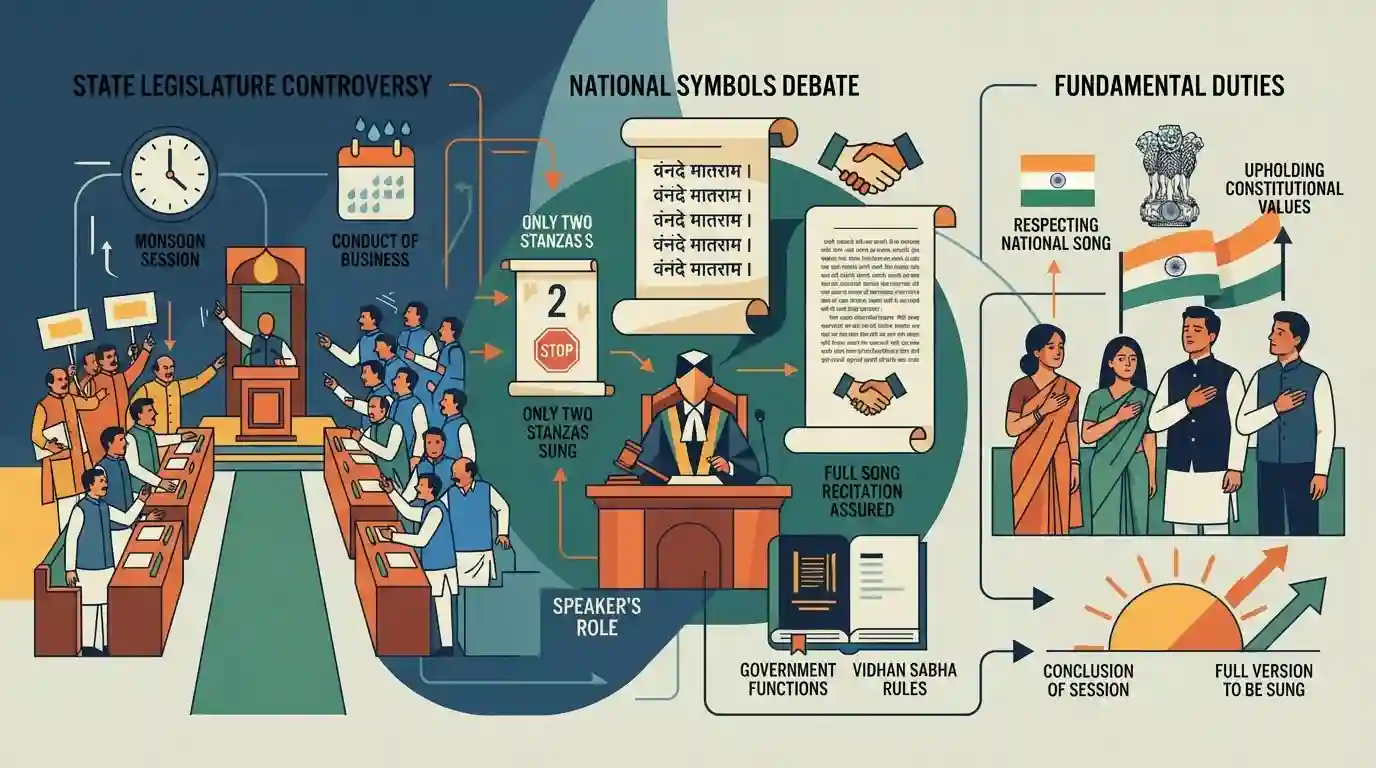
During the Monsoon Session of the Himachal Pradesh Assembly, a controversy broke out between the ruling Congress and opposition BJP over the recitation of 'Vande Mataram'. The BJP protested that only two stanzas were sung, demanding the full recitation. Speaker Kuldeep Singh Pathania intervened, clarifying that the rules mandating the full song apply to government functions, while the Vidhan Sabha operates under its own internal rules for the conduct of business. He assured members that the full version of the national song would be sung at the conclusion of the session.
Key Points
- A political row erupted in the Himachal Pradesh Assembly over the truncated singing of the national song, 'Vande Mataram'.
- The opposition BJP protested, demanding the full version be sung and noting that PM Modi recited the full version at the Red Fort.
- Speaker Kuldeep Singh Pathania clarified that the assembly follows its own established rules of procedure regarding the conduct of business.
- The Speaker ruled that statutory mandates requiring the full recitation apply primarily to government functions and do not supersede the assembly's internal rules, though he assured the full version would be sung at the session's conclusion.
Important Terms
Prevention of Insults to National Honour Act, 1971

A central legislation prohibiting the desecration of or insult to India's national symbols, including the National Flag, Anthem, and Constitution. A 2026 amendment extended its protection to the National Song, Vande Mataram.
UPSC context
GS Paper 2 (Indian Polity). Tests knowledge of fundamental duties, statutory protections for national symbols, and recent legislative amendments.
Vande Mataram (National Song)
Composed by Bankim Chandra Chatterjee, it is the National Song of India, granted equal status with the National Anthem by the Constituent Assembly in 1950. Its recitation protocol recently sparked a legislative dispute.
UPSC context
GS Paper 1 & 2. Tests the historical significance, cultural heritage, and constitutional status of national symbols.
Himachal Pradesh Vidhan Sabha
The unicameral state legislature of Himachal Pradesh, comprising 68 members. Its internal proceedings are strictly governed by its own rules and parliamentary conventions, functioning independently of direct central government operational mandates.
UPSC context
GS Paper 2 (State Legislature). Tests understanding of state assembly rules, legislative autonomy, and the separation of powers.
Speaker of the Legislative Assembly
The principal presiding officer of the Vidhan Sabha, currently Kuldeep Singh Pathania in Himachal Pradesh. The Speaker possesses constitutional authority to regulate House conduct, enforce rules, and uphold established parliamentary conventions.
UPSC context
GS Paper 2. Tests the constitutional powers, privileges, and duties of presiding officers in managing House proceedings.
Prelims Trap
"The Constitution under Article 51A(a) explicitly mandates respect for both the National Anthem and the National Song."
Article 51A(a) explicitly mandates respect for the National Anthem and the National Flag. The Constitution does not explicitly mention the "National Song" under Fundamental Duties.
Static Concepts Connected
What is the constitutional basis for a State Legislature's independent rule-making power?
- Article 208: Under this article, a State Legislature makes rules for regulating its procedure and conduct of business, subject to Constitutional provisions.
- Separation of Powers: This ensures functional autonomy; general executive or government mandates do not automatically apply inside the House unless adopted by its own rules.
- Speaker's Authority: The Speaker is the final interpreter and authority regarding these internal rules and procedures within the Assembly.
What is the historical and constitutional status of 'Vande Mataram'?
- Historical Origins: Composed by Bankim Chandra Chatterjee in his 1882 novel Anandamath; first sung in a political context at the 1896 INC session by Rabindranath Tagore.
- Equal Status: Declared by Dr. Rajendra Prasad in the Constituent Assembly on Jan 24, 1950, to have equal status and honour with 'Jana Gana Mana'.
- Fundamental Duties: Unlike the National Anthem and National Flag, the National Song is notably omitted from explicit mention in Fundamental Duty Article 51A(a).
Cross-Topic Patterns
National Symbols + Fundamental Duties
The distinction between the National Anthem (protected under the Prevention of Insults to National Honour Act, 1971) and the National Song is a classic multi-statement polity trick in HPAS exams.
Speaker's Discretion vs Executive Mandates
Highlights the boundary between executive orders and internal legislative procedures (Article 208), reinforcing the Speaker's absolute authority over the conduct of business inside the Assembly.

Expect a multi-statement question contrasting constitutional protections of the National Anthem vs. National Song, and Article 208 powers.
Linked PYQs · 3
Linked PYQs · 3
- 2025HPAS_PRELIMSGS1
In which case Supreme Court decided that not singing of National Anthem cannot be considered its disrespect or offence ?
- 2025HPAS_PRELIMSGS1
Who decides the disqualification of members of State Legislative Assembly, for matters other than those in the Tenth Schedule of the Constitution ?
- 2023HPAS_PRELIMSGS1
Under which Article of the Constitution a Speaker allows any member to speak in Parliament in his/her mother language ?
