Lok Sabha Passes Legislation Regulating National Song Vande Mataram
Source:Indian Express ↗
આ શા માટે મહત્વનું છે
Legislation concerning national songs touches upon matters of constitutional law, national identity, and parliamentary functioning, making it an important topic for polity and modern history.
સારાંશ
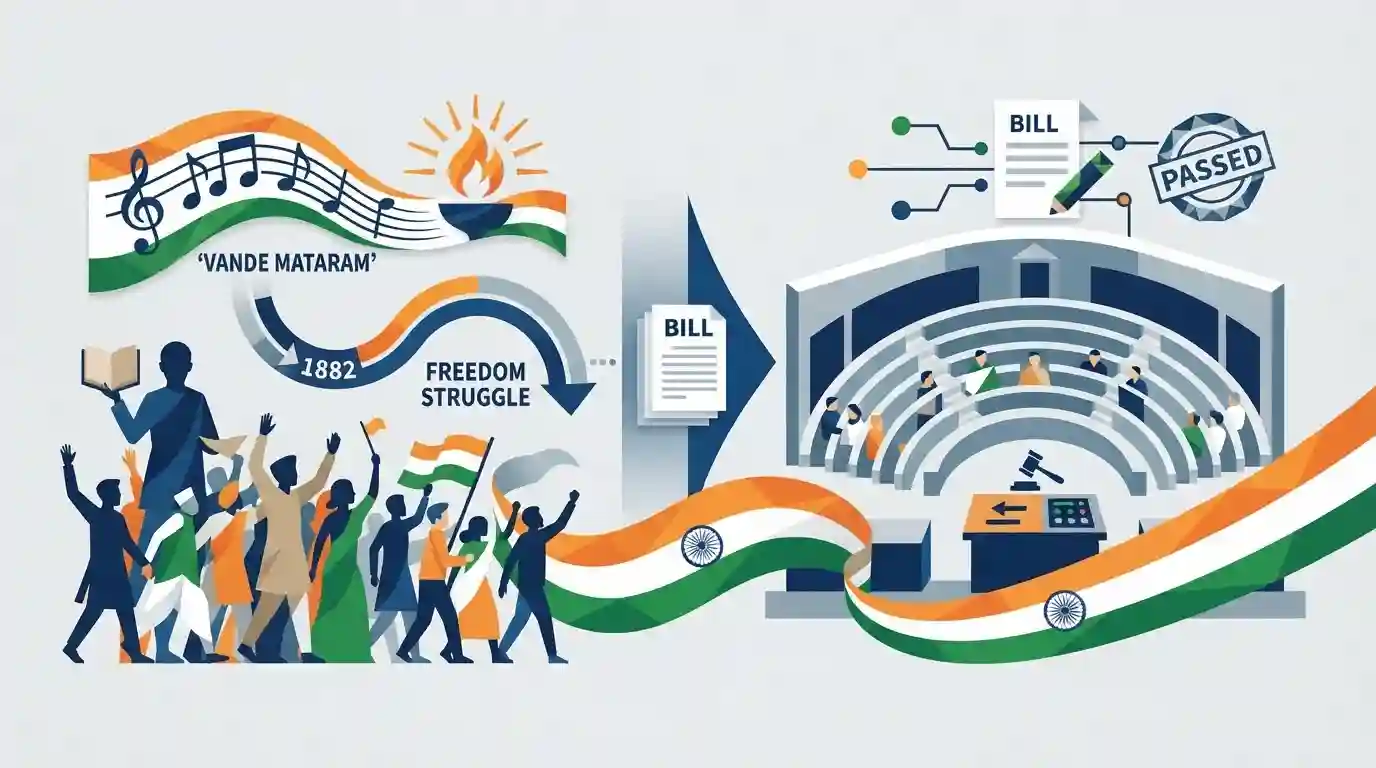
The Lok Sabha has passed the Vande Mataram Bill, putting national symbols and the historic national song under fresh legislative attention. Originally composed by Bankim Chandra Chattopadhyay in his 1882 novel Anandamath, 'Vande Mataram' holds immense significance in India's freedom struggle.
મુખ્ય મુદ્દા
- The Lok Sabha passed the Vande Mataram Bill, focusing on regulatory or statutory provisions regarding India's national song, 'Vande Mataram'.
- 'Vande Mataram' was composed by Bankim Chandra Chattopadhyay in his novel Anandamath (1882) and played a historic role in the Indian national movement.
- The development brings focus to legal, constitutional, and historical aspects concerning national symbols and songs in India.
મહત્વપૂર્ણ શબ્દો
Vande Mataram Bill

A legislative measure amending the Prevention of Insults to National Honour Act, 1971, to criminalize intentional insults or obstructions during the rendition of India's national song, Vande Mataram.
UPSC context
Important for GS Paper II (Polity and Governance - Legislation, Fundamental Duties, and National Symbols).
Anandamath
An 1882 Bengali novel by Bankim Chandra Chattopadhyay set during the Sanyasi Rebellion, famous for featuring the poem Vande Mataram and inspiring early Indian nationalism.
UPSC context
Important for GS Paper I (Modern Indian History - Freedom Struggle, Literature, and Cultural Awakening).
Lok Sabha
The lower house of India's bicameral Parliament, composed of representatives directly elected by the public on the basis of adult suffrage.
UPSC context
Important for GS Paper II (Indian Constitution, Parliament Structure, Functioning, and Conduct of Business).
Parliament
The supreme legislative body of India comprising the President, Lok Sabha, and Rajya Sabha, responsible for making laws and holding the executive accountable.
UPSC context
Important for GS Paper II (Parliament and State Legislatures - Structure, Functioning, and Conduct of Business).
પ્રિલિમ્સ ટ્રેપ
Vande Mataram is explicitly prescribed under a specific article of the Constitution of India in the same manner as the National Anthem.
Unlike the National Anthem (Jana Gana Mana) which was given full constitutional status, Vande Mataram has statutory frameworks and was adopted as the national song by Constituent Assembly resolution rather than a direct constitutional article.
સંલગ્ન સ્થિર ખ્યાલો
What is the historical and constitutional status of India's National Song versus National Anthem?
- Status: Constitutional Status: Both Jana Gana Mana and Vande Mataram were adopted by the Constituent Assembly on January 24, 1950, but neither has an explicit standalone article dictating their usage.
- INC Role: INC Adoption: Vande Mataram was first sung at the 1896 INC session by Rabindranath Tagore; its first two stanzas were adopted by the Congress in 1937.
- Origin: Literary Origin: Composed by Bankim Chandra Chattopadhyay in his 1882 novel Anandamath, set against the Sannyasi Rebellion in Bengal.
આંતર-વિષય પેટર્ન
National Symbols vs. Fundamental Duties
While fundamental rights guarantee freedom of speech, Article 51A(a) of the DPSP specifically enjoins citizens to respect the National Flag and National Anthem.
Sannyasi Rebellion + 19th-Century Nationalism
The Sannyasi Rebellion forms a crucial bridge between agrarian peasant uprisings of the late 18th century and early institutional nationalism.

Expect a statement-based prelims question combining the origins of Anandamath, INC adoption history, and constitutional status of national symbols.
સંલગ્ન PYQ · 3
સંલગ્ન PYQ · 3
- 2003PrelimsGS1
Which one of the following statements is correct?
- 2018PrelimsGS1
Which among the following events happened earliest ?
- 2026PrelimsGS1
Which one of the following Carnatic music ragas is similar to Raga Bilawal in Hindustani music?
