Sesquicentennial Celebrations of Vande Mataram and National Anthem
Source:The Hindu ↗
Why It Matters
The 150th anniversary of 'Vande Mataram' is a significant cultural milestone that brings attention to key historical figures (Bankim Chandra Chatterjee, Rabindranath Tagore) and literature ('Anandamath', 'Bangadarshan'). These elements—specifically the novel 'Anandamath' and its connection to the Sanyasi Rebellion—are recurring topics in UPSC Prelims and Mains under Modern Indian History.
Summary
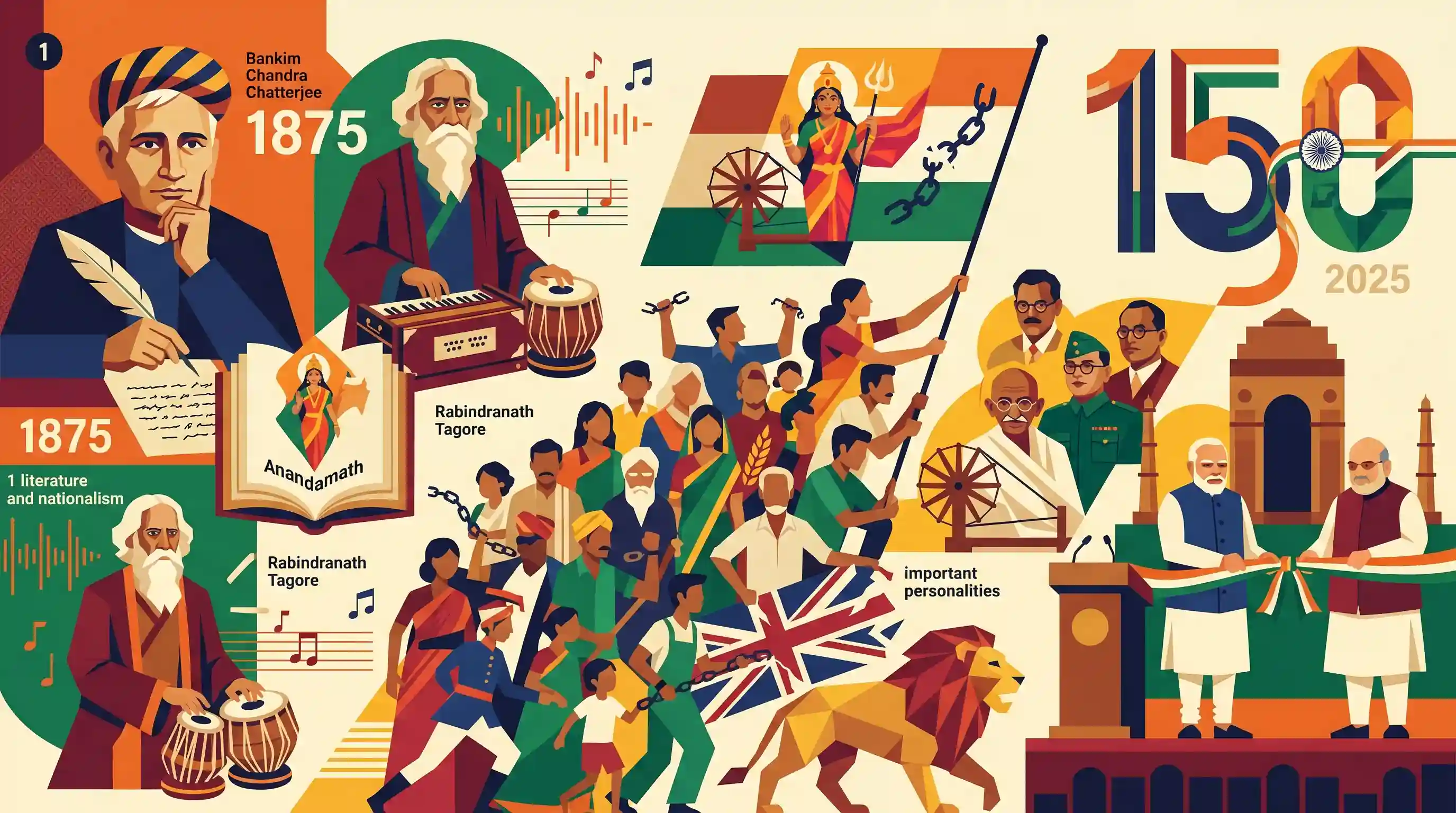
Prime Minister Narendra Modi and Union Home Minister Amit Shah will inaugurate the 150th-anniversary celebrations of India's national song, 'Vande Mataram', on November 7, 2025. Composed by Bankim Chandra Chatterjee and first published in 1875, the song was later included in his famous novel 'Anandamath' and set to music by Rabindranath Tagore. The anthem played a crucial role in uniting the masses against British colonial rule during the freedom struggle.
Key Points
- The 150th anniversary of India's national song, 'Vande Mataram', will be commemorated with a year-long celebration starting November 7, 2025.
- The song was composed by Bankim Chandra Chatterjee and first published in his literary journal 'Bangadarshan' on November 7, 1875.
- It was later incorporated into Chatterjee's prominent 1882 novel, 'Anandamath', which is set against the backdrop of the Sanyasi Rebellion.
- Rabindranath Tagore set the song to music, helping it become a profound unifying anthem during the Indian independence movement.
Important Terms
Vande Mataram

Composed by Bankim Chandra Chatterjee in 1875, this Sanskrit-Bengali poem became the battle cry of India's freedom struggle. It was later adopted as India's official National Song.
UPSC context
GS Paper I: Modern History/Culture. Significant as a symbol of cultural nationalism and a recurrent Prelims topic.
Bankim Chandra Chatterjee
A pioneering 19th-century Bengali novelist and journalist known as 'Sahitya Samrat.' He bridged colonial service and nationalism, authoring works that catalyzed the Bengal Renaissance.
UPSC context
GS Paper I: Personalities. Important for his role in intellectual awakening and literature-based resistance.
Anandamath
A landmark 1882 Bengali novel by Bankim Chandra. Set against the 18th-century Sanyasi Rebellion, it popularized the concept of 'Mother India' and first included the song Vande Mataram.
UPSC context
GS Paper I: Modern History. Often tested for its historical setting (famine/rebellion) and nationalist impact.
Bangadarshan
A monthly literary journal founded by Bankim Chandra in 1872. It fostered a Bengali public sphere, promoting cultural identity and early nationalism; later revived by Rabindranath Tagore in 1901.
UPSC context
GS Paper I: Press and Literature. Relevant for the role of journals in the freedom movement.
Sanyasi Rebellion
A late 18th-century uprising (c. 1770–1820) in Bengal by displaced ascetics and peasants against British East India Company exploitation and the devastating 1770 famine.
UPSC context
GS Paper I: Peasant/Tribal Uprisings. A key 'pre-1857' resistance movement often linked to Anandamath.
1896 INC Session
The Calcutta session of the Indian National Congress where Rabindranath Tagore first sang Vande Mataram publicly, cementing its status as a cornerstone of the nationalist movement.
UPSC context
GS Paper I: Freedom Struggle. Frequently asked in Prelims regarding the first public performance of national songs.
National Song
Adopted by the Constituent Assembly in 1950, this status grants Vande Mataram equal honor with the National Anthem, reflecting its unique historical role in the independence movement.
UPSC context
GS Paper II: Polity/Constitution. Tests awareness of constitutional status and historical distinctions between patriotic hymns.
Prelims Trap
Vande Mataram was first published in the novel Anandamath in 1882.
It was actually composed earlier and first published in the journal 'Bangadarshan' in 1875, before being incorporated into Anandamath later in 1882.
Static Concepts Connected
What was the Sanyasi Rebellion depicted in Bankim Chandra's Anandamath?
- Trigger: Occurred in late 18th-century Bengal, driven by harsh British tax policies and exacerbated by the catastrophic 1770 famine.
- Participants: Displaced peasants, demobilized soldiers of native rulers, and wandering monks (Sanyasis/Fakirs) whose traditional pilgrimage routes were restricted.
- Leaders: Key figures included Majnu Shah, Musa Shah, Bhawani Pathak, and Devi Chaudhurani.
When and how was Vande Mataram adopted by independent India?
- Adoption Date: The Constituent Assembly adopted the first two stanzas as the National Song on January 24, 1950.
- Equal Status: Dr. Rajendra Prasad declared it would have equal status with the National Anthem, Jana Gana Mana.
- Musical Distinction: While Bankim Chandra wrote it, Rabindranath Tagore set it to music and first sang it at the 1896 INC session.
Cross-Topic Patterns
Swadeshi Movement & Literary Catalysts
Vande Mataram bridges literature and mass movements, similar to how Tagore's 'Amar Sonar Bangla' became the defining cultural rallying cry during the 1905 anti-Bengal Partition protests.
Constituent Assembly's Final Session
The adoption of the National Song is linked to the Constituent Assembly's final session on Jan 24, 1950, alongside the adoption of the National Anthem and election of the first President.

Expect a chronological multi-statement question linking the Sanyasi Rebellion, publication of Anandamath, and the 1896 INC session in 2026.
Linked PYQs · 3
Linked PYQs · 3
- 2006PrelimsGS1
Which one of the following revolts was made famous by Bankim Chandra Chatterjee in his novel Anand Math?
- 2018PrelimsGS1
Which among the following events happened earliest ?
- 2023MainsGS1
What was the difference between Mahatma Gandhi and Rabindranath Tagore in their approach towards education and nationalism?
