Vande Ganga Water Conservation Campaign Launched in Rajasthan
Source:rasonly ↗
Why It Matters
Given Rajasthan's arid and water-scarce geography, water conservation techniques, both traditional (like Khadin) and modern administrative campaigns, are heavily tested in the RPSC RAS Prelims and Mains. Understanding state-led water conservation drives, public participation dynamics, and institutional water resource audits is crucial for scoring well in GS and Economy sections.
Summary
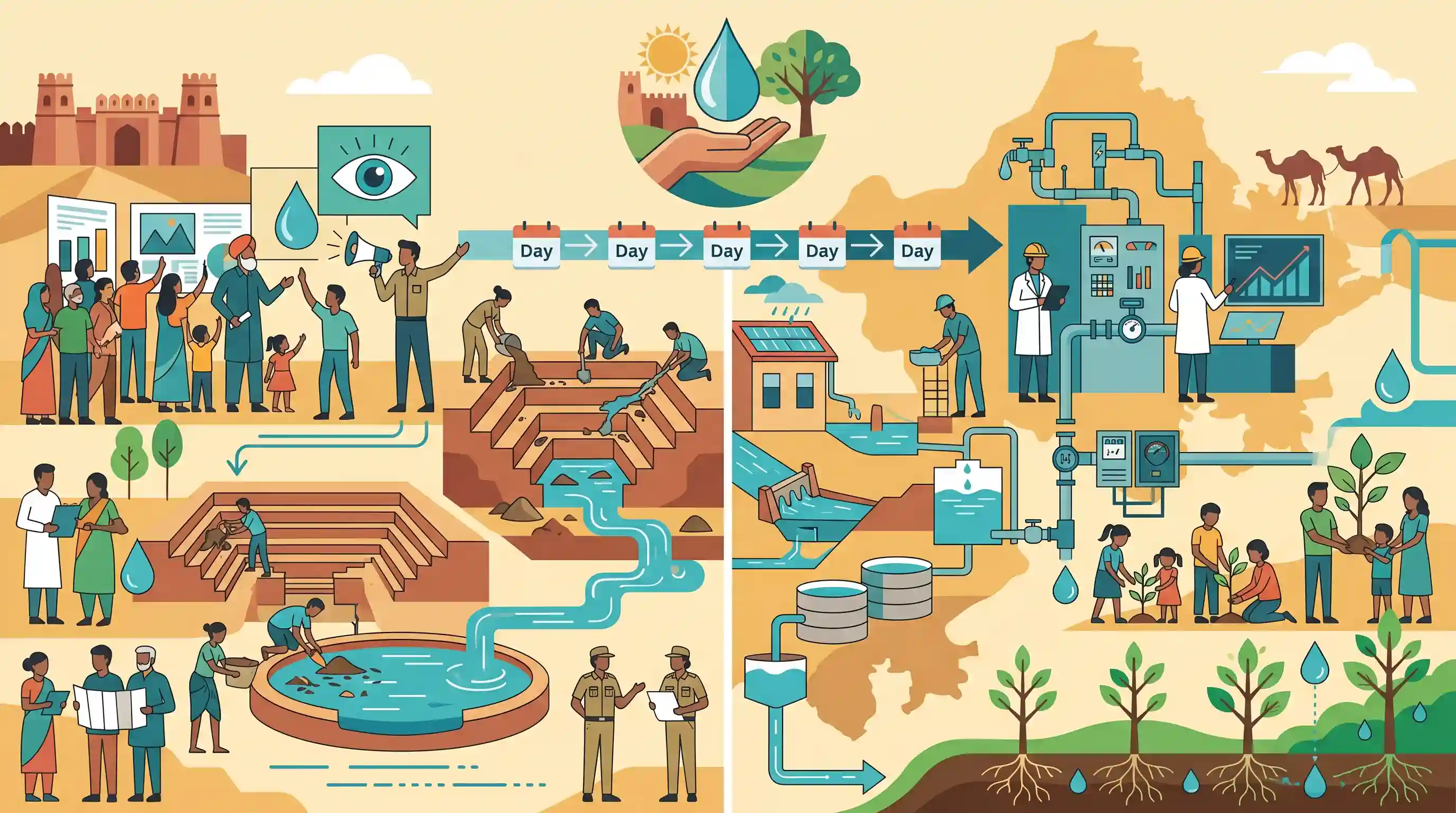
The Rajasthan Government has launched the 'Vande Ganga Water Conservation Public Campaign 2026' (Vande Ganga Jal Sanrakshan Jan Abhiyan), running from May 25 to June 5, 2026. The state-wide initiative focuses on raising water conservation awareness, cleaning traditional and modern water harvesting bodies, conducting water/energy audits, and promoting tree plantation through community, administrative, and scientific engagement.
Key Points
- The 'Vande Ganga Water Conservation Public Campaign 2026' (Vande Ganga Jal Sanrakshan Jan Abhiyan) is scheduled to run from May 25 to June 5, 2026, under the direction of the Rajasthan Government.
- The campaign aims to integrate environmental protection, rainwater harvesting, cleanliness of water sources, water conservation, and public participation across district, block, gram panchayat, and urban levels.
- District-level launch preparations were coordinated under administrators such as District Collector Sandesh Nayak on May 25, 2026.
- Community activities include cleanliness drives at rivers, ponds, canals, and water harvesting structures, alongside voluntary labor (shramdan) and the lighting of lamps (deep prajjwalan).
- Cultural and traditional programs are embedded in the campaign, such as the Vande Ganga Prabhat Pheri, Kalash Yatra, Peepal tree worship, and Peepal tree plantation drives.
- Scientific and accountability measures include water testing campaigns to raise quality awareness, corporate social responsibility (CSR) workshops, water use audits, energy audits, and disseminating details on the green budget.
- Cleanliness and repair initiatives will also target public institutions like railway stations, bus stands, local gaushalas (cowsheds), veterinary hospitals, dairy unions, and government establishments.
Important Terms
Vande Ganga Jal Sanrakshan Jan Abhiyan

A water conservation campaign launched by the Rajasthan Government in May 2026, combining administrative and public efforts to revive traditional water harvesting bodies, promote tree plantation, and secure localized water sustainability.
UPSC context
GS Paper III (Water Resources). Tests awareness of localized climate adaptation strategies and state-level decentralized governance campaigns.
Jal Shakti Abhiyan
A national campaign launched in 2019 by India’s Ministry of Jal Shakti to boost water-stressed districts through five critical conservation and groundwater recharge interventions.
UPSC context
GS Paper II (Government Schemes). Tests analysis of central welfare schemes addressing India's severe groundwater depletion and water-stress.
Catch the Rain Campaign
A sub-campaign under the Jal Shakti Abhiyan, themed "Catch the rain, where it falls, when it falls," advocating decentralized rainwater harvesting across rural and urban locations.
UPSC context
GS Paper III (Conservation). Tests understanding of community-led decentralized water resource management and rainwater harvesting techniques.
Mukhyamantri Jal Swavalamban Abhiyan
Rajasthan’s flagship water conservation campaign launched in 2016, utilizing public crowd-funding and the "four-waters concept" to make rural areas self-sufficient in water resources.
UPSC context
GS Paper III (Water Resources). Evaluates successful state-level models of decentralized resource convergence and community-driven watershed management.
Four Waters Concept
An integrated watershed management model focusing on simultaneously harvesting and optimizing four water pools: rainfall runoff, surface water, groundwater, and in-situ soil moisture.
UPSC context
GS Paper I & III (Geography & Conservation). Tests scientific knowledge of drought mitigation and micro-watershed development in arid regions.
Traditional Water Harvesting Systems
Indigenous structures like Bawris (stepwells), Johads (earthen check dams), and Taankas (underground cisterns) engineered historically to collect and preserve rainfall in arid zones.
UPSC context
GS Paper I & III (Culture & Environment). Assesses knowledge of local ecological wisdom, climate resilience, and historically sustainable resource conservation.
Prelims Trap
The Vande Ganga Campaign is a Central Government initiative to clean the main channel of the holy river Ganga.
Despite the "Ganga" in its name, this is a Rajasthan state initiative launched from the Banas River basin to rejuvenate local arid water-harvesting systems.
Static Concepts Connected
What are the key traditional rainwater harvesting structures in Rajasthan's arid ecosystem?
- Khadin: An agro-pastoral runoff-farming system utilizing a long earthen bund across slopes, pioneered by Paliwal Brahmins.
- Taanka: A paved underground rainwater storage tank built in homes or community spaces to store drinking water.
- Johad & Nadi: Johads are crescent-shaped earthen check dams; Nadis are traditional village ponds used to collect runoff.
How does the Indian Constitution distribute legislative powers over water resources?
- State List (Entry 17): Grants states jurisdiction over water supply, irrigation, canals, drainage, water storage, and water power.
- Union List (Entry 56): Allows the Union to regulate and develop inter-state rivers and river valleys if declared expedient by Parliament.
- Article 262: Empowers Parliament to enact laws for adjudicating disputes relating to inter-state river waters.
Cross-Topic Patterns
Traditional Hydrology & Climate Adaptation
Integrating historic systems like Khadins with MGNREGA-led asset creation showcases how traditional engineering can serve modern decentralized climate-resilience goals.
Diaspora Philanthropy & Rural Assets
Rajasthan's integration of non-resident funding for village water bodies highlights a model for public-private-diaspora partnership in rural infrastructure development.

Expect a multi-statement prelims question mapping traditional water harvesting terms (Khadin, Johad) to their geographical regions.
Linked PYQs · 3
Linked PYQs · 3
- 2023RPSC_PRELIMSGS1
Which of the following statements is/are correct regarding the Atal Bhujal Yojana in Rajasthan? (a) The Atal Bhujal Yojana is being run by the Government of Rajasthan with financial assistance from the Government of India. (b) The focus of this scheme is to improve groundwater management and prevent its declining levels.
- 2024RPSC_PRELIMSGS1
In which district of Rajasthan 'Khadin' is a popular method of water conservation?
- 2025RPSC_PRELIMSGS1
In which district of Rajasthan is the ‘Khadin’ water conservation method prevalent?
