Vande Bharat Sleeper Train Trial Run
Source:Indian Express ↗
Why It Matters
The successful trial of the Vande Bharat Sleeper train underscores India's push towards modernizing its railway infrastructure with indigenous semi-high-speed technology, crucial for improving connectivity between economic hubs and driving inclusive economic growth.
Summary
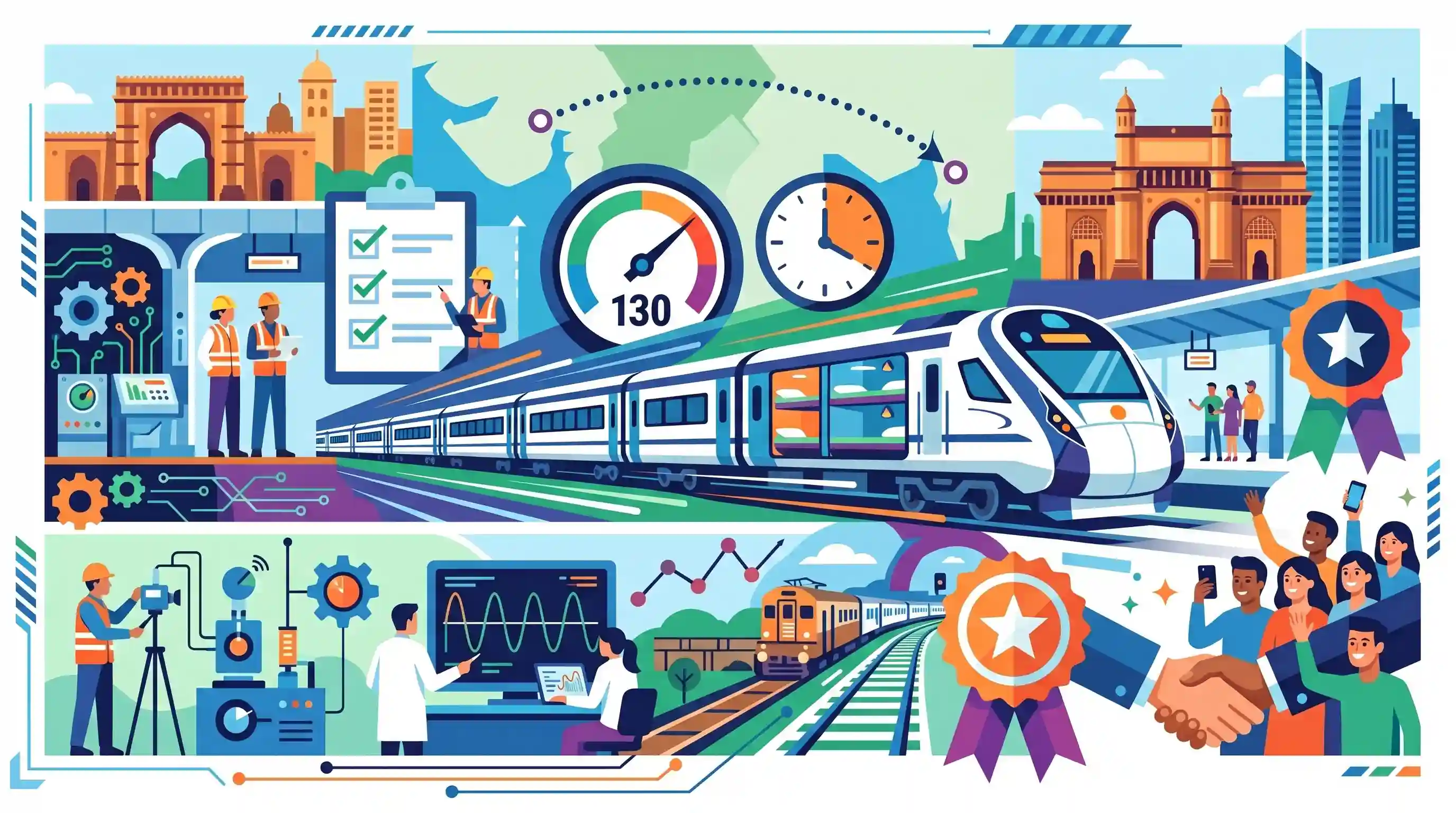
The Indian Railways successfully conducted a trial run of the new Vande Bharat Sleeper train between Ahmedabad and Mumbai. Overseen by the Research Design and Standards Organisation (RDSO), the 16-coach train covered the distance in about four hours at a maximum speed of 130 kmph. Following successful initial trials, additional technical assessments, including Confirmatory Oscillograph Car Run (COCR) trials, are being executed to finalize the train's readiness for public service, marking a step forward in India's semi-high-speed rail modernization.
Key Points
- The Vande Bharat Sleeper train successfully completed a trial run between Ahmedabad and Mumbai, covering the distance in roughly four hours.
- The train achieved a maximum speed of 130 kmph during the trial, demonstrating its semi-high-speed capabilities.
- The tests were overseen by the Research Design and Standards Organisation (RDSO) and involved a 16-coach rake with specially modified bogies.
- Further technical evaluations include Confirmatory Oscillograph Car Run (COCR) trials to ensure safety and performance standards before finalizing the operational route.
Important Terms
Vande Bharat Sleeper

An indigenous, semi-high-speed self-propelled trainset designed for long-distance overnight travel, featuring advanced safety systems like KAVACH and potential speeds of 160-180 kmph.
UPSC context
GS Paper 3 (Infrastructure). Tests knowledge of indigenization (Make in India) and modernization of national transportation networks.
Research Design and Standards Organisation (RDSO)
The Lucknow-based R&D wing of Indian Railways that sets technical standards and conducts safety/stability trials for rail infrastructure and rolling stock.
UPSC context
GS Paper 3 (Science & Technology/Infrastructure). Relevant for institutional frameworks supporting indigenous innovation and safety standards.
Railway Board
The apex executive body of the Ministry of Railways, led by a Chairman/CEO, responsible for the overall administration and policy-making of the national rail network.
UPSC context
GS Paper 2 (Governance). Pertains to administrative restructuring and institutional efficiency within key infrastructure ministries.
Confirmatory Oscillograph Car Run (COCR)
A specialized high-speed trial involving sensor-equipped cars to evaluate a train's stability, suspension, and track interaction before final operational clearance.
UPSC context
GS Paper 3 (Infrastructure/Security). Highlights technical safety protocols and speed-upgradation requirements in modern railway management.
Indian Railways
A statutory body under the Ministry of Railways that manages India's national rail system, serving as the backbone of the country's logistics and mobility.
UPSC context
GS Paper 3 (Infrastructure). Central to discussions on economic logistics, regional connectivity, and public-sector infrastructure management.
Prelims Trap
"Vande Bharat trains operate using a centralized, high-power locomotive engine to achieve semi-high speeds."
Vande Bharat utilizes 'distributed traction power technology'. It is a locomotive-less trainset where motorized axles are distributed across multiple coaches, not reliant on one engine.
Static Concepts Connected
What is distributed traction technology used in Vande Bharat trains?
- Locomotive-less design: Propulsion systems are distributed across multiple passenger coaches rather than relying on a single, heavy front-end locomotive.
- Faster Acceleration: Multiple powered axles allow the train to reach top speeds and decelerate much faster than conventional locomotive-hauled trains.
- Regenerative Braking: Motors act as generators during braking, feeding electrical energy back to the overhead grid, saving up to 30% in energy.
What is the 'One Nation, One Standard' mission concerning RDSO?
- BIS Initiative: An initiative launched by the Bureau of Indian Standards (BIS) to aggregate and harmonize standard-formulation efforts across the country.
- First SDO Status: The Research Design and Standards Organisation (RDSO) under the Ministry of Railways became India's first institution to be recognized as a Standard Developing Organization (SDO).
Cross-Topic Patterns
Rolling Stock vs. Legacy Track Constraints
While Vande Bharat trains are designed for 160-180 kmph, operational trials are often restricted to 130 kmph, underscoring the need for synchronized capital investment in track strengthening and Kavach signaling upgrades.
Climate Targets and Rail Electrification
The energy efficiency of Vande Bharat's regenerative braking directly supports India's Panchamrit climate goals by significantly reducing the carbon emissions intensity of the public transport sector.

Expect a 2026 prelims question testing Vande Bharat's distributed traction tech alongside RDSO's 'One Nation, One Standard' status.
Linked PYQs · 2
Linked PYQs · 2
- 2021MainsGS3
“Investment in infrastructure is essential for more rapid and inclusive economic growth.” Discuss in the light of India's experience.
- 2023MainsGS3
What is the status of digitalization in the Indian economy? Examine the problems faced in this regard and suggest improvements.
