Railway Ministry Highlights Comparative Pricing of Vande Bharat
Source:The Hindu ↗
Why It Matters
This highlights the balance Indian Railways must strike between modernizing infrastructure (capital expenditure) and fulfilling its socio-economic welfare obligations (affordable pricing). It provides useful data points for GS3 answers concerning transport infrastructure, passenger service monetization, and public sector subsidies.
Summary
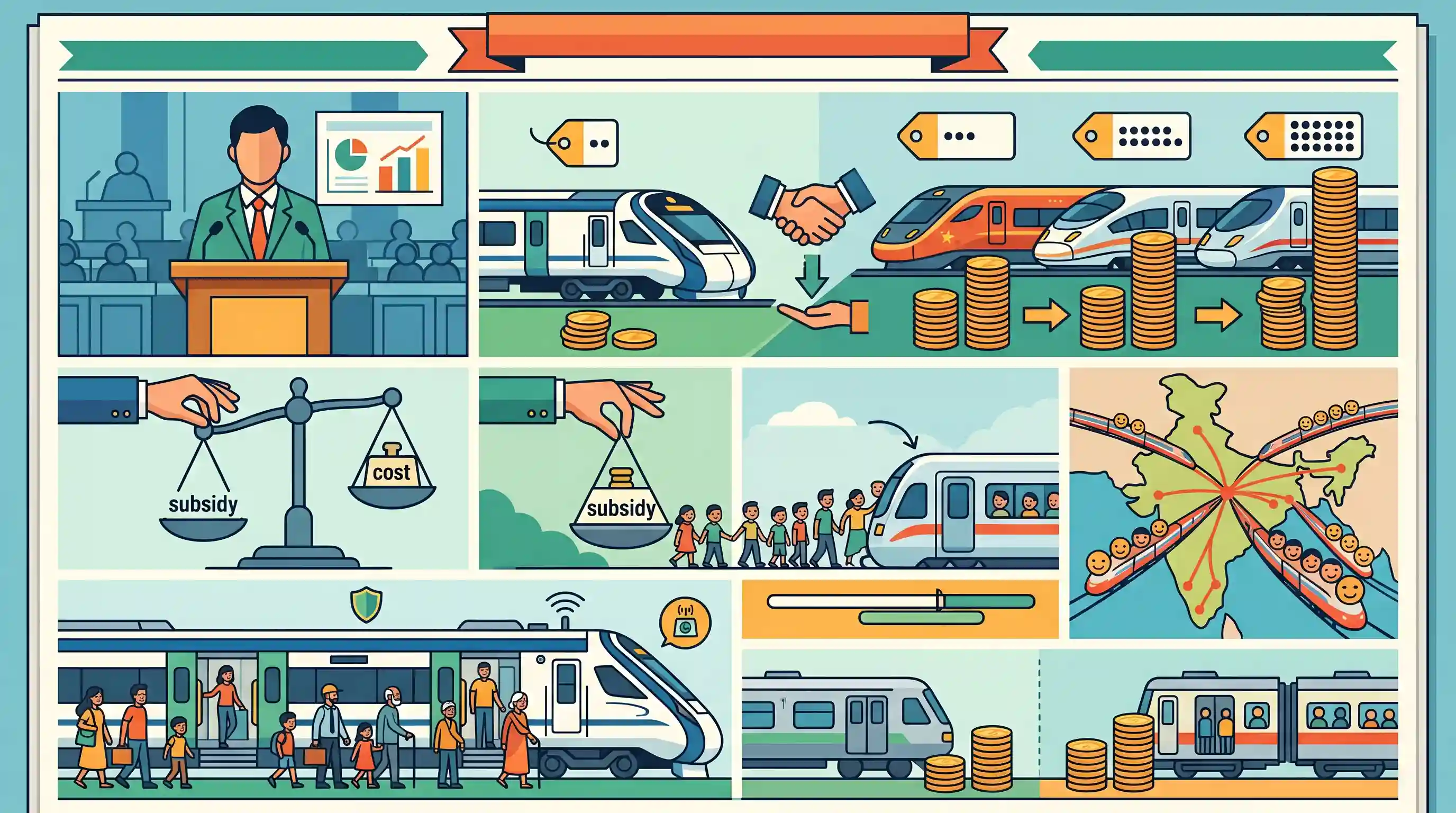
Railway Minister Ashwini Vaishnaw informed the Lok Sabha that Vande Bharat AC chair car fares are kept much lower (₹2.19 per kilometre) than similar services in nations like China, Japan, and France (₹7 to ₹20 per km) to ensure affordability. Setting fares below the cost of service aligns with the government's socio-economic considerations. Ordinary class fares in India also remain highly competitive compared to neighboring countries. Vande Bharat features advanced tech like KAVACH and automatic doors, and currently sees near 100% occupancy on 82 routes, reflecting high passenger demand for modernized infrastructure.
Key Points
- The Vande Bharat AC chair car fare is around ₹2.19 per km, significantly lower than comparable services in China, Japan, and France (₹7 to ₹20 per km).
- Indian Railways ordinary class fare stands at 20 paise per km, lower than those in neighboring countries such as Pakistan (54 paise), Bangladesh (37 paise), and Sri Lanka (51 paise).
- The Ministry of Railways intentionally keeps fares below the cost of service to ensure affordability while considering socio-economic obligations and competition.
- Currently operating on 82 routes with 164 services, Vande Bharat trains have achieved nearly 100% occupancy across major routes.
- Vande Bharat services operate as a distinct passenger segment equipped with advanced features such as semi-high-speed operations, automatic plug doors, CCTVs, and the KAVACH anti-collision system.
Important Terms
Vande Bharat Express

India's first indigenous semi-high-speed, self-propelled trainset (Train 18), capable of 160-180 km/h. It features aerodynamic design and modern amenities, symbolizing India's 'Make in India' manufacturing prowess.
UPSC context
GS Paper 3: Infrastructure (Railways). Focuses on indigenous technology, modernization of transport, and 'Make in India' achievements.
KAVACH
An indigenously developed Automatic Train Protection (ATP) system for Indian Railways. It prevents collisions by automatically applying brakes if a pilot overshoots signals or detects another train on the same track.
UPSC context
GS Paper 3: Science & Technology and Infrastructure. Tests knowledge of indigenous safety tech and railway disaster management.
Social Service Obligation
The requirement for Indian Railways to operate uneconomic services (like low fares and non-profitable routes) in the larger national interest of affordability and socio-economic equity.
UPSC context
GS Paper 3: Indian Economy (Infrastructure/Pricing). Explains the tension between commercial viability and public welfare in state-run utilities.
Automatic Train Protection (ATP)
A safety infrastructure that monitors train movements and automatically intervenes (braking) to prevent human-error accidents. KAVACH is India’s SIL-4 certified national ATP standard.
UPSC context
GS Paper 3: Infrastructure and Security. Relevant for discussions on modernizing railway signaling and passenger safety.
Semi-high Speed Train
Trains operating at speeds between 130 km/h and 200 km/h. They fill the gap between conventional express trains and dedicated high-speed (bullet) rail systems.
UPSC context
GS Paper 3: Infrastructure development. Tests understanding of different tiers of railway technology and connectivity.
Prelims Trap
"Vande Bharat trains utilize an upgraded, high-power traditional locomotive to achieve semi-high speeds."
Vande Bharat operates without a traditional locomotive. It uses distributed traction power technology (multiple self-propelled coaches) for quicker acceleration and deceleration.
Static Concepts Connected
How does cross-subsidization in Indian Railways impact the broader economy?
- The Mechanism: Passenger fares are intentionally kept below operational costs for socio-economic reasons, while freight tariffs are increased to cover the deficit.
- Logistics Impact: This inflates freight costs, pushing cargo toward road transport and increasing India's overall logistics cost as a percentage of GDP.
- Export Competitiveness: Higher inland freight costs make Indian manufactured goods more expensive, reducing their competitiveness in the global export market.
What are the core technical features of the KAVACH anti-collision system?
- Indigenous ATP: Developed indigenously by RDSO, it is a Safety Integrity Level-4 (SIL-4) certified Automatic Train Protection (ATP) system.
- RFID Technology: Uses Radio Frequency Identification (RFID) tags on tracks and station yards for precise track identification and train location.
- Collision Prevention: Automatically applies brakes to prevent Signal Passed at Danger (SPAD) and head-on or rear-end collisions.
Cross-Topic Patterns
Rail Cross-Subsidization + National Logistics Policy
Subsidized passenger fares force high rail freight tariffs, directly challenging the National Logistics Policy's goal to reduce India's logistics costs to global benchmarks (under 10% of GDP).
Distributed Traction + Energy Efficiency
Vande Bharat's distributed traction (no single locomotive) links to energy-efficient mass transit and climate goals, as it allows regenerative braking and lower per-passenger energy consumption.

Expect a Prelims question combining the mechanics of KAVACH (RFID/UHF) with the distributed traction (no locomotive) tech of Vande Bharat.
Linked PYQs · 3
Linked PYQs · 3
- 2022MainsGS3
Why is Public Private Partnership (PPP) required in infrastructural projects ? Examine the role of PPP model in the redevelopment of Railway Stations in India.
- 2021MainsGS3
“Investment in infrastructure is essential for more rapid and inclusive economic growth.” Discuss in the light of India's experience.
- 2015MainsGS3
In what way could replacement of price subsidy with Direct Benefit Transfer (DBT) change the scenario of subsidies in India ? Discuss.
