Conflicting Statements Emerge from US-Iran Diplomatic Talks
Source:Indian Express ↗
Why It Matters
The US-Iran dynamic and the status of the Iranian nuclear program are central to Middle East stability. The security of the Strait of Hormuz is a crucial geopolitical chokepoint that directly impacts global energy security, oil prices, and India's strategic energy interests.
Summary
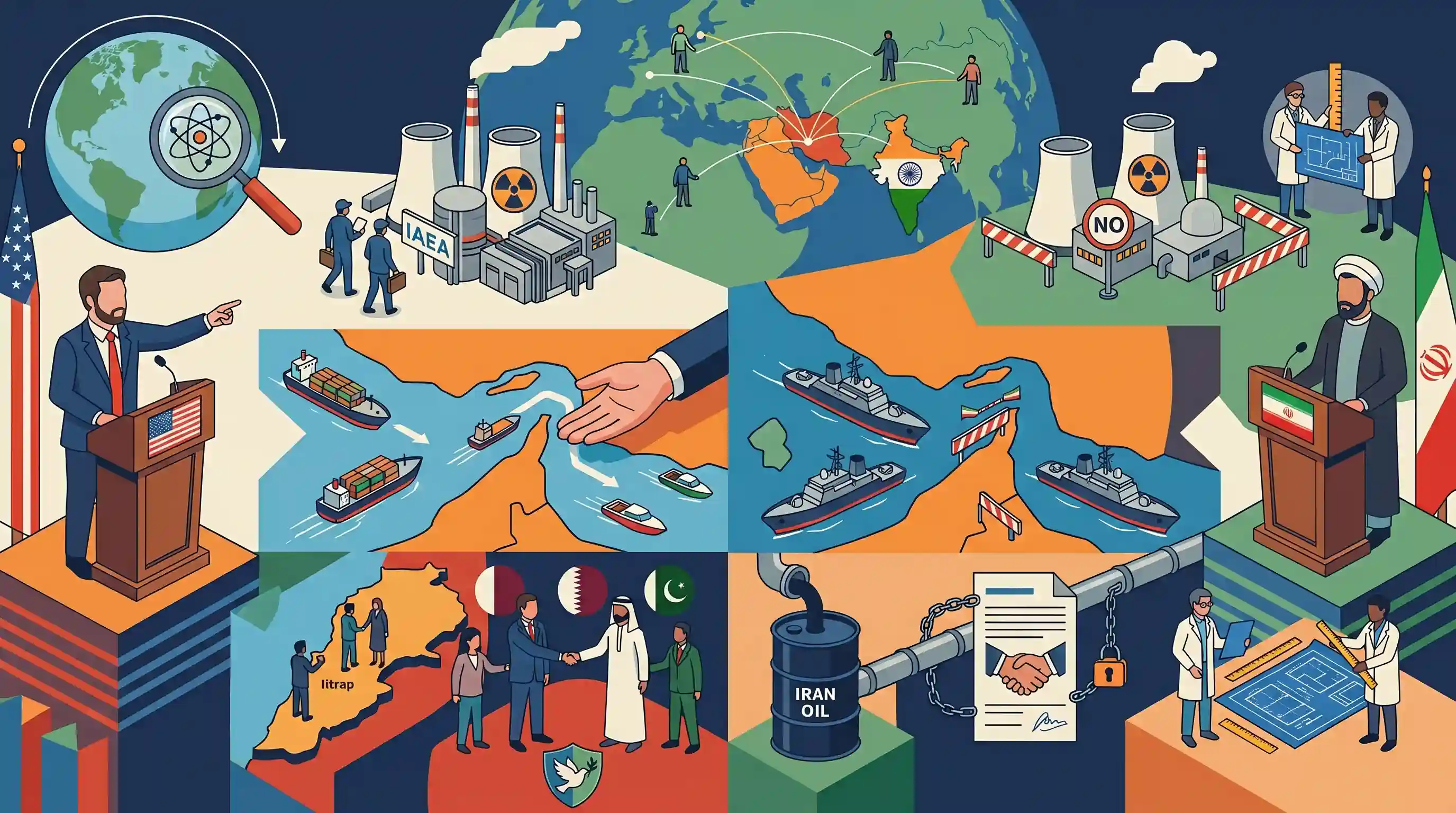
The article discusses the conflicting narratives emerging from the first full day of US-Iran talks in Switzerland. US Vice President JD Vance claimed several breakthroughs, including Iran's commitment to readmit IAEA nuclear inspectors, a mechanism to keep the Strait of Hormuz open, and the establishment of a Lebanon de-confliction cell facilitated by Qatar and Pakistan. However, Iran firmly denied making any new commitments on nuclear monitoring, and its negotiators maintained that the Strait of Hormuz would stay under Iranian control. Concurrently, the US Treasury temporarily lifted sanctions on Iranian oil following a newly signed MoU, while technical talks are slated to continue.
Key Points
- US Vice President JD Vance claimed Iran agreed to readmit UN (IAEA) nuclear inspectors, establish a mechanism to keep the Strait of Hormuz open, and create a Lebanon de-confliction cell during talks in Switzerland.
- Iran's foreign ministry contradicted these claims, denying any new commitments regarding nuclear monitoring and stating that substantial negotiations have yet to begin.
- Iranian negotiator Mohammad Bagher Ghalibaf asserted that the Strait of Hormuz, a critical global chokepoint for oil, would remain under Iranian management.
- The US Treasury temporarily lifted sanctions on Iranian oil based on a recent Memorandum of Understanding, as diplomatic efforts continue.
Important Terms
Islamabad Memorandum of Understanding (MoU)

A 2026 interim peace framework between the US and Iran, mediated by Pakistan, aiming to halt hostilities, resume nuclear negotiations, and reopen the Strait of Hormuz.
UPSC context
GS Paper II: Bilateral and global agreements affecting India’s strategic autonomy and energy security in West Asia.
International Atomic Energy Agency (IAEA)
The UN-affiliated nuclear watchdog (est. 1957) responsible for verifying that Iran’s nuclear program remains peaceful and complies with non-proliferation safeguards through inspections.
UPSC context
GS Paper II: International institutions; Paper III: Security challenges and nuclear non-proliferation.
Strait of Hormuz
The world’s most critical energy chokepoint between the Persian Gulf and Gulf of Oman, handling approximately one-fifth of global oil and LNG transit.
UPSC context
GS Paper I: Geography; GS Paper III: Energy security and India’s dependence on West Asian crude.
Lebanon de-confliction cell
A 2026 coordination mechanism involving the US, Iran, Lebanon, Qatar, and Pakistan to prevent military escalations between Israel and Hezbollah from derailing broader peace talks.
UPSC context
GS Paper II: Regional geopolitics and the role of mediators like Qatar and Pakistan in conflict resolution.
US Treasury Sanctions (OFAC)
Economic measures used as foreign policy tools; in 2026, the US Treasury issued a 60-day license waiving these to allow Iranian oil exports.
UPSC context
GS Paper II: Effect of policies of developed countries on India’s interests and global energy markets.
Prelims Trap
"The Strait of Hormuz connects the Red Sea to the Gulf of Aden."
Aspirants frequently confuse the Strait of Hormuz (Persian Gulf to Gulf of Oman) with the Bab el-Mandeb strait (Red Sea to Gulf of Aden).
Static Concepts Connected
What are the IAEA Safeguards and the Additional Protocol?
- Safeguards Agreement: Mandatory for NPT non-nuclear-weapon states, allowing the IAEA to verify that declared nuclear facilities are not diverted for military uses.
- Additional Protocol: A voluntary agreement granting the IAEA expanded access to information and undeclared sites, often a major negotiation hurdle in Iran nuclear talks.
What is the strategic geography of the Strait of Hormuz?
- Location: A narrow maritime chokepoint between Iran and Oman, connecting the Persian Gulf to the Gulf of Oman and the Arabian Sea.
- Energy Transit: Handles roughly 20% of global petroleum liquids. Any disruption directly impacts global oil prices and India's macro-economic energy security.
Cross-Topic Patterns
US sanctions & India's energy basket
Temporary lifting of US sanctions on Iranian oil could allow India to resume cheap crude imports, diversifying its energy sourcing away from heavy reliance on Russian supplies.
Qatar's rise in mediation diplomacy
Qatar facilitating the Lebanon de-confliction cell reinforces its status as the go-to regional mediator, paralleling its earlier roles in US-Taliban and Hamas-Israel negotiations.

Expect a multi-statement Prelims question pairing Middle East chokepoint mapping (Hormuz) with IAEA Additional Protocol provisions.
Linked PYQs · 3
Linked PYQs · 3
- 2025MainsGS2
"Energy security constitutes the dominant kingpin of India's foreign policy, and is linked with India's overarching influence in Middle Eastern countries.” How would you integrate energy security with India's foreign policy trajectories in the coming years?
- 2012MainsGS2
How have the US sanctions against Iran affected India's bilateral relations with Iran?
- 2024PrelimsGS1
Consider the following statements : Statement-I : Sumed pipeline is a strategic route for Persian Gulf oil and natural gas shipments to Europe. Statement-II : Sumed pipeline connects the Red Sea with the Mediterranean Sea. Which one of the following is correct in respect of the above statements?
