US Criticism of West Bank Annexation Vote
Source:The Hindu ↗
Why It Matters
The evolving US-Israel dynamic is critical for understanding the shifting geopolitical landscape in West Asia. It highlights the complexities of achieving the two-state solution and regional peace, affecting global energy markets and India's strategic interests in the Middle East.
Summary
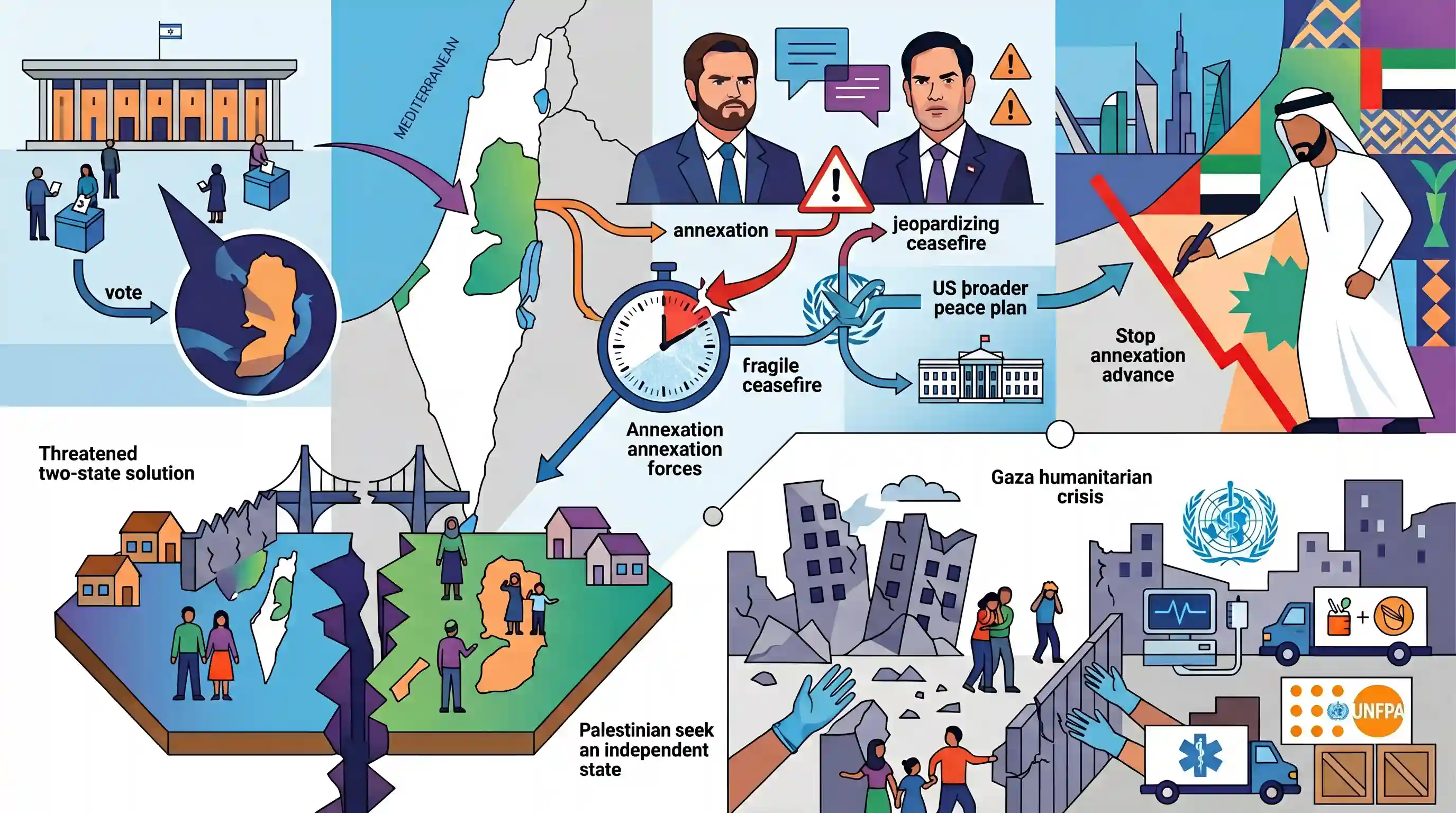
US Vice President JD Vance strongly criticized the Israeli parliament's preliminary vote supporting the annexation of the occupied West Bank, terming it an "insult" that undermines the incoming Trump administration's agenda. Both Vance and Secretary of State Marco Rubio warned that such a move jeopardizes the fragile Israel-Hamas ceasefire in Gaza and contradicts broader US peace efforts. The UAE, an essential regional ally, firmly stated that annexation remains a "red line." The proposed annexation poses a grave threat to the two-state solution, as the Palestinians seek the West Bank for an independent state. Meanwhile, international organizations like WHO and UNFPA continue to struggle to address the catastrophic humanitarian and medical crisis in Gaza.
Key Points
- The Israeli parliament's preliminary vote favoring West Bank annexation drew sharp criticism from US Vice President JD Vance, who called it an 'insult'.
- US Secretary of State Marco Rubio noted that the vote disrupts the Trump administration's policy goals and ongoing efforts to uphold the Israel-Hamas ceasefire in Gaza.
- The UAE, a key regional partner, has declared the annexation of the West Bank a 'red line'.
- Annexation severely threatens the two-state solution, as Palestinians seek the West Bank as a core territory for a future independent state.
- Amidst geopolitical friction, the humanitarian crisis in Gaza continues, with WHO and UNFPA citing severe constraints while executing medical evacuations for critical patients.
Important Terms
Two-State Solution

An internationally proposed peace framework envisioning two independent states—Israel and Palestine—coexisting side-by-side. It is the dominant diplomatic goal for resolving territorial and sovereign disputes in West Asia.
UPSC context
GS-II (International Relations). Tests understanding of India’s long-standing diplomatic stance and regional stability in West Asia.
West Bank
A landlocked territory bordered by Israel and Jordan, currently under Israeli occupation. Palestinians seek to establish their future independent state here, making its status central to peace negotiations.
UPSC context
GS-I (Geography) and GS-II (IR). Tests knowledge of key geopolitical flashpoints and territorial disputes.
Annexation
The formal act of a state claiming sovereignty over a territory it currently occupies. In the West Bank context, this move is widely regarded as illegal under international law.
UPSC context
GS-II (International Relations). Evaluates understanding of international law, sovereignty, and the impact of unilateral actions on global order.
Hamas
A Palestinian Sunni-Islamic militant and political organization. It has been a central party in the conflict with Israel and the subsequent 2025-2026 ceasefire negotiations.
UPSC context
GS-II (International Relations). Concerns non-state actors, regional security, and the challenges of peace-building in conflict zones.
UNFPA
The United Nations Population Fund is a specialized agency focused on reproductive and maternal health. It provides critical services for pregnant women in crisis-hit regions like Gaza.
UPSC context
GS-II (International Organizations). Tests awareness of the humanitarian roles of specialized UN agencies in crisis-hit regions.
World Health Organization (WHO)
The UN’s primary agency for international public health. It coordinates responses to medical crises, monitors disease outbreaks, and works to restore healthcare systems in conflict zones.
UPSC context
GS-II (International Organizations). Tests knowledge of global health governance and institutional responses to humanitarian catastrophes.
Prelims Trap
The United States officially recognizes Israel's annexation and sovereignty over the West Bank.
While the US recognized Israeli sovereignty over the Golan Heights in 2019, it actively opposes West Bank annexation to protect regional normalization deals like the Abraham Accords.
Static Concepts Connected
What is the historical basis of the Two-State Solution?
- UNGA Resolution 181: Adopted in 1947, it originally recommended partitioning Mandatory Palestine into independent Arab and Jewish states, forming the legal bedrock of the two-state paradigm.
- 1967 Borders: The international community generally considers the territorial lines before the 1967 Six-Day War as the baseline for a future Palestinian state.
- Oslo Accords: Signed in the 1990s, these agreements established the Palestinian Authority with limited self-governance in specific areas of the West Bank and Gaza Strip.
What are the key geographical features and boundaries of the West Bank?
- Landlocked Status: It is a landlocked territory in West Asia, meaning it has no direct access to the Mediterranean Sea or Red Sea.
- Borders: It is bordered by Israel to the west, north, and south, and by the nation of Jordan to the east across the Jordan River.
- Dead Sea Coast: Despite being landlocked, the West Bank shares a significant portion of the western coastline of the highly saline Dead Sea.
Cross-Topic Patterns
Annexation threatens India's I2U2 minilateral
The UAE's 'red line' on annexation threatens the Abraham Accords, indirectly paralyzing the I2U2 (India, Israel, UAE, USA) framework which relies heavily on Arab-Israeli economic cooperation.
Geopolitics limiting UN humanitarian mandates
WHO and UNFPA's struggles in Gaza illustrate how UN specialized agencies often lack enforcement mechanisms, remaining strictly subordinate to sovereign and military blockades during active conflicts.

Expect a Prelims 2026 match-the-pair question linking West Asian contested territories (West Bank, Golan Heights, Gaza) with their borders.
Linked PYQs · 3
Linked PYQs · 3
- 2019MainsGS2
‘Too little cash, too much politics, leaves UNESCO fighting for life.’ Discuss the statement in the light of US' withdrawal and its accusation of the cultural body as being 'anti-Israel bias'.
- 2020MainsGS2
Critically examine the role of WHO in providing global health security during the Covid-19 pandemic.
- 2023PrelimsGS1
Consider the following pairs: Regions often mentioned in news Reason for being in news 1. North Kivu and Ituri : War between Armenia and Azerbaijan 2. Nagorno-Karabakh : Insurgency in Mozambique 3. Kherson and Zaporizhzhia : Dispute between Israel and Lebanon How many of the above pairs are correctly matched?
