Constitutional Preamble Values and Roots in Ancient Indian Dharma
Source:The Hindu ↗
Why It Matters
This article is highly relevant for GS-2 (Constitutional features and Preamble) and GS-4 (Ethical foundations, Dharma). It provides excellent fodder for Mains answers regarding the indigenous roots of India's democratic values, offering specific examples from ancient texts (Tirukkural) and historical events. The mention of Keeladi also links to GS-1 (Art and Culture/Ancient History).
Summary
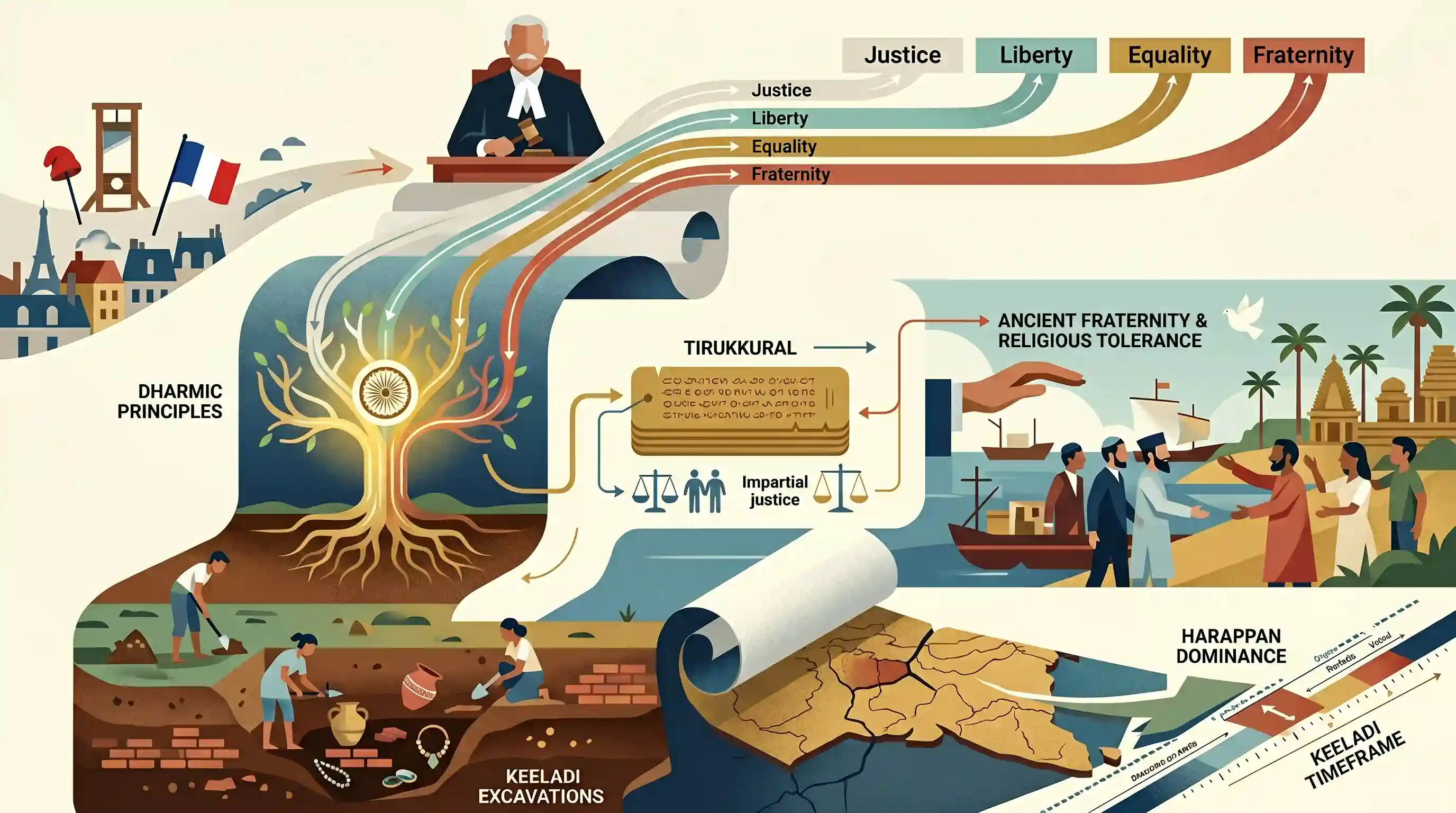
Supreme Court Justice N. Kotiswar Singh has argued that the core values enshrined in the Preamble of the Indian Constitution—justice, liberty, equality, and fraternity—derive from the ancient Indian philosophy of 'dharma', rather than being borrowed from the French Revolution. Speaking at a law university event, he emphasized that dharma signifies a righteous way of life, not religion. He cited the ancient Tamil text Tirukkural as proof of India's long-standing ideals of equality and impartial justice. Additionally, he highlighted India's historical tradition of religious tolerance and fraternity, referencing the refuge given to Jews and Parsis. He also noted that excavations at Keeladi are reshaping understanding of India's ancient history, challenging the primacy of the Harappan civilization.
Key Points
- Supreme Court Justice N. Kotiswar Singh stated that the foundational values of the Constitution's Preamble—justice, liberty, equality, and fraternity—are rooted in the Indian concept of 'dharma' rather than the French Revolution.
- He clarified that 'dharma' is not a religion but represents the right way of leading a righteous life.
- The ancient Tamil text Tirukkural illustrates a 1,000-year-old concept of equality through its advocacy for impartial justice irrespective of a person's class.
- India's historical record of fraternity and liberty is evidenced by Hindu kings permitting Jews to build synagogues, granting refuge to Parsis, and allowing Muslim settlements on the Malabar Coast before the Mughal era.
- Recent archaeological findings at Keeladi have shifted historical perspectives, challenging the long-held belief that the Harappan civilization was the oldest in the subcontinent.
Important Terms
Preamble

The introductory statement of the Indian Constitution that outlines its guiding philosophy, objectives (Justice, Liberty, Equality, Fraternity), and identifies the 'People of India' as the ultimate source of authority.
UPSC context
GS2 (Polity): Essential for understanding the basic structure, core values, and the ideological foundation of the Indian State.
Dharma
An ancient Indian philosophical concept signifying 'righteousness,' universal moral order, and duty. In governance, it represents a secular way of life and ethical conduct rather than narrow religious rituals.
UPSC context
GS4 (Ethics) & GS1 (Culture): Tests the ability to link ancient Indian ethical traditions with modern constitutional and administrative values.
Tirukkural
A classic Tamil text by Saint Thiruvalluvar comprising 1,330 couplets (kurals). It offers a secular and universal framework for ethics (Aram), statecraft (Porul), and personal love (Inbam).
UPSC context
GS1 (History/Culture): A vital source for Sangam-era social history and the study of ancient Indian political and moral philosophy.
Keeladi Excavations
An archaeological site in Tamil Nadu revealing a sophisticated, literate urban settlement (c. 6th century BCE) on the Vaigai river. It provides evidence for the early antiquity and reach of Sangam culture.
UPSC context
GS1 (Ancient History): Pivotal for discussing ancient urbanization, Sangam Age chronology, and potential cultural links between Harappan and South Indian civilizations.
Constitution of India
The supreme law of India that establishes the political framework, fundamental rights, and duties. Modern jurisprudence increasingly explores its historical roots in both Western thought and indigenous philosophy.
UPSC context
GS2 (Polity): Focuses on historical underpinnings, the blend of borrowed features with Indian traditions, and its evolutionary nature.
Supreme Court of India
The highest judicial body in India and the final interpreter of the Constitution. Its judges frequently define the 'spirit of the law' by analyzing historical and cultural contexts.
UPSC context
GS2 (Polity): Tests knowledge of the judiciary's role in constitutional interpretation and the protection of the document's basic structure.
Prelims Trap
"The Preamble ideals of Liberty, Equality and Fraternity were formally borrowed from ancient texts like the Tirukkural."
Formally, these ideals were inspired by the French Revolution. The judge highlights their philosophical resonance with 'Dharma', not the historical drafting source of the text.
Static Concepts Connected
What is the historical context and structure of the Tirukkural?
- Authorship: Authored by poet-philosopher Thiruvalluvar, it is a prominent secular Tamil classic belonging to the post-Sangam literature (Pathinenkilkanakku).
- Tripartite Structure: The text is structurally divided into three books: Aram (virtue/ethics), Porul (wealth/polity), and Inbam (love).
- Significance: It provides early indigenous evidence of ideals like impartial justice and social equality, remaining entirely free from religious dogma.
What are the key archaeological findings at Keeladi?
- Location: An advanced urban settlement situated along the banks of the Vaigai river in Tamil Nadu.
- Chronological shift: Carbon dating pushes the Sangam Age back to 800 BCE, revealing urbanization in the South that was contemporaneous with the Gangetic plains.
- Artifacts found: Yielded Tamil-Brahmi script, brick structures, and weaving tools, but notably lacks religious idols, suggesting a secular, industrialized society.
Cross-Topic Patterns
Dharma & Constitutional Morality
The philosophical debate on Western vs. Indian roots of constitutionalism directly bridges GS-2 (Constitutional features) and GS-4 (Ethics of public administration).
Ancient origins of Secular Fraternity
The historical accommodation of Jews, Parsis in Sanjan, and early Muslims on the Malabar coast provides powerful GS-1 Mains examples of India's enduring syncretic culture.

Expect a GS-2/GS-4 Mains question evaluating the indigenous roots of Constitutional Morality against Western philosophical borrowings.
Linked PYQs · 5
Linked PYQs · 5
- 2023MainsGS2
“The Constitution of India is a living instrument with capabilities of enormous dynamism. It is a constitution made for a progressive society.” Illustrate with special reference to the expanding horizons of the right to life and personal liberty.
- 2024MainsGS4
“Ethics encompasses several key dimensions that are crucial in guiding individuals and organizations towards morally responsible behaviour.” Explain the key dimensions of ethics that influence human actions. Discuss how these dimensions shape ethical decision-making in the professional context.
- 2021MainsGS1
How does Indian society maintain continuity in traditional social values ? Enumerate the changes taking place in it.
- 2017PrelimsGS1
The mind of the makers of the Constitution of India is reflected in which of the following?
- 2013PrelimsGS1
‘Economic Justice’ as one of the objectives of the Indian Constitution has been provided in
