Jain Philosophy and Environmental Ethics in Modern Governance
Source:The Hindu ↗
Why It Matters
Provides a contemporary application of ancient Jain philosophy to modern global issues (useful for GS1 and GS4), while highlighting the recent recognition of Pali and Prakrit as classical languages.
Summary
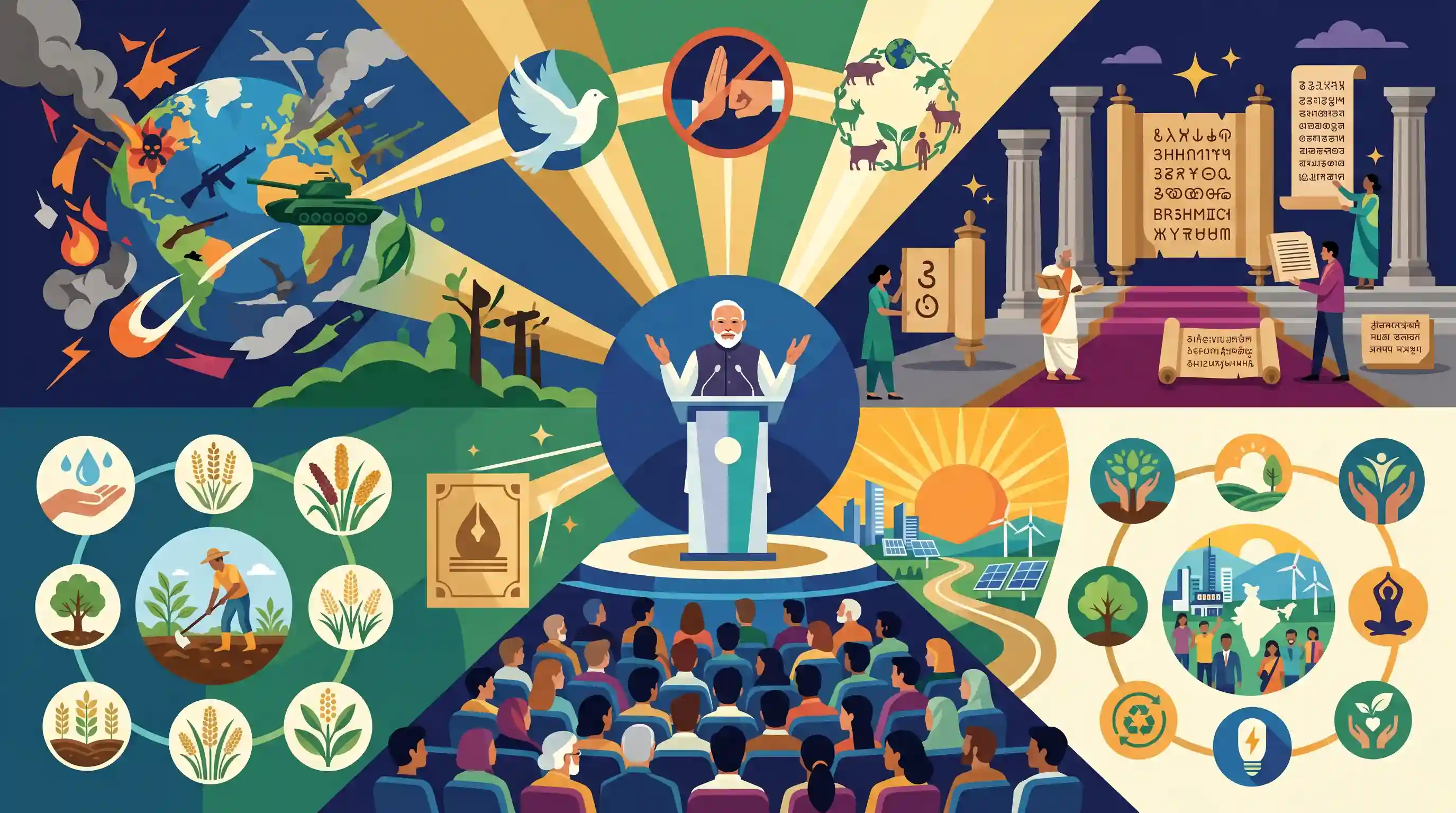
During the 'Navkar Mahamantra Divas' programme, Prime Minister Narendra Modi underscored the enduring relevance of Jainism in addressing contemporary global crises such as terrorism, war, and environmental degradation. Emphasizing Jain principles of non-violence and the interdependence of all living beings, he highlighted how these values provide a robust ethical framework for global peace and ecological conservation. The PM also noted the government's commitment to preserving Jain heritage, notably through the recent elevation of Pali and Prakrit to classical languages. Connecting ancient wisdom to the modern goal of 'Viksit Bharat', he appealed to citizens to embrace nine lifestyle pledges—including water conservation, natural farming, and millet consumption—to foster personal and national well-being.
Key Points
- PM Narendra Modi highlighted the relevance of Jain values, such as non-violence and self-purification, in solving modern global challenges during the 'Navkar Mahamantra Divas' event.
- Jainism's core belief in the interdependence of all life provides a strong philosophical and ethical foundation for peace, harmony, and environmental protection.
- The central government is actively working to preserve Jain literary heritage, recently granting classical language status to Pali and Prakrit.
- The PM connected the philosophy of the Navkar Mantra to the 'Viksit Bharat' vision, emphasizing the need to balance developmental progress with cultural roots.
- Citizens were urged to adopt nine pledges, including practicing natural farming, consuming millets, saving water, and supporting 'vocal for local' initiatives.
Important Terms
Viksit Bharat

The Indian government's vision to transform the country into a developed nation by 2047, the centenary of independence, focusing on economic growth, social progress, and global leadership.
UPSC context
Relevant for GS Paper III (Economy) and GS Paper II (Governance) regarding long-term planning and national development goals.
Classical Languages
A prestigious status granted to Indian languages with high antiquity (1500-2000 years), original literary tradition, and distinctiveness; recently expanded to include Marathi, Pali, Prakrit, Assamese, and Bengali.
UPSC context
Important for GS Paper I (Indian Culture) regarding linguistic heritage and the recent 2024 Cabinet expansion.
Prakrit
A group of ancient Indo-Aryan vernacular languages that served as the primary medium for Jain canonical texts and Ashokan inscriptions; recently designated as a Classical Language.
UPSC context
Tests knowledge of Ancient History and Cultural Heritage under GS Paper I.
Pali
An ancient Middle Indo-Aryan language primarily known as the liturgical language of Theravada Buddhism, recently elevated to Classical Language status by the Union Cabinet in 2024.
UPSC context
Crucial for GS Paper I, focusing on Buddhist literature and India's ancient linguistic history.
Ahimsa
The principle of non-violence and non-injury toward all living beings, serving as the foundational ethical doctrine in Jainism and a tool for modern conflict resolution.
UPSC context
Key concept for GS Paper IV (Ethics) and GS Paper I (Indian Heritage) regarding philosophical solutions to global crises.
Mission LiFE
An India-led global movement (Lifestyle for Environment) promoting mindful and deliberate utilization instead of mindless consumption to protect the environment and combat climate change.
UPSC context
Highly relevant for GS Paper III (Environment) and GS Paper IV (Environmental Ethics).
Navkar Mahamantra
The most fundamental mantra of Jainism that offers veneration to the five supreme beings (Pancha-Paramesthi), emphasizing spiritual humility, equanimity, and universal welfare rather than specific boons.
UPSC context
Tests understanding of Indian spiritual traditions and religious philosophy under GS Paper I.
Prelims Trap
India currently has 6 recognized classical languages, and the status is conferred by the Sahitya Akademi.
Classical language status is granted by the Ministry of Culture, not Sahitya Akademi. Furthermore, the Union Cabinet expanded the list to 11 in late 2024, adding Pali, Prakrit, Marathi, Bengali, and Assamese.
Static Concepts Connected
What are the foundational philosophical concepts of Jainism?
- Anekantavada: The doctrine of many-sidedness, asserting that ultimate truth and reality is complex and has multiple aspects.
- Syadvada: The theory of conditioned predication; it states that all judgments are conditional, holding good only in certain conditions.
- Ahimsa and Aparigraha: The principles of absolute non-violence and non-possessiveness, emphasizing minimal harm to all life and limiting material desires.
What are the criteria for granting Classical Language status in India?
- High Antiquity: The language must have early texts or recorded history spanning a period of 1500 to 2000 years.
- Valuable Heritage: It must possess a body of ancient literature or texts considered a valuable heritage by generations of speakers.
- Original Tradition: The literary tradition must be original and not borrowed from another speech community.
Cross-Topic Patterns
Jain ethics fueling the LiFE movement
The PM's 9 lifestyle pledges align directly with the 'Lifestyle for Environment' (LiFE) initiative, linking ancient Jain 'Aparigraha' (non-possession) to modern sustainable consumption and climate action.
Linguistic heritage integration under NEP 2020
The elevation of Pali and Prakrit ties into the National Education Policy 2020's push to integrate ancient Indian knowledge systems and classical languages into contemporary education.

Expect a Prelims question matching Jain texts/philosophies to their newly recognized classical languages (Prakrit/Pali) or core tenets.
Linked PYQs · 4
Linked PYQs · 4
- 2023PrelimsGS1
"Souls are not only the property of animal and plant life, but also of rocks, running water and many other natural objects not looked on as living by other religious sects." The above statement reflects one of the core beliefs of which one of the following religious sects of ancient India?
- 2022PrelimsGS1
With reference to Indian history, consider the following texts : 1. Nettipakarana 2. Parishishtaparvan 3. Avadanashataka 4. Trishashtilakshana Mahapurana Which of the above are Jaina texts?
- 2015MainsGS4
What is meant by 'environmental ethics'? Why is it important to study? Discuss any one environmental issue from the viewpoint of environmental ethics.
- 2024MainsGS3
Explain the role of millets for ensuring health and nutritional security in India.
