Telangana Mobile Migration Resource Centres for Climate Distress
Source:The Hindu ↗
Why It Matters
The article provides a practical, real-world example of governance addressing the intersection of climate change, agricultural distress, and labor migration. It is highly relevant for GS1 (Migration trends), GS2 (Welfare schemes for vulnerable sections, role of international bodies), and GS3 (Climate resilience in agriculture).
Summary
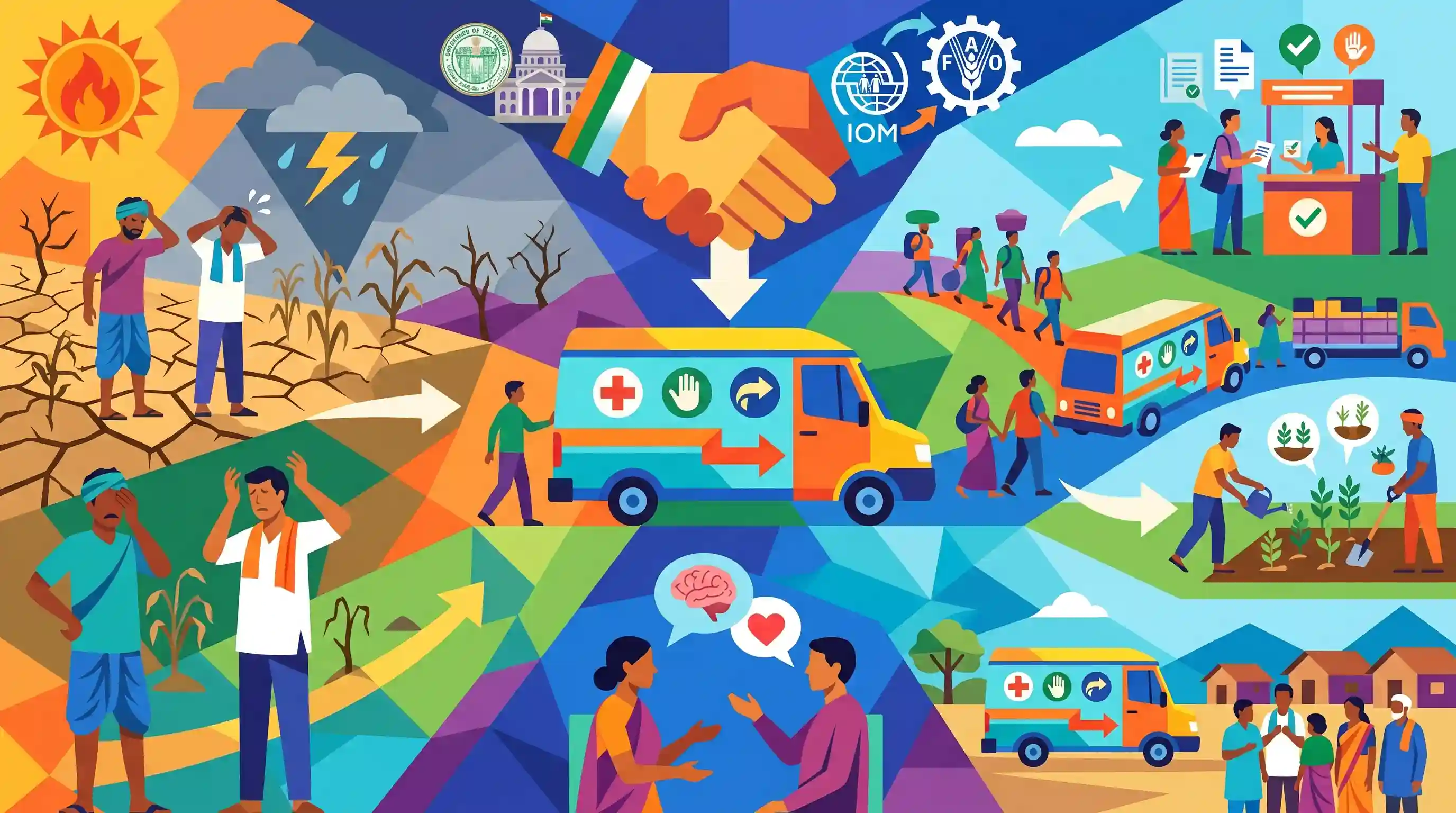
The Telangana government, in collaboration with the International Organisation for Migration (IOM) and the Food and Agriculture Organisation (FAO), has launched 'Valasa Sahaya Kendram' — a Mobile Migration Resource Centre (m-MRC). Rolled out in Nizamabad and Narayanpet districts, the initiative assists rural households driven to migrate due to climate change and agricultural distress. It offers comprehensive migration support before, during, and after return, including psycho-social counselling. The scheme highlights a decentralized approach to building climate resilience and protecting vulnerable migrant laborers through last-mile outreach.
Key Points
- Telangana has launched 'Valasa Sahaya Kendram', a Mobile Migration Resource Centre (m-MRC) in Nizamabad and Narayanpet districts.
- The initiative is a joint program by the International Organisation for Migration (IOM) and the UN Food and Agriculture Organisation (FAO).
- It is designed to support vulnerable rural populations forced into internal or international migration due to climate change and agricultural instability.
- The centres will provide end-to-end migration support services, including decision-making assistance, psycho-social counselling, and post-return reintegration.
- The m-MRC model aims for 'last mile' outreach to enhance the climate resilience of rural households and ensure sustainable livelihoods for migrant workers.
Important Terms
Valasa Sahaya Kendram

A mobile help center for migrants in Telangana, launched with IOM and FAO support. It provides end-to-end assistance—pre-migration, during, and post-return—for rural households facing climate and agricultural distress.
UPSC context
GS Paper II: Welfare schemes for vulnerable sections; regional innovations for labor migration and rural distress.
Mobile Migration Resource Centre (m-MRC)
A decentralized service model (m-MRC) using mobile units to reach remote rural households. It provides migration counseling, information on rights, and links vulnerable populations to formal government welfare systems.
UPSC context
GS Paper II: Governance and Social Justice; tests last-mile delivery mechanisms for social security and labor protection.
International Organisation for Migration (IOM)
The leading UN-related intergovernmental organization promoting humane and orderly migration. It advises governments on policy, protects migrant rights, and produces the annual 'World Migration Report'.
UPSC context
GS Paper II: International Institutions; important for global migration governance and humanitarian response frameworks.
Food and Agriculture Organisation (FAO)
A specialized UN agency (HQ: Rome) focused on defeating hunger and ensuring food security. It supports climate-adaptive agriculture and rural resilience to reduce distress-driven migration in agrarian communities.
UPSC context
GS Paper II: International Agencies; relevant for food security, rural development, and SDG 2.
Climate-induced Migration
The movement of people forced to leave their homes due to sudden or gradual environmental changes. It is often described as 'climate-augmented migration' when environmental stress compounds existing economic vulnerabilities.
UPSC context
GS Paper III: Environment and GS Paper I: Social Issues; tests human-impact dimensions of climate change.
Prelims Trap
Valasa Sahaya Kendram is a central sector scheme launched by the Ministry of Labour.
It is a state-level initiative by the Telangana government in collaboration with UN agencies, not a central government or Ministry of Labour scheme.
Static Concepts Connected
What is the mandate and status of the International Organization for Migration (IOM)?
- UN Status: Originally established in 1951, it officially became a 'related organization' of the United Nations in 2016.
- Core Mandate: Works to help ensure the orderly and humane management of migration, providing humanitarian assistance to migrants in need.
- Key Publication: Publishes the flagship 'World Migration Report' every two years detailing global demographic shifts.
How is climate-induced displacement treated under international frameworks?
- Push Factor: Environmental degradation and erratic weather force agricultural communities into survival migration, acting as a major 'push factor'.
- Legal Gap: Unlike political refugees, 'climate refugees' are currently not formally recognized or protected under the 1951 UN Refugee Convention.
- Global Compact: The Global Compact for Migration (2018) acknowledges climate change as a driver of migration, though it is non-binding.
Cross-Topic Patterns
Sub-national diplomacy & UN partnerships
State governments (like Telangana with IOM/FAO or Odisha with WFP) are increasingly partnering directly with global multilateral agencies to localize SDG and climate adaptation programs.
Climate Change as a Demographic Driver
Links GS3 (Climate Impact on Agriculture) to GS1 (Society/Migration), demonstrating how environmental degradation acts as a primary 'push factor' for rural-to-urban and international distress migration.

Climate-induced migration push factors linked with IOM's World Migration Report will likely feature in Prelims 2026 as a combined MSQ.
Linked PYQs · 4
Linked PYQs · 4
- 2024MainsGS1
Why do large cities tend to attract more migrants than smaller towns? Discuss in the light of conditions in developing countries.
- 2015MainsGS1
Discuss the changes in the trends of labour migration within and outside India in the last four decades.
- 2012MainsGS1
Keeping in view the informal sector's share in the total workforce of the country, critically examine the relevant inclusive measures initiated by the Government of India and their effectiveness.
- 2017MainsGS3
'Climate change' is a global problem. How India will be affected by climate change? How Himalayan and coastal states of India will be affected by climate change?
