Consumer Dispute Redressal Commissions and Pendency Report
Source:The Hindu ↗
Why It Matters
Provides concrete data and recent Supreme Court intervention (Article 142) on the functional collapse of quasi-judicial bodies. Essential for Mains GS-2 answers evaluating the efficacy of tribunals, the Consumer Protection Act of 2019, judicial pendency, and alternate dispute resolution (ADR) mechanisms.
Summary
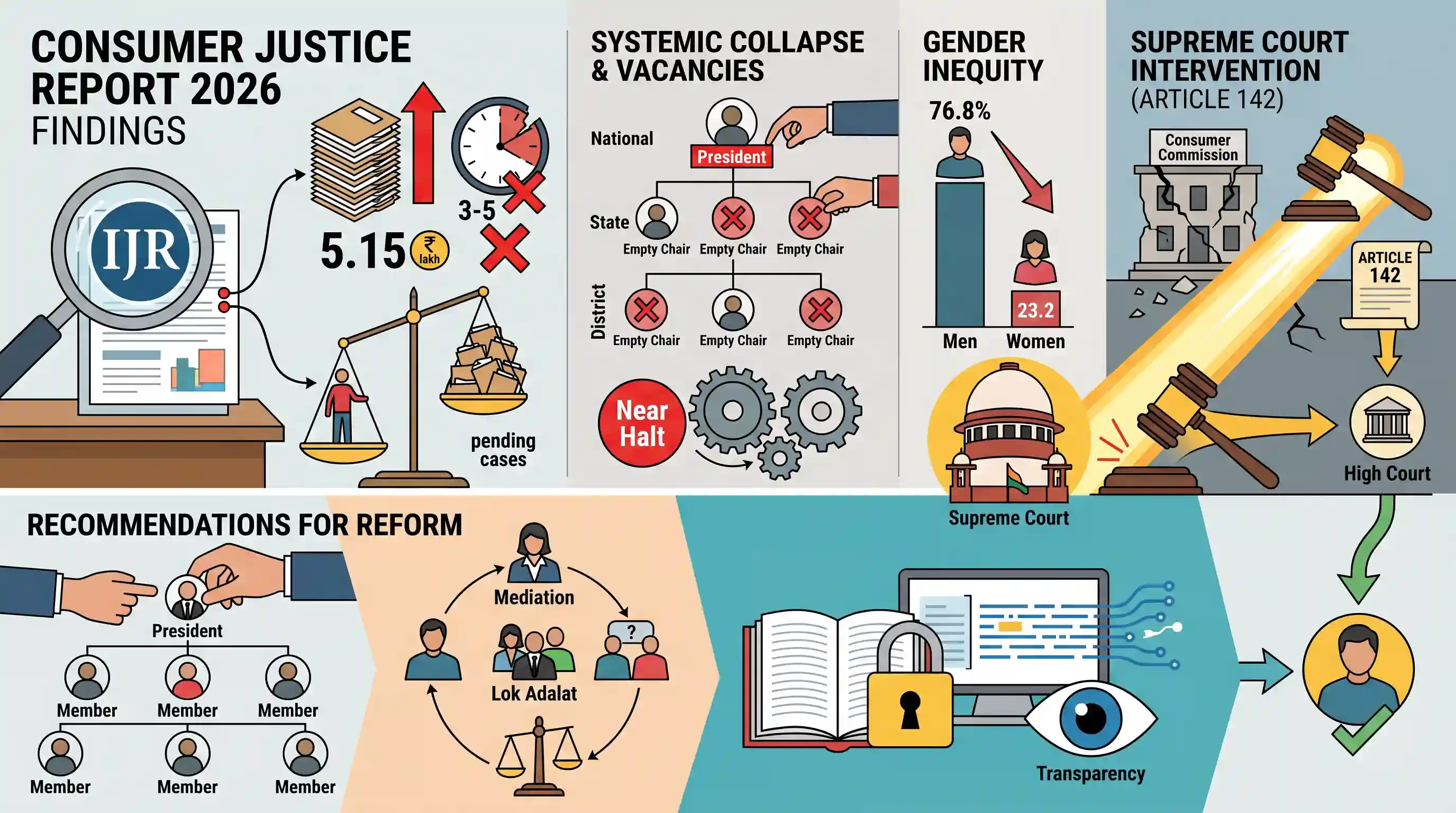
The 'Consumer Justice Report 2026', released by the India Justice Report (IJR), exposes critical weaknesses in India's consumer dispute redressal system, including soaring pendency, massive vacancies, and poor transparency. Case pendency jumped by 21% post-2020 to over 5.15 lakh, severely violating the 3-5 month disposal timeline set by the Consumer Protection Act, 2019. About half of state commissions and a third of district commissions lack a president, bringing grievance resolution to a near halt. Women's representation in these tribunals also fell sharply to 23.2%. Acknowledging the systemic collapse, the Supreme Court invoked Article 142 in early 2026, granting High Courts the authority to hear consumer appeals directly where commissions are defunct. The report underscores the dire need to fill vacancies, enhance Alternative Dispute Resolution (ADR), and mandate greater administrative transparency.
Key Points
- The Consumer Justice Report 2026 highlights a 21% rise in consumer case pendencies between 2020 and 2024, surpassing 5.15 lakh cases.
- Statutory timelines mandated by the Consumer Protection Act, 2019 (3-5 months for disposal) are systematically breached.
- Nearly 50% of State Consumer Disputes Redressal Commissions (SCDRCs) and 33% of district commissions operate without a president, with 40% of member posts remaining vacant.
- Representation of women in consumer forums dropped significantly from 35% in 2021 to 23.2% in 2024.
- In response to the crisis, the Supreme Court invoked Article 142 in February 2026 to allow High Courts to hear consumer appeals in states lacking functional commissions.
- The report highlighted widespread non-transparency, with many commissions refusing to disclose infrastructure or budgetary data via RTI.
Important Terms
Consumer Protection Act, 2019

Comprehensive legislation replacing the 1986 Act; it established the Central Consumer Protection Authority (CCPA), introduced product liability, e-commerce rules, and mandates a 3-5 month case disposal timeline.
UPSC context
GS Paper 2: Statutory/quasi-judicial bodies. Tests knowledge of consumer rights, legislative evolution, and administrative efficiency.
Article 142 of the Constitution of India
Constitutional provision granting the Supreme Court plenary power to pass any decree or order necessary for doing 'complete justice' in any matter pending before it.
UPSC context
GS Paper 2: Judiciary. Focuses on judicial activism, extraordinary powers of the Supreme Court, and separation of powers.
India Justice Report (IJR)
A quantitative tool ranking Indian states on their capacity to deliver justice across four pillars: Police, Prisons, Judiciary, and Legal Aid, emphasizing systemic gaps and reforms.
UPSC context
GS Paper 2: Important aspects of governance. Useful for data-driven arguments on judicial pendency and administrative accountability.
State Consumer Disputes Redressal Commissions (SCDRCs)
Intermediate quasi-judicial bodies established at the state level to adjudicate consumer disputes (claims between ₹50 lakh and ₹2 crore) and hear appeals from District Commissions.
UPSC context
GS Paper 2: Dispute redressal mechanisms. Critical for understanding tribunal functioning and the impact of administrative vacancies.
Alternative Dispute Resolution (ADR)
Methods like mediation and arbitration used to resolve disputes outside traditional courtrooms; the 2019 Act specifically integrates mediation to reduce the burden on consumer commissions.
UPSC context
GS Paper 2: Dispute redressal institutions. Tests knowledge of non-adversarial justice and reducing judicial backlog.
High Courts
Constitutional courts (Articles 214–231) with original, appellate, and writ jurisdiction; they exercise judicial superintendence over subordinate courts and tribunals within their territorial limits.
UPSC context
GS Paper 2: Structure and functioning of the Judiciary. Relevant for judicial review and the 'Basic Structure' doctrine.
Prelims Trap
Under the Consumer Protection Act 2019, appeals from State Consumer Commissions lie directly to the High Court.
Under CPA 2019, state appeals go to the National Commission (NCDRC), not High Courts. The High Court route was an extraordinary, temporary measure created via SC's Article 142 powers.
Static Concepts Connected
What is the hierarchy and pecuniary jurisdiction under the CPA 2019?
- District Commission: Handles consumer complaints where the value of goods or services paid as consideration does not exceed Rs. 50 lakh (revised in 2021).
- State Commission: Adjudicates claims where the value exceeds Rs. 50 lakh but does not exceed Rs. 2 crore.
- National Commission: Has jurisdiction over consumer complaints where the value of consideration paid exceeds Rs. 2 crore.
- Statutory Timelines: The Act mandates case disposal within 3 months if no analysis is required, and 5 months if goods require testing.
What is the scope of Article 142 of the Indian Constitution?
- Complete Justice: Allows the Supreme Court to pass any decree or order necessary for doing "complete justice" in any pending cause or matter.
- Statutory Supplement: It can supplement ordinary laws to bridge legal gaps and provide extraordinary relief, though it cannot outrightly ignore statutory law or fundamental rights.
- Judicial Intervention: Often used to overcome institutional paralysis, such as clearing the Bhopal gas tragedy settlement or bypassing defunct consumer tribunals to allow High Court appeals.
Cross-Topic Patterns
Tribunalization paradox and pendency
Tribunals were created to reduce judicial burden, but massive vacancies in bodies like consumer commissions and NCLT are forcing cases back to constitutional courts, defeating their core purpose.
Gender disparity in quasi-judicial bodies
The sharp decline in women's representation in consumer forums to 23.2% provides a stark data point for Mains answers on gender diversity in India's legal and administrative institutions.

Expect a Prelims question mixing CPA 2019's pecuniary limits with the Supreme Court's use of Article 142 to bypass defunct tribunals.
Linked PYQs · 3
Linked PYQs · 3
- 2016MainsGS2
What is a quasi-judicial body? Explain with the help of concrete examples.
- 2019MainsGS2
“The Central Administrative Tribunal which was established for redressal of grievances and complaints by or against central government employees, nowadays is exercising its powers as an independent judicial authority.” Explain.
- 2024MainsGS2
Explain and distinguish between Lok Adalats and Arbitration Tribunals. Whether they entertain civil as well as criminal cases ?
