ISRO Cryogenic Propulsion and Rocket Technology
Source:The Hindu ↗
Why It Matters
UPSC frequently tests the achievements of Indian scientists and advancements in space technology (GS3). Understanding the development of cryogenic and semi-cryogenic engines and their applications in launch vehicles like LVM3 is essential for both Prelims and Mains (Space Technology).
Summary
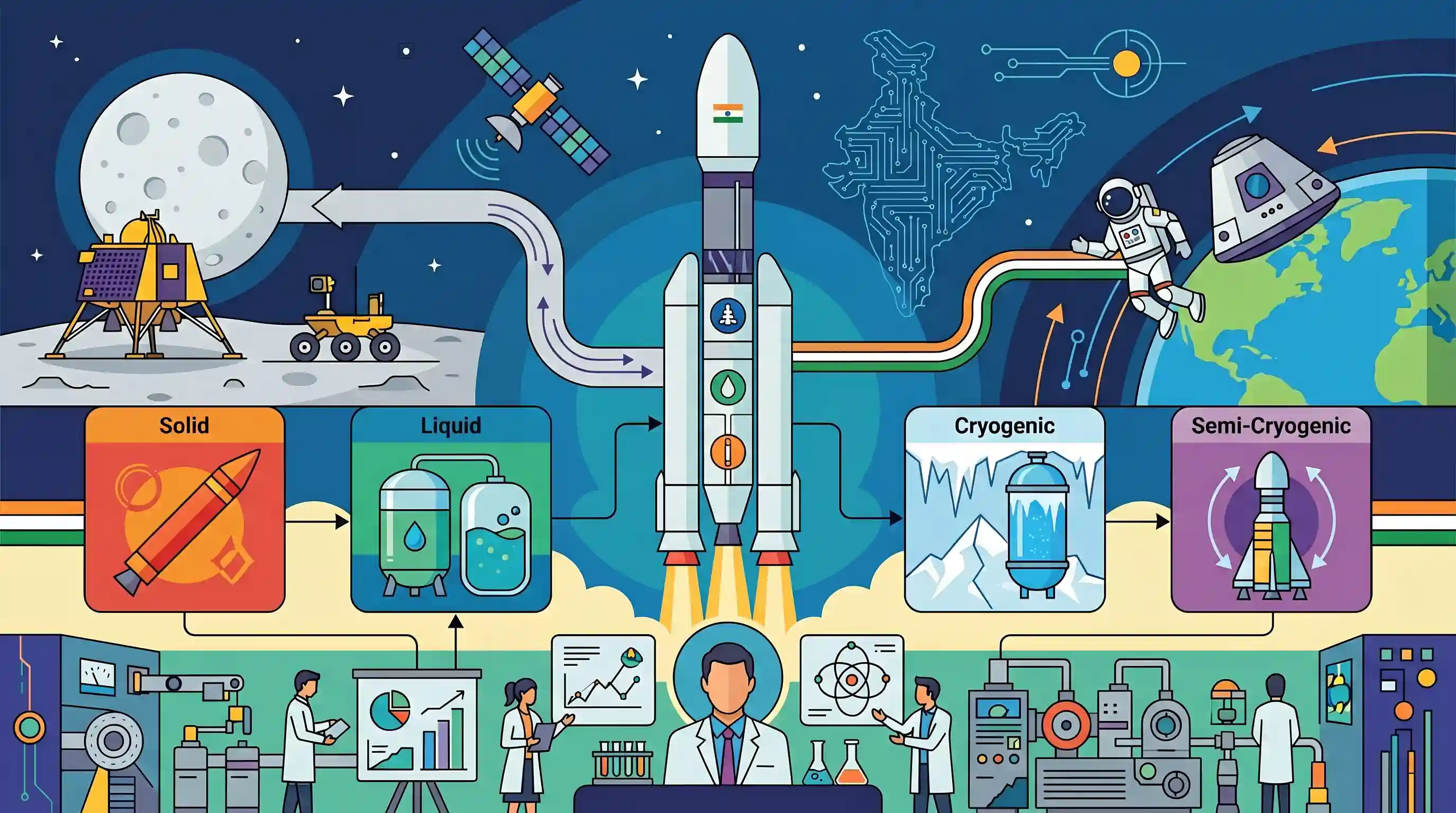
The article profiles V. Narayanan, an eminent Indian space scientist and Director of ISRO's Liquid Propulsion Systems Centre (LPSC). Known as an expert in rocket propulsion, he has played a pivotal role in the research and development of solid, liquid, cryogenic, and semi-cryogenic engines. These advanced propulsion technologies power ISRO's flagship launch vehicles like the PSLV, GSLV, and LVM3, and serve as the backbone for high-profile national space missions such as Chandrayaan and the Gaganyaan human spaceflight programme.
Key Points
- V. Narayanan is an eminent space scientist and the Director of ISRO's Liquid Propulsion Systems Centre (LPSC).
- He has extensive expertise in developing solid, liquid, cryogenic, and semi-cryogenic rocket propulsion systems.
- His leadership and technological contributions have been instrumental to the success of India's workhorse and heavy-lift launch vehicles, including the PSLV, GSLV, and LVM3 (GSLV Mk-III).
- The advanced propulsion systems developed by his team are crucial to the success of India's major space exploration endeavours, including the Chandrayaan lunar missions and the upcoming Gaganyaan human spaceflight programme.
Important Terms
Gaganyaan

India’s first human spaceflight mission aiming to send a three-member crew to a 400 km Low Earth Orbit for three days and bring them safely back to Earth.
UPSC context
GS Paper III (Space Tech); tests indigenous human-rated launch capabilities and India's global standing in crewed missions.
Cryogenic Engine
A rocket engine using liquefied gases stored at extremely low temperatures—typically liquid hydrogen (fuel) and liquid oxygen (oxidizer)—for high efficiency in upper stages of rockets.
UPSC context
GS Paper III (Science & Tech); crucial for understanding heavy-lift rocket propulsion and indigenization of complex technology.
Semi-cryogenic Engine
An advanced propulsion system using liquid oxygen and refined kerosene (ISROSENE), offering higher thrust and denser fuel storage than full cryogenic engines for booster stages.
UPSC context
GS Paper III (Indigenization of Technology); essential for increasing LVM3 payload capacity and future heavy-lift missions.
LVM3 (Launch Vehicle Mark-III)
ISRO’s heaviest three-stage launch vehicle, formerly known as GSLV Mk III, designed to carry heavy satellites to orbit and power flagship missions like Gaganyaan.
UPSC context
GS Paper III (Space Tech); signifies India’s self-reliance in heavy-lift capabilities and entry into the global commercial market.
Liquid Propulsion Systems Centre (LPSC)
A premier ISRO center specializing in the design and development of liquid, cryogenic, and semi-cryogenic propulsion systems for India’s launch vehicles and spacecraft.
UPSC context
GS Paper III (Indian Scientists/Institutions); central to the development of the "backbone" engines for Indian space missions.
Chandrayaan
India’s series of lunar exploration missions, notably including Chandrayaan-3, which achieved the first-ever successful soft landing near the lunar South Pole in August 2023.
UPSC context
GS Paper III (Space Exploration); demonstrates India’s leadership in cost-effective, high-success interplanetary exploration.
Prelims Trap
Semi-cryogenic engines operate without any cryogenic fluids, utilizing ambient-temperature propellants exclusively.
This is a trap. While the fuel (refined space-grade kerosene/Isrosene) is stored at ambient temperatures, the oxidizer (Liquid Oxygen) still requires storage at cryogenic temperatures (-183°C).
Static Concepts Connected
What is the difference between Cryogenic and Semi-cryogenic engines?
- Fuel (Cryogenic): Uses liquid hydrogen (LH2) at -253°C, which is highly volatile, expensive, and requires complex storage mechanisms.
- Fuel (Semi-cryo): Uses refined space-grade kerosene (Isrosene/RP-1) at room temperature, drastically reducing storage complexity, toxicity, and cost.
- The Oxidizer: Both engine types utilize liquid oxygen (LOX) at -183°C as the oxidizing agent.
What are the three stages of Launch Vehicle Mark-3 (LVM3)?
- Solid Strap-ons (S200): Two solid rocket boosters that provide the massive initial thrust required at lift-off.
- Liquid Core (L110): Powered by twin Vikas engines utilizing earth-storable liquid propellants. (ISRO plans to replace this with a semi-cryo stage).
- Cryogenic Upper (C25): Powered by the indigenous CE20 engine, providing high efficiency for final orbital insertion of heavy payloads.
Cross-Topic Patterns
Propulsion tech & Private Space Sector
ISRO's mastery in semi-cryogenic engines at LPSC sets the foundation for tech transfers via IN-SPACe, directly enabling private aerospace startups like Agnikul to develop 3D-printed semi-cryo engines.
Gaganyaan & Human-Rating standards
The CE20 cryogenic engine's recent "human-rating" links technical propulsion physics to the ultra-strict safety and redundancy parameters legally and ethically required for Gaganyaan's crewed spaceflight.

Expect a 2026 multi-statement Prelims question comparing Cryogenic (LH2/LOX) and Semi-cryogenic (Kerosene/LOX) fuel properties.
Linked PYQs · 4
Linked PYQs · 4
- 2018PrelimsGS1
With reference to India's satellite launch vehicles, consider the following statements: 1. PSLVs launch the satellites useful for Earth resources monitoring whereas GSLVs are designed mainly to launch communication satellites. 2. Satellites launched by PSLV appear to remain permanently fixed in the same position in the sky, as viewed from a particular location on Earth. 3. GSLV Mk III is a four-staged launch vehicle with the first and third stages using solid rocket motors; and the second and fourth stages using liquid rocket engines. Which of the statements given above is/are correct?
- 2016MainsGS3
Discuss India's achievements in the field of Space Science and Technology. How the application of this technology has helped India in its socio-economic development?
- 2017MainsGS3
India has achieved remarkable successes in unmanned space missions including the Chandrayaan and Mars Orbitter Mission, but has not ventured into manned space missions. What are the main obstacles to launching a manned space mission, both in terms of technology and logistics? Examine critically.
- 2023MainsGS3
What is the main task of India's third moon mission which could not be achieved in its earlier mission? List the countries that have achieved this task. Introduce the subsystems in the spacecraft launched and explain the role of the Virtual Launch Control Centre' at the Vikram Sarabhai Space Centre which contributed to the successful launch from Sriharikota.
