Himalayan Ecology Vulnerability and Climate Disaster Management
Source:Indian Express ↗
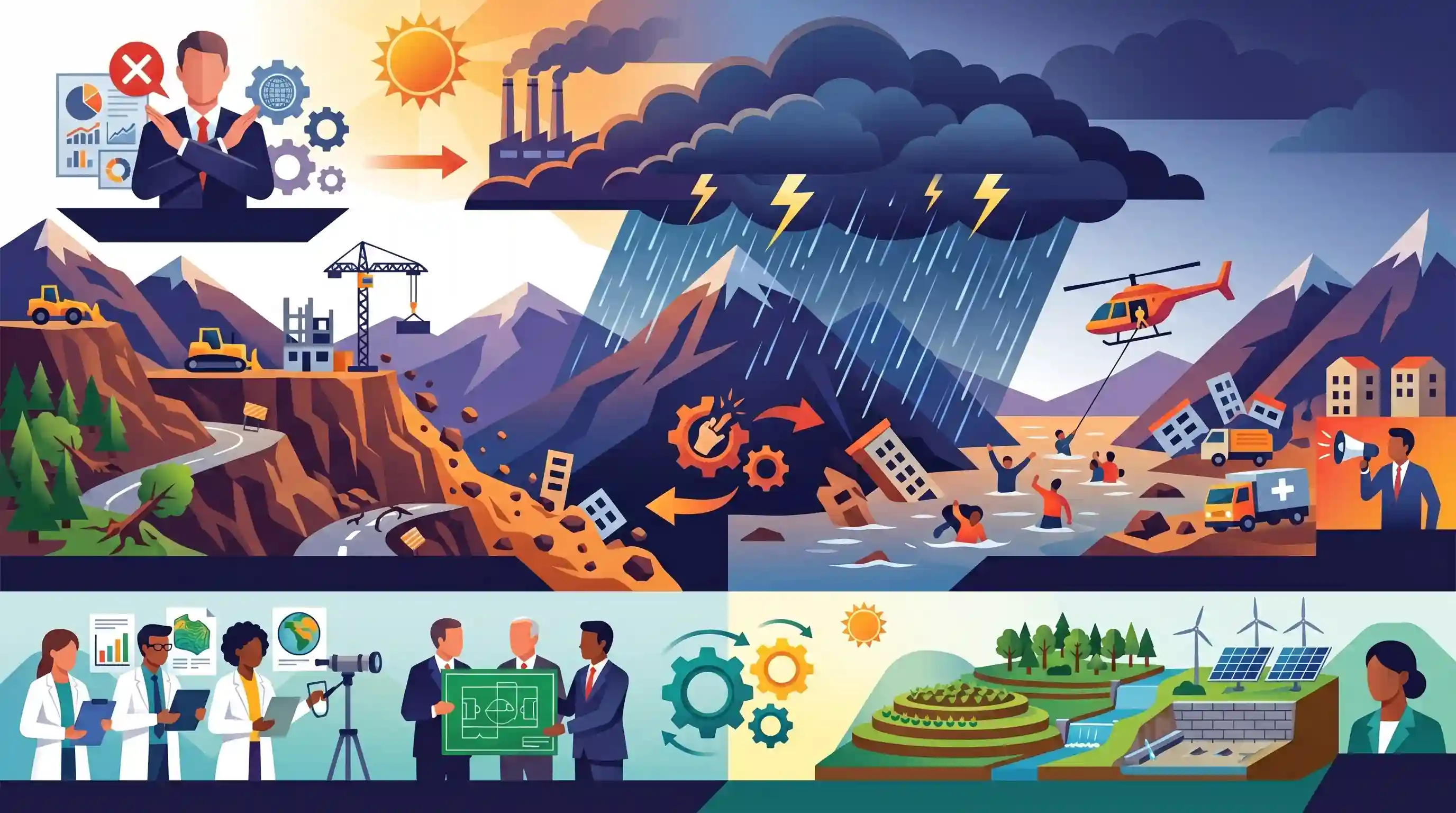
Why It Matters
It provides a crucial contemporary case study of how the intersection of climate change and policy failures—specifically ignoring ecological science—exacerbates natural disasters in the Himalayas. This directly aligns with recurring UPSC syllabus topics on cloudburst mechanisms, landslide vulnerability, and sustainable development.
Summary
The article examines the recent cloudbursts and landslides in Uttarkashi, Uttarakhand, framing them as a severe consequence of climate denial and the marginalization of scientific expertise. It highlights how unchecked infrastructure development and disregard for the fragile Himalayan ecology have amplified the region's vulnerability to extreme weather events. The author argues that mitigating future catastrophes requires urgently integrating scientific advice into policy, recognizing the realities of climate change, and adopting sustainable, proactive disaster management strategies rather than relying solely on reactive relief efforts.
Key Points
- The Uttarkashi cloudbursts and landslides are stark reminders of the escalating impacts of climate change in the ecologically fragile Himalayan region.
- Ignoring scientific consensus and ecological guidelines in pursuit of rapid infrastructure development significantly increases the region's vulnerability to disasters.
- The rising frequency of extreme weather events demands a shift from reactive disaster response to proactive, science-backed mitigation strategies.
- Sustainable development in Uttarakhand requires acknowledging climate change realities and balancing human settlements with environmental conservation.
Prelims Trap
IMD defines a cloudburst as rainfall exceeding 50 mm per hour over a large state-wide area.
The IMD strictly defines a cloudburst as unexpected precipitation exceeding 100 mm per hour over a highly localized geographical area (20-30 sq km).
Static Concepts Connected
Why are cloudbursts highly frequent in the Himalayan region?
- Orographic lifting: Warm, moist monsoon winds are forced rapidly upwards by steep Himalayan slopes.
- Rapid condensation: The sudden vertical lift causes rapid cooling and massive cumulonimbus cloud formation, resulting in intense downpours.
Why are the Himalayas more prone to landslides than the Western Ghats?
- Tectonic activity: The Himalayas are young, tectonically active fold mountains, making their slopes structurally unstable and earthquake-prone.
- Geological composition: Himalayan rocks are mainly sedimentary and un-compacted, unlike the stable, highly degraded igneous block structure of the Western Ghats.
- Anthropogenic stress: Deforestation and unchecked infrastructure (like road widening) easily destabilize these fragile slopes.
Cross-Topic Patterns
Carrying capacity and infrastructure projects
The Supreme Court’s mandate for all 13 Himalayan states to assess carrying capacity links ecological vulnerability directly to large-scale infrastructure projects like Char Dham and hydro-dams.
Doppler radars and extreme weather forecasting
Mitigating localized disasters like cloudbursts requires advanced early warning systems. Expect questions linking disaster response to the deployment of X-Band Doppler Weather Radars in hilly terrain.

Expect a paired question linking IMD’s exact cloudburst criteria (100mm/hr) with geomorphological reasons for Himalayan landslides.
Linked PYQs · 5
Linked PYQs · 5
- 2022MainsGS3
Explain the mechanism and occurrence of cloudburst in the context of the Indian subcontinent. Discuss two recent examples.
- 2016MainsGS3
Rehabilitation of human settlements is one of the important environmental impacts which always attracts controversy while planning major projects. Discuss the measures to be adopted to mitigate the impact of the recent incidents of cloudbursts in many places of Uttarakhand.
- 2021MainsGS3
Describe the various causes and the effects of landslides. Mention the important components of the National Landslide Risk Management Strategy.
- 2021MainsGS1
Differentiate the causes of landslides in the Himalayan region and Western Ghats.
- 2016MainsGS1
The Himalayas are highly prone to landslides. Discuss the causes and suggest suitable measures of mitigation.
