UNESCO Heritage Site Valley Of Flowers Welcomes Visitors
Source:newsonair ↗
Why It Matters
The Valley of Flowers is a major tourist and ecological landmark in Uttarakhand. Due to its status as a combined UNESCO World Heritage Site with Nanda Devi, it is a highly recurring topic in UKPSC Prelims questions regarding protected areas, local biodiversity, and regional geography.
Summary
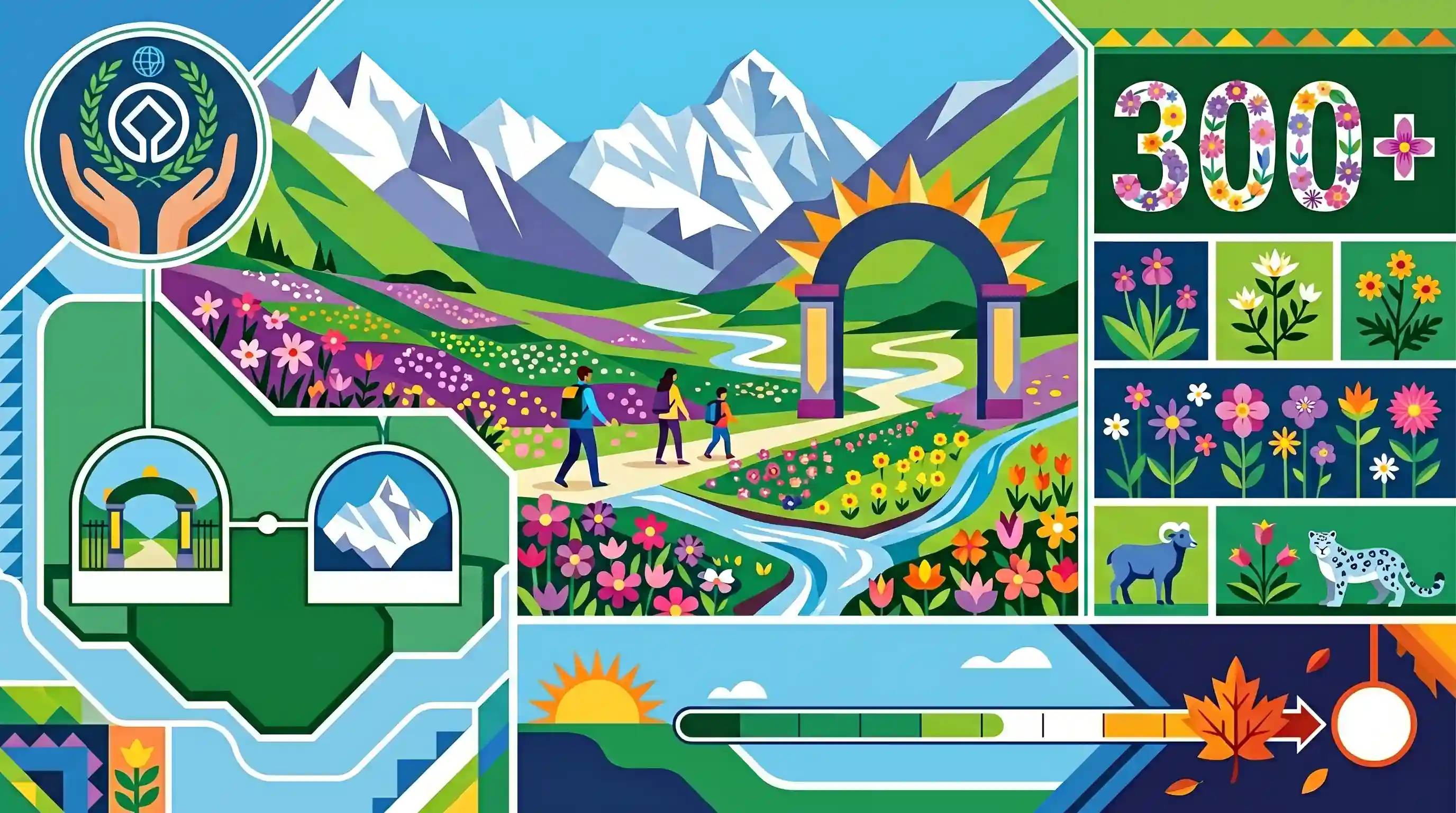
The UNESCO World Heritage Site, Valley of Flowers, located in Chamoli district of Uttarakhand, has officially opened for the tourist season, which will run until October 31. Home to over 300 flower species and a rich collection of rare alpine flora, the national park, alongside Nanda Devi National Park, forms a combined World Heritage Site situated within the ecologically rich Nanda Devi Biosphere Reserve.
Key Points
- The Valley of Flowers National Park is located in Chamoli district, Uttarakhand, and has officially opened to tourists for the season, remaining accessible until October 31.
- The valley is high-altitude alpine terrain situated in the transition zone between the Zanskar range and the Great Himalayas, hosting over 300 endemic species of flowers and rare flora.
- It constitutes a combined UNESCO World Heritage Site with the Nanda Devi National Park; Nanda Devi was inscribed in 1988, and the site was extended to include the Valley of Flowers in 2005.
- The Nanda Devi Biosphere Reserve (including both national parks) serves as a vital habitat for rare and endangered Himalayan wildlife like the snow leopard, Himalayan musk deer, and blue sheep (bharal).
- The valley was brought to global prominence by British mountaineer Frank S. Smythe in 1931 during his return from an expedition to Mount Kamet.
Important Terms
Valley of Flowers National Park

A high-altitude national park in Chamoli, Uttarakhand, established in 1982, internationally renowned for its pristine meadows of endemic alpine flowers and unique Himalayan biodiversity.
UPSC context
GS Paper I (Physical Geography) & GS Paper III (Environment): Conservation of protected areas.
Nanda Devi Biosphere Reserve
A UNESCO-designated reserve in Uttarakhand established in 1988, encompassing Nanda Devi and Valley of Flowers National Parks as its core zones to protect Western Himalayan ecology.
UPSC context
GS Paper III (Environment): Biodiversity conservation, biosphere reserves, and MAB Programme.
UNESCO World Heritage Convention
Officially adopted in 1972, this international treaty aims to identify, protect, and preserve cultural and natural heritage sites of outstanding universal value across the globe.
UPSC context
GS Paper I (Art & Culture) & GS Paper III (Environment): Global conservation frameworks.
Wildlife Protection Act, 1972
India's landmark legislation providing a legal framework for protecting wild animals, birds, and plants, regulating hunting/trade, and establishing protected areas like national parks.
UPSC context
GS Paper III (Environment): Environmental laws, schedules of protection, and institutional bodies.
UNESCO
A specialized agency of the United Nations, founded in 1945, working to foster world peace, security, and sustainable development through international cooperation in education, sciences, and culture.
UPSC context
GS Paper II (International Relations): Structure and mandate of global institutions.
Prelims Trap
The Alaknanda River originates within and directly drains the Valley of Flowers National Park.
The park is drained by the Pushpawati River (from Tipra Glacier), which only later meets Bhyundar Ganga and eventually merges into Alaknanda.
Static Concepts Connected
What are the structural zones of a UNESCO Biosphere Reserve?
- Core Zone: Legally protected undisturbed territory, usually a National Park, focusing strictly on biodiversity conservation and minimal human interference.
- Buffer Zone: Area surrounding the core, used for activities compatible with sound ecological practices like managed education, training, and ecotourism.
- Transition Zone: Outer area where sustainable resource management practices, local community livelihood activities, and economic development are harmoniously integrated.
How do Greater Himalayas and Zanskar Range differ geographically?
- Greater Himalayas: High, snow-clad peaks (Himadri) acting as the main moisture barrier, receiving significant monsoonal precipitation and feeding major perennial rivers.
- Zanskar Range: Located north of the Greater Himalayas; features drier, cold-desert microclimates as it lies partially in the trans-Himalayan rain shadow.
Cross-Topic Patterns
Glacial retreats + Alaknanda headwaters
Climate-induced melting of the Tipra Glacier threatens the perennial flow of the Pushpawati River, disrupting downstream Himalayan river ecology and hydrology.
Carrying capacity + Fragile alpine ecotourism
Balancing high-volume tourism in ecological transition zones with strict conservation laws tests the carrying capacity framework of Western Himalayan biodiversity.

UPSC may combine West-to-East Himalayan passes, biosphere core zones, and localized river systems (Pushpawati) into a single 2026 question.
Linked PYQs · 3
Linked PYQs · 3
- 2025UKPSC_PRELIMSGS1
Which of the following UNESCO World Heritage Sites is/are located in Uttarakhand? Choose the correct option: A. Valley of Flowers B. Kaziranga National Park C. Mountain Railways of India D. Nanda Devi National Park
- 2025UKPSC_PRELIMSGS1
Consider the following statements about Nanda Devi Biosphere Reserve : 1. It is World Heritage Site. 2. Its inhabitants include snow leopard, musk deer and blue sheep. Choose the correct answer using following options :
- 2005UKPSC_PRELIMSGS1
Which of the following is a 'World Heritage Site' in Uttarakhand?
