Uttarakhand Lakhpati Didi Scheme Crosses Three Lakh Beneficiaries
Source:livemint ↗
Why It Matters
Crucial for UKPSC Prelims because it explicitly details a highly prioritized state-specific scheme (Lakhpati Didi) along with its statistical targets, nodal implementing agency (USRLM), and associated marketing umbrellas like the 'House of Himalayas' brand, directly feeding into state-specific current affairs and governance questions.
Summary
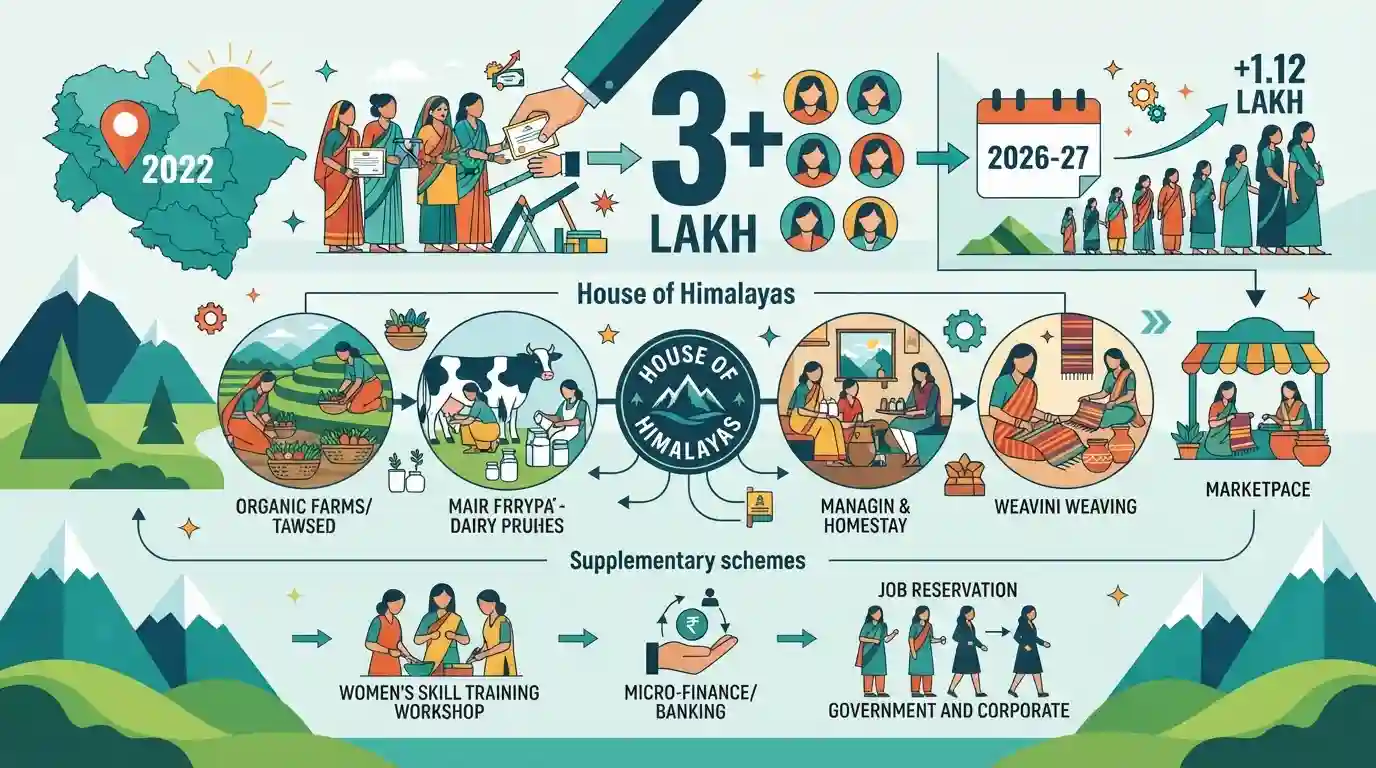
Uttarakhand's 'Lakhpati Didi' scheme, launched in November 2022 under the Uttarakhand State Rural Livelihood Mission (USRLM), has successfully empowered over 3 lakh women associated with Self-Help Groups (SHGs), achieving its target ahead of the 2025-26 schedule. The state government has consequently set a new goal to integrate an additional 1.12 lakh women by 2026-27. Women in SHGs earn sustainable livelihoods through organic farming, dairy, homestays, and handicrafts, with products marketed under the 'House of Himalayas' brand. This is supplemented by various other state empowerment schemes and specific employment reservations for women.
Key Points
- The 'Lakhpati Didi' initiative in Uttarakhand achieved its initial target of empowering 3 lakh women well ahead of the March 2026 deadline.
- The state government has established a new target to empower an additional 1.12 lakh women under the scheme for the financial year 2026-27.
- Launched in November 2022 under the Uttarakhand State Rural Livelihood Mission (USRLM), the scheme boosts incomes via Self-Help Groups (SHGs).
- Women in these SHGs generate income through activities such as organic farming, dairy, food processing, beekeeping, handicrafts, and homestays.
- Local products manufactured by these SHGs are marketed nationally and globally under the 'House of Himalayas' brand.
- Uttarakhand provides 30% horizontal reservation for women in government jobs and 33% reservation in cooperative societies to complement livelihood schemes.
Important Terms
Lakhpati Didi Scheme

A government initiative aiming to train and enable women in Self-Help Groups to earn a sustainable annual income of at least ₹1 lakh through farming, crafts, and micro-enterprises.
UPSC context
Important for GS-II (Welfare Schemes) and GS-III (Inclusive Growth), testing interventions for rural women's economic empowerment.
Mukhyamantri Ekal Mahila Swarojgar Yojana
A targeted Uttarakhand state scheme providing financial assistance and up to a 75% subsidy (maximum ₹1.5 lakh) to single, widowed, or destitute women to establish their own micro-businesses.
UPSC context
Relevant to GS-II (Vulnerable Sections) and GS-III (Employment), highlighting targeted social security and entrepreneurship for marginalized women.
Mukhyamantri Sashakt Bahna Yojana
A scheme by the Uttarakhand government designed to boost the livelihoods of women in Self-Help Groups by providing wider market access, branding, and exhibition platforms for their products.
UPSC context
Covers GS-II (Governance) and GS-III (Marketing of Rural Produce), emphasizing state support for SHG market linkages.
Uttarakhand State Rural Livelihood Mission (USRLM)
The state-level implementing body of the National Rural Livelihoods Mission in Uttarakhand, focused on reducing poverty by building grassroots community institutions and promoting diverse self-employment opportunities.
UPSC context
Vital for GS-II (Poverty Alleviation), demonstrating institutional frameworks for rural development and financial inclusion at the state level.
Self-Help Groups (SHGs)
Informal, voluntary associations of 10-20 people, predominantly marginalized women, who pool their savings to provide collateral-free micro-credit to members and engage in collective income-generating activities.
UPSC context
A core GS-II Governance topic. It evaluates community-led developmental models, micro-finance, and participatory mechanisms for poverty alleviation.
Prelims Trap
"Lakhpati Didi scheme provides a direct cash transfer of Rs 1 lakh to rural women."
The scheme aims to enable an *earned* annual income of ₹1 lakh per SHG household through diversified livelihoods, not via direct benefit transfers (DBT).
Static Concepts Connected
How does horizontal reservation differ from vertical reservation in public employment?
- Vertical Quotas: Applied under Article 16(4) for defined social categories like SC, ST, OBC, and EWS.
- Horizontal Quotas: Applied under Article 15(3) or 16(1) for special groups like women, veterans, and PwD.
- Interlocking Application: Horizontal quotas cut across vertical ones. Selected women candidates adjust against their respective social category's quota.
What is the institutional and financial framework of SHGs under DAY-NRLM?
- Group Constitution: Comprises 10-20 women from socio-economically homogenous backgrounds who pool savings for collateral-free internal lending.
- Federal Structure: SHGs are federated into Village Organizations (VOs) and Cluster Level Federations (CLFs) for scale.
- Financial Linkage: Supported through Revolving Funds, Community Investment Support Funds (CISF), and facilitated bank credit linkage.
Cross-Topic Patterns
SHG Marketing + E-commerce integration
Umbrella brands like 'House of Himalayas' solve market-access barriers. When paired with ONDC, this bridges the gap between rural SHG products and global consumer markets.
Lakhpati Didi + Rural Female LFPR
The scheme reflects a shift from wage-employment (MGNREGA) to self-employment for women, crucial for addressing the stagnation in India's rural female Labour Force Participation Rate (LFPR).

Expect a multi-statement prelims question on DAY-NRLM linking SHG funding mechanisms, Lakhpati Didi income targets, and horizontal quotas.
Linked PYQs · 2
Linked PYQs · 2
- 2025UKPSC_PRELIMSGS1
Which programme was approved by the Union Cabinet in April, 2025 to develop border villages ?
- 2025UKPSC_PRELIMSGS1
Consider the following statements with reference to animal husbandry in Uttarakhand. Select the correct answer from the codes given below : 1. Animal husbandry is a supplementary occupation of agriculture. 2. Sheep rearing in the mountainous areas has been affected by environmental degradation.
