Vasundhara Tal GLEWS for GLOF disaster mitigation in Uttarakhand
Source:drishtiias ↗
Why It Matters
Important for Uttarakhand state public service exams under disaster management, climate change vulnerability, and state geography/infrastructure developments.
Summary
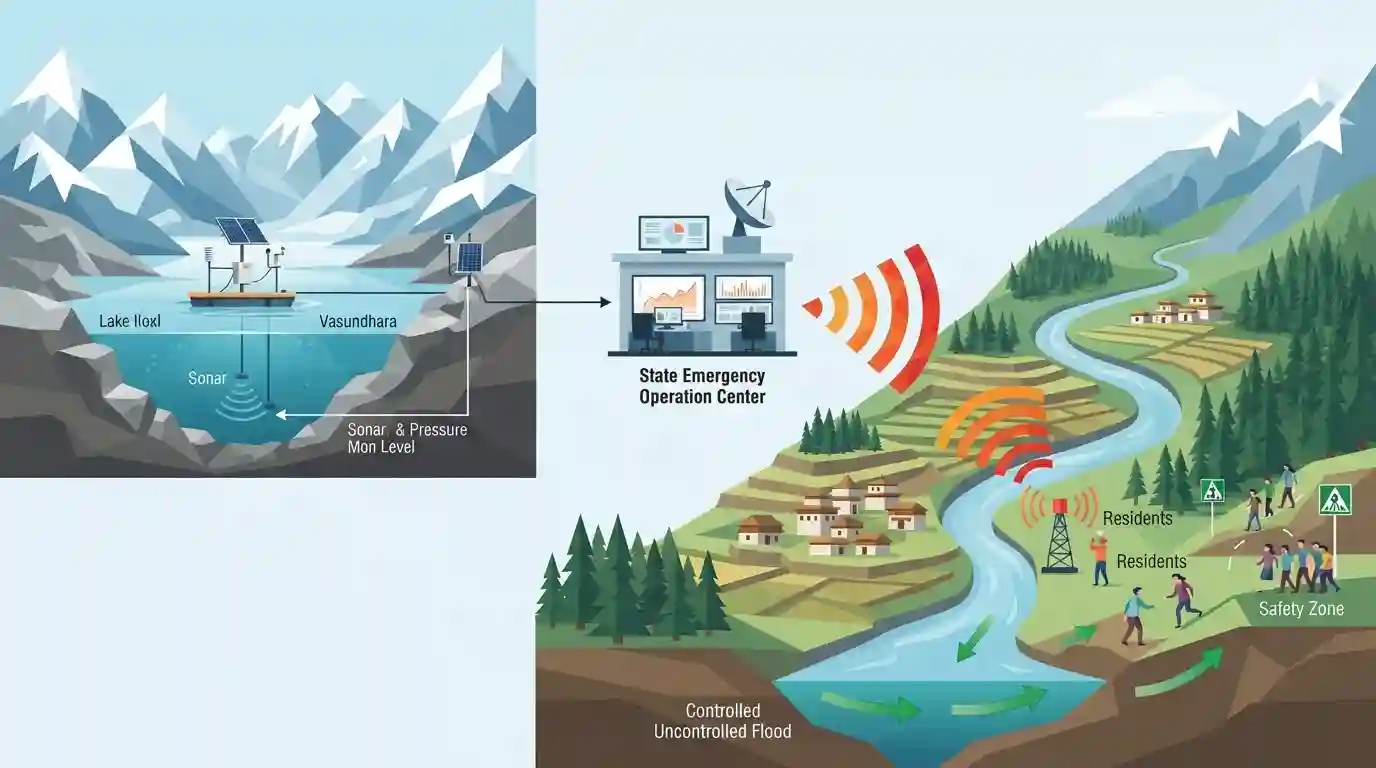
Uttarakhand has launched its first Glacial Lake Early Warning System (GLEWS) at Vasundhara Tal in the Chamoli district. Designed to detect potential Glacial Lake Outburst Floods (GLOFs) and provide timely warnings to protect downstream regions, this initiative highlights the state's focus on technological interventions for disaster mitigation in fragile Himalayan ecosystems.
Key Points
- Uttarakhand's first Glacial Lake Early Warning System (GLEWS) has been installed at Vasundhara Tal in Chamoli district.
- The system aims to mitigate risks associated with Glacial Lake Outburst Floods (GLOFs) by providing real-time monitoring and early alerts.
- Vasundhara Tal is located near the Alaknanda river basin, making early warnings critical for downstream infrastructure and human settlements.
- The initiative forms a crucial part of Uttarakhand's proactive climate change adaptation and disaster management framework.
Important Terms
Glacial Lake Early Warning System

A technological mechanism deployed to monitor high-risk glacial lakes and provide real-time alerts against Glacial Lake Outburst Floods (GLOFs), safeguarding vulnerable downstream settlements in mountainous terrains.
UPSC context
Important for GS Paper III (Disaster Management) and UKPSC Mains (Environment & Vulnerability in Uttarakhand), testing mitigation strategies for GLOFs.
Uttarakhand State Disaster Management Authority
A statutory body established under the Disaster Management Act, 2005, responsible for formulating policies, planning, and coordinating disaster response and mitigation efforts across Uttarakhand.
UPSC context
Crucial for UKPSC GS Paper-V and State Governance, evaluating institutional frameworks for disaster risk reduction in disaster-prone hill states.
State Disaster Management Department
The nodal administrative department in Uttarakhand tasked with handling disaster preparedness, capacity building, relief operations, and coordinating state-level disaster management agencies.
UPSC context
Relevant for UKPSC State-Specific Administration and Disaster Management topics, testing governance mechanisms for handling natural calamities.
Static Concepts Connected
What are the primary institutional mechanisms and high-risk classification criteria for Glacial Lake Outburst Floods (GLOFs) in India?
- High-Risk Lakes: NRSC Mapping identified hundreds of glacial lakes in Uttarakhand, classifying specific high-risk water bodies needing remote monitoring.
- Institutional Roles: Wadia Institute of Himalayan Geology and USDMA spearhead scientific assessment and ground installations like GLEWS.
- Satellite Telemetry: Satellite Communication overcomes total lack of cellular coverage in high-altitude Himalayan terrain for real-time telemetry.
Cross-Topic Patterns
GLOF mitigation and Himalayan remote sensing infra
High-altitude sensor installation in fragile Himalayan regions requires bridging remote sensing data with local disaster response frameworks, intersecting geography, disaster management, and science-tech.

UKPSC frequently asks specific district-lake pairings and institutional roles (e.g., Wadia Institute) in disaster management questions.
Linked PYQs · 2
Linked PYQs · 2
- 2025UKPSC_PRELIMSGS1
Which of the following is the correct order of the following physiographic regions of Uttarakhand from south to north direction?
- 2025UKPSC_PRELIMSGS1
Consider the following statements and select the correct answer from the options given below : Statement 1 : Uttarakhand is highly vulnerable to climate change. Statement 2 : Climate change is causing water stress and depleting biodiversity in Uttarakhand.
