Uttarakhand Electoral Roll Draft Scheduled For Release On July 14
Source:thestatesman ↗
Why It Matters
Understanding the constitutional and legal frameworks of election administration (Article 324, RPA 1950/1951) and the role of state-level electoral authorities is essential for both Indian Polity and state-specific governance questions in the UKPSC PCS Prelims.
Summary
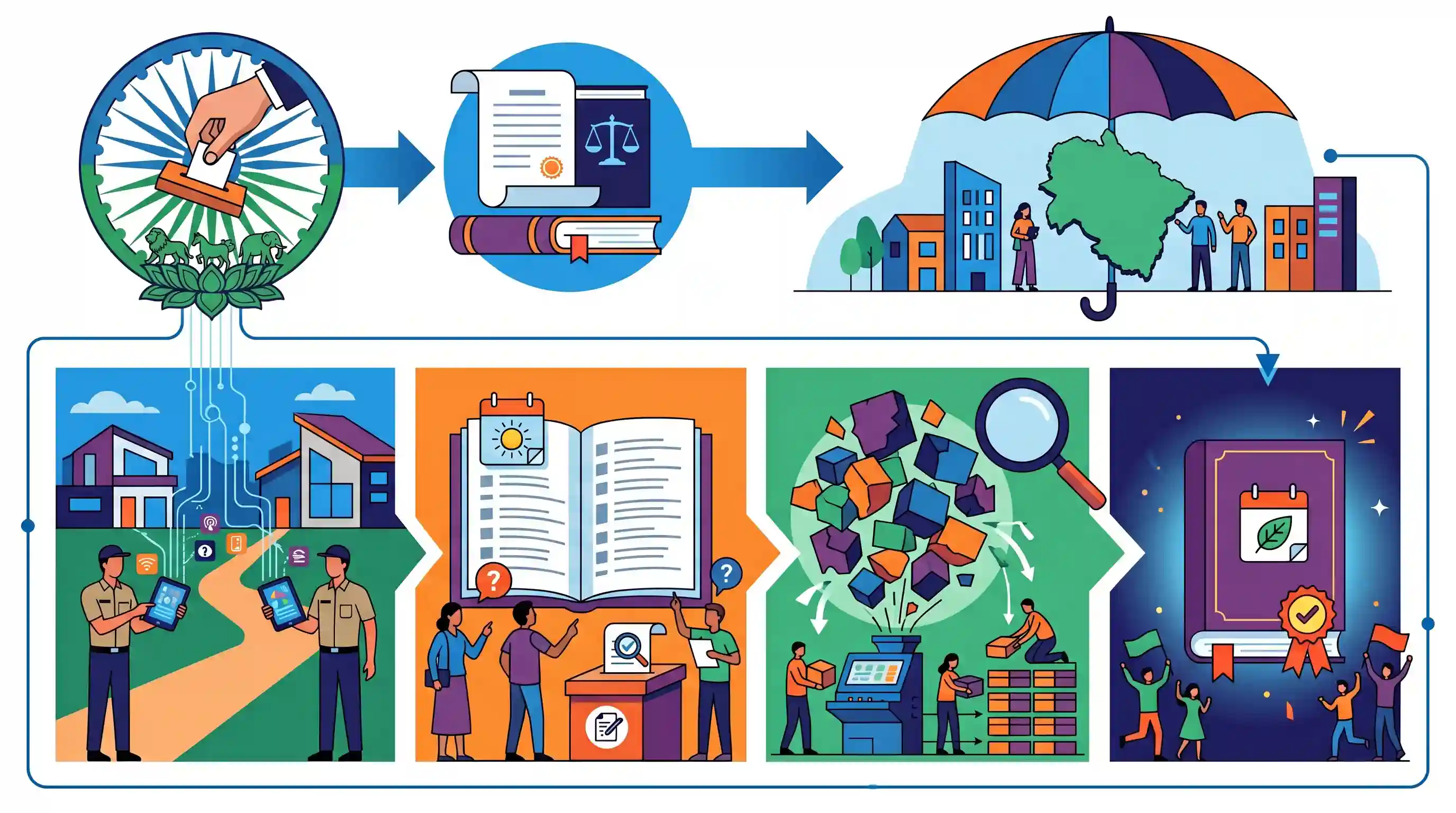
Uttarakhand is conducting a Special Intensive Revision (SIR) of its electoral rolls under the guidance of the ECI. The door-to-door verification by Booth Level Officers (BLOs) was digitized via the BLO App. A draft electoral roll is scheduled for publication on July 14, 2026, allowing citizens to file claims and objections. Efforts are being made to address around 8.5 lakh anomalies/unmapped voters before the final electoral roll is published on September 15, 2026.
Key Points
- Under the guidance of the Election Commission of India (ECI), Uttarakhand is undergoing a Special Intensive Revision (SIR) of electoral rolls to prepare an error-free, updated voter database.
- The first draft of the electoral roll post-SIR will be published on July 14, 2026.
- A door-to-door verification of electors was conducted by Booth Level Officers (BLOs) from June 8 to July 7, 2026, using the digitized 'BLO App' instead of manual records.
- Approximately 8.5 lakh electors could not be mapped/verified due to missing documents or absence during door-to-door checks, and special efforts are underway to resolve these anomalies.
- The timeline for the revision includes: Claims & Objections from July 14 to August 13, 2026; disposal of claims from July 14 to September 11, 2026; and publication of the final electoral roll on September 15, 2026.
Important Terms
Representation of the People Act, 1950

A foundational Indian law providing the statutory framework for the allocation of seats, delimitation of constituencies, voter qualifications, and the preparation and revision of electoral rolls.
UPSC context
GS Paper II (Polity & Governance); tests pre-election structures, delimitation, and voter eligibility provisions.
Representation of the People Act, 1951
An Indian act that regulates the actual conduct of elections, detailing candidate qualifications and disqualifications, corrupt practices, election disputes, and political party registration.
UPSC context
GS Paper II (Polity & Elections); tests candidate eligibility criteria, election dispute resolution, and electoral integrity.
Election Commission of India (ECI)
An autonomous constitutional authority established under Article 324 of the Indian Constitution to conduct free and fair elections to Parliament, state legislatures, and offices of the President and Vice-President.
UPSC context
GS Paper II (Constitutional Bodies); tests Article 324 provisions, independence, structure, and administrative powers.
Office of the Chief Electoral Officer of Uttarakhand
The state-level statutory authority in Uttarakhand, appointed by the ECI, responsible for supervising the preparation of electoral rolls and conducting national and state elections.
UPSC context
GS Paper II (Electoral Administration); tests state-level election machinery and its coordination under ECI supervision.
Prelims Trap
The State Election Commission is responsible for preparing and revising electoral rolls for State Legislative Assembly elections under RPA 1951.
Aspirants often confuse State Election Commissions (SECs) with the ECI. SECs only prepare rolls for local body (Panchayat/Municipality) elections, while the ECI prepares rolls for Parliament and State Assemblies under the RPA 1950.
Static Concepts Connected
What is the statutory division of domains between RPA 1950 and RPA 1951?
- RPA 1950 domain: Governs preparatory tasks including constituency delimitation, voter qualifications, seat allocation, and the preparation/revision of electoral rolls.
- RPA 1951 domain: Governs actual conduct of elections, administrative machinery, qualifications/disqualifications of members, election disputes, and corrupt practices.
How does the 'deemed deputation' rule function during elections?
- Statutory basis: Under Section 13CC of RPA 1950, all state administrative personnel on electoral roll duty are deemed on deputation to ECI.
- Disciplinary control: During this period, these officers are under the direct control, superintendence, and disciplinary authority of the ECI, bypassing state governments.
- Constitutional mandate: Backed by Article 324(6), which requires state executives to provide administrative staff requested by the ECI.
Cross-Topic Patterns
Digitization of grassroots electoral machinery
Using the BLO App for door-to-door verification links e-governance with electoral reforms, demonstrating how digital tools enhance voter database integrity and streamline administrative efficiency.
Federalism and ECI's disciplinary control
The ECI's absolute disciplinary control over state staff on electoral duty highlights functional centralization, balancing state executive autonomy with the mandates of a constitutional authority.

Statements testing the 2021 RPA amendments (four qualifying dates) alongside statutory boundaries of RPA 1950/1951 are highly likely in 2026.
Linked PYQs · 2
Linked PYQs · 2
- 2016UKPSC_PRELIMSGS1
Who recognizes the political parties in India?
- 2025UKPSC_PRELIMSGS1
Consider the following statements with reference to Uttarakhand and choose the correct answer: 1. The executive of Uttarakhand includes Governor as the head of the state. 2. It also includes the Chief Minister and his/her council of ministers.
