Uttarakhand Wildlife Board Discusses Forest Economy and Eco Tourism
Source:indianmasterminds ↗
Why It Matters
Crucial for understanding state-level policy decisions regarding forest economy, wildlife conservation, and eco-tourism management in Uttarakhand, directly relevant to regional governance and environmental planning questions.
Summary
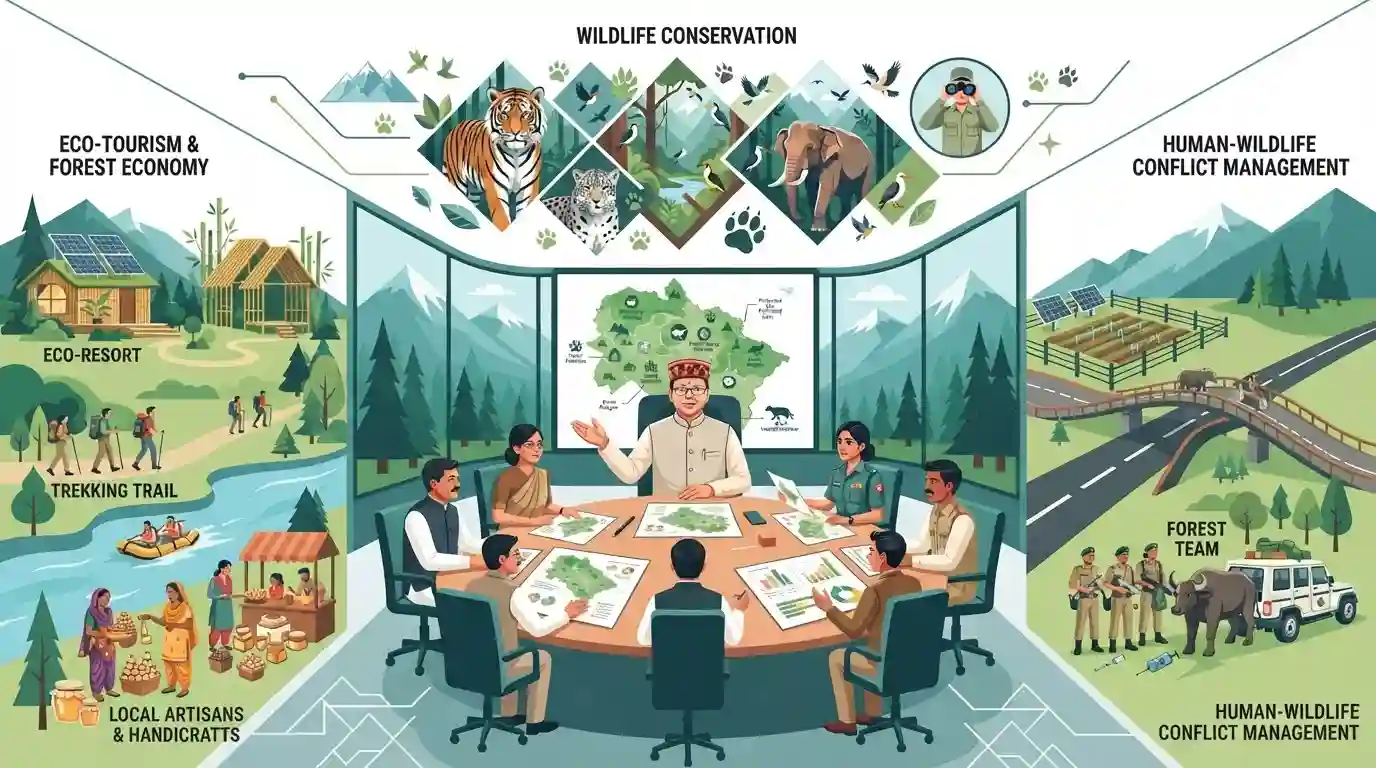
Chief Minister Pushkar Singh Dhami chaired a meeting of the Uttarakhand Wildlife Board, focusing on boosting eco-tourism, strengthening the forest economy, and ensuring balanced wildlife conservation and human-wildlife conflict management in the hill state.
Key Points
- Chief Minister Pushkar Singh Dhami chaired the Uttarakhand Wildlife Board meeting, emphasizing balancing wildlife conservation with eco-tourism.
- The state government is formulating a comprehensive forest economy plan to boost rural livelihoods and generate employment through sustainable tourism.
- Focus was laid on mitigating human-wildlife conflict and protecting critical forest and biodiversity resources in the state.
Important Terms
Uttarakhand Wildlife Board

A statutory advisory body headed by the Chief Minister of Uttarakhand, responsible for advising the state government on wildlife conservation, protected area management, and balancing ecological preservation with development projects.
UPSC context
Important for UKPSC Paper V (Environment & Ecology, Biodiversity Conservation, State Specific Developments) testing knowledge of state-level institutional mechanisms for wildlife management.
Eco-Tourism
A sustainable development approach that promotes responsible travel to natural areas, conserving the environment while improving the well-being and livelihoods of local hill communities.
UPSC context
Important for UKPSC Mains (Paper V - Environment and Economic Development in Uttarakhand), testing sustainable economic models for hill states.
Forest Economy
An economic strategy that integrates sustainable forest resource utilization, non-timber forest products, and eco-tourism to generate local livelihoods while preserving forest cover.
UPSC context
Relevant for UKPSC Economics and Environment syllabus, testing strategies for green growth and rural livelihood generation in forested regions like Uttarakhand.
Prelims Trap
The Uttarakhand Wildlife Board is chaired by the Union Minister of Environment, Forest and Climate Change.
Aspirants often confuse the State Wildlife Board (chaired by the Chief Minister) with the State Board for Wildlife execution committees or National Board for Wildlife (chaired by the Prime Minister).
Static Concepts Connected
What are the key institutional bodies and legal frameworks governing wildlife conservation in Uttarakhand?
- State Wildlife Board:: Headed by the Chief Minister, it is the apex state body for deciding policy on wildlife protection, national parks, and sanctuaries.
- Wildlife Protection Act:: Enacted in 1972, it provides the legal framework for declaring Protected Areas like National Parks, Wildlife Sanctuaries, and Conservation Reserves.
- Van Panchayats:: Uttarakhand has unique community forest councils established under colonial rule and continued post-independence to manage local forest resources.
Cross-Topic Patterns
Eco-Tourism vs. Van Panchayats in Uttarakhand
Uttarakhand's forest economy initiatives intersect with Eco-Sensitive Zones (ESZs) and Panchayati Raj forest management under the Van Panchayat framework.

Uttarakhand Wildlife Board decisions and forest economy plans frequently feature in UKPSC State-Specific mains questions and prelims statements.
Linked PYQs · 2
Linked PYQs · 2
- 2025UKPSC_PRELIMSGS1
Given below are two statements, one is Assertion (A) and other is Reason (R). Select the correct answer from the given codes: Assertion (A): Uttarakhand is rich in forest and bio-diversity. Reason (R): Topography and climate primarily determine the forest and bio-diversity.
- 2025UKPSC_PRELIMSGS1
Consider the following statements with reference to animal husbandry in Uttarakhand. Select the correct answer from the codes given below : 1. Animal husbandry is a supplementary occupation of agriculture. 2. Sheep rearing in the mountainous areas has been affected by environmental degradation.
