Uttarakhand wildlife board discusses eco tourism and forest economy
Source:indianmasterminds ↗
Why It Matters
Crucial for understanding Uttarakhand's policy measures regarding wildlife governance, forest economy growth, and sustainable eco-tourism initiatives relevant to the state PCS exam.
Summary
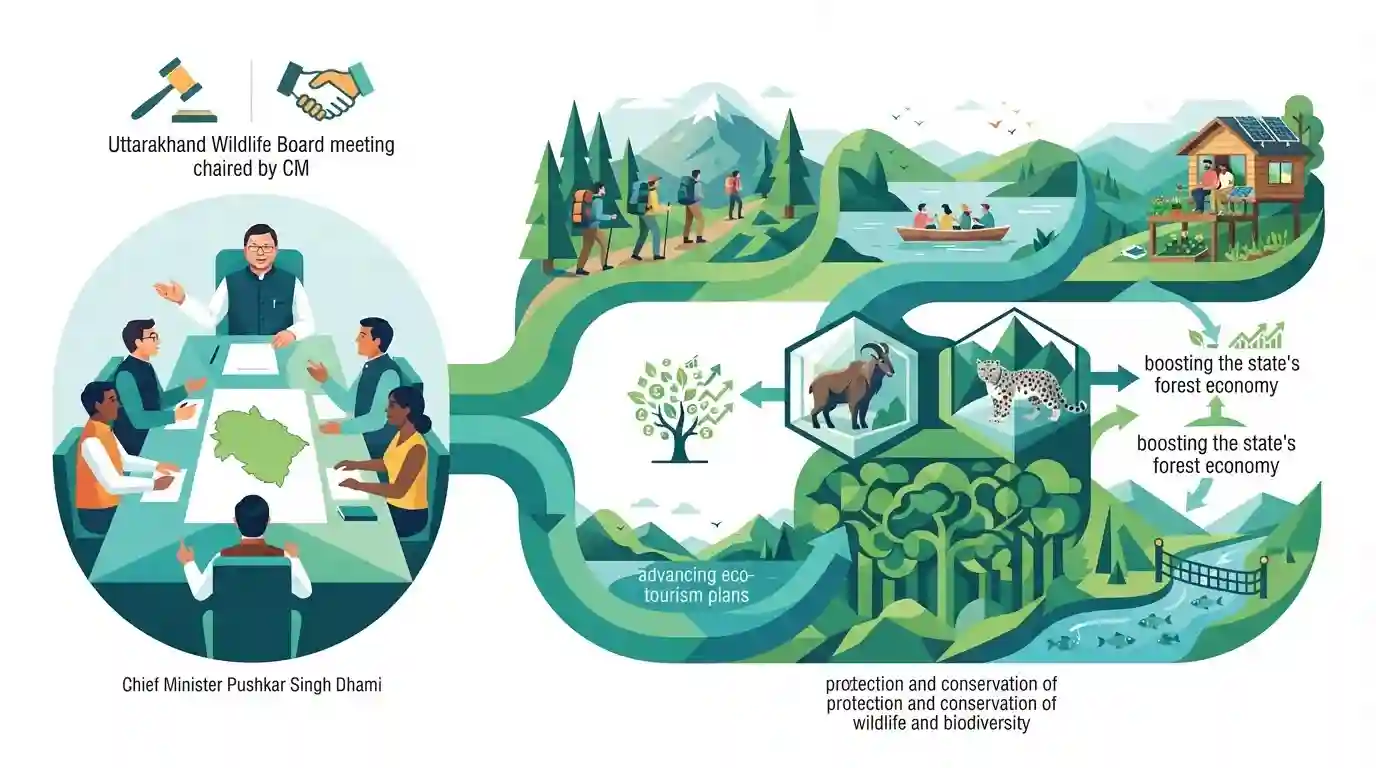
Chief Minister Pushkar Singh Dhami chaired the Uttarakhand Wildlife Board meeting, focusing on advancing eco-tourism plans to boost the state's forest economy while ensuring the protection and conservation of wildlife and biodiversity in the Himalayan region.
Key Points
- Chief Minister Pushkar Singh Dhami chaired the Uttarakhand Wildlife Board meeting to discuss eco-tourism and strengthening the forest economy.
- The meeting focused on balancing wildlife conservation with sustainable economic growth through eco-tourism initiatives in Uttarakhand.
- Emphasis was laid on generating livelihood opportunities for local communities residing near forest and wildlife areas.
Important Terms
Uttarakhand Wildlife Board

A statutory advisory body headed by the Chief Minister of Uttarakhand, responsible for advising the state government on wildlife conservation, protected area management, and sustainable eco-tourism policies.
UPSC context
Important for UKPSC Paper V (Environment & Biodiversity) and Uttarakhand-specific governance; tests understanding of state-level wildlife administration and institutional bodies.
State Government of Uttarakhand
The apex executive authority of the state of Uttarakhand, responsible for formulating policies on forest economy, eco-tourism, disaster management, and wildlife conservation.
UPSC context
Relevant for UKPSC General Studies (Uttarakhand Administration and Polity); tests knowledge of state-level policy execution and sustainable development strategies.
Static Concepts Connected
What are the key statutory provisions and bodies governing wildlife conservation in India and Uttarakhand?
- Wildlife Act: Wildlife Protection Act, 1972 is the primary legislation, providing legal protection through various schedules and establishing the National and State Wildlife Boards.
- State Board: Uttarakhand State Wildlife Board is chaired by the Chief Minister, acting as the apex advisory body for wildlife clearance, protected areas, and eco-tourism policies.
- STPF Deployment: Special Tiger Protection Force (STPF) can be deployed under Project Tiger provisions to enhance anti-poaching measures in sensitive reserves like Corbett and Rajaji.
Cross-Topic Patterns
Eco-tourism versus Himalayan Carrying Capacity
Uttarakhand's delicate Himalayan ecosystem demands balancing rapid revenue generation through tourism with fragile carrying capacity norms, mirroring national debates on green federalism.
Community-Based Conservation & Forest Economy
Integrating local communities into forest fringe economies connects state wildlife governance directly with rural livelihood missions and anti-poaching rural intelligence networks.

UKPSC frequently tests state wildlife boards, tiger reserves, and eco-tourism policies in Prelims matching lists and Mains GS-V questions.
Linked PYQs · 2
Linked PYQs · 2
- 2025UKPSC_PRELIMSGS1
Given below are two statements, one is Assertion (A) and other is Reason (R). Select the correct answer from the given codes: Assertion (A): Uttarakhand is rich in forest and bio-diversity. Reason (R): Topography and climate primarily determine the forest and bio-diversity.
- 2025UKPSC_PRELIMSGS1
Consider the following statements and select the correct answer from the options given below : Statement 1 : Uttarakhand is highly vulnerable to climate change. Statement 2 : Climate change is causing water stress and depleting biodiversity in Uttarakhand.
