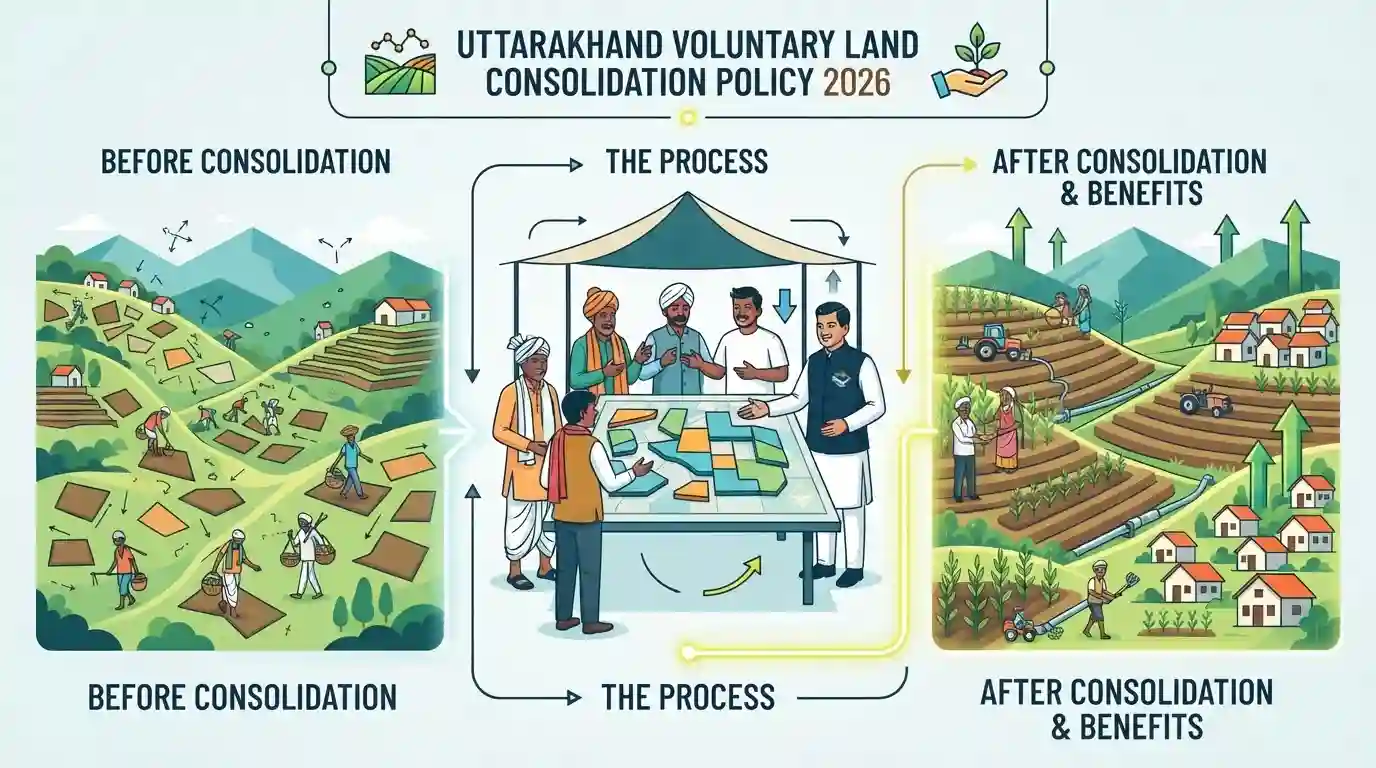
Uttarakhand voluntary land consolidation policy targets farming
Source:samvegias ↗
Why It Matters
Land consolidation is a crucial agrarian reform instrument specifically tailored for hill states like Uttarakhand, where extreme land fragmentation and migration hinder agricultural growth. It is a high-yield topic for UKPSC PCS Prelims concerning state governance and economic policies.
Summary
The article discusses the newly approved Uttarakhand Voluntary Land Consolidation Policy 2026, aimed at addressing land fragmentation, boosting agricultural productivity, and curbing migration in the hill districts of Uttarakhand by allowing voluntary consolidation of fragmented land holdings.
Key Points
- The Uttarakhand government has approved the Uttarakhand Voluntary Land Consolidation Policy 2026 to tackle the issue of fragmented land holdings in the hill state.
- The policy aims to encourage farmers to voluntarily club their small, scattered agricultural plots together into larger, contiguous pieces of land to enhance farming efficiency.
- It seeks to combat rural out-migration, revive abandoned or barren agricultural land (chal-khal/banjar), and promote commercial horticulture and modern agricultural practices in hilly terrains.
Important Terms
Uttarakhand Voluntary Land Consolidation Policy 2026

A policy approved to address land fragmentation in hill districts, boosting agricultural productivity and curbing migration by enabling farmers to voluntarily consolidate scattered land holdings into contiguous plots.
UPSC context
Crucial for UKPSC GS Paper V (Uttarakhand Economy and Agriculture), testing knowledge of state-specific agrarian reforms and rural development schemes.
State Cabinet
The executive branch of the state government responsible for policy formulation, legislative proposals, and administrative decisions in Uttarakhand.
UPSC context
Important for UKPSC Polity and Governance, examining the executive decision-making process and governance structure at the state level.
Prelims Trap
The Uttarakhand Voluntary Land Consolidation Policy 2026 enforces mandatory acquisition of fragmented lands across all hill districts.
Aspirants often confuse voluntary policies with mandatory state-enforced chakbandi acts; the 2026 policy emphasizes voluntary farmer pooling.
Static Concepts Connected
What are the key objectives and mechanisms of land consolidation (Chakbandi) in hilly states?
- Holding fragmentation: Fragmented holdings make mechanization, irrigation, and commercial farming economically unviable in hill regions.
- Voluntary pooling: Voluntary pooling allows farmers to create contiguous land parcels without altering total ownership value.
- Migration check: Consolidation directly targets barren land (banjar) revival and checks reverse-migration trends by making farming profitable.
Cross-Topic Patterns
Land reforms meet hill migration challenges
Land consolidation in fragile Himalayan ecologies intersects with rural out-migration policies and disaster resilience planning in hill districts.
Horticulture promotion and agrarian livelihoods
Commercializing horticulture via consolidated holdings connects state agricultural modernization schemes with traditional agrarian livelihood protections.

Uttarakhand Land Consolidation Policy 2026 will be tested via multi-statement questions linking hill migration, barjar land, and farming.
Linked PYQs · 3
Linked PYQs · 3
- 2025UKPSC_PRELIMSGS1
Consider the following statements with reference to animal husbandry in Uttarakhand. Select the correct answer from the codes given below : 1. Animal husbandry is a supplementary occupation of agriculture. 2. Sheep rearing in the mountainous areas has been affected by environmental degradation.
- 2025UKPSC_PRELIMSGS1
Which of the following districts of Uttarakhand has the highest agricultural land ?
- 2025UKPSC_PRELIMSGS1
Which programme was approved by the Union Cabinet in April, 2025 to develop border villages ?
