Uttarakhand formulates district plans for Vision 2047
Source:indianmasterminds ↗
Why It Matters
Decentralized planning is a core concept in the Indian governance framework (73rd and 74th Amendments). The transition from centralized five-year plans to long-term visionary frameworks (Vision 2047) involving state and district-level inputs is highly relevant for UKPSC Prelims (Polity and Economy sections).
Summary
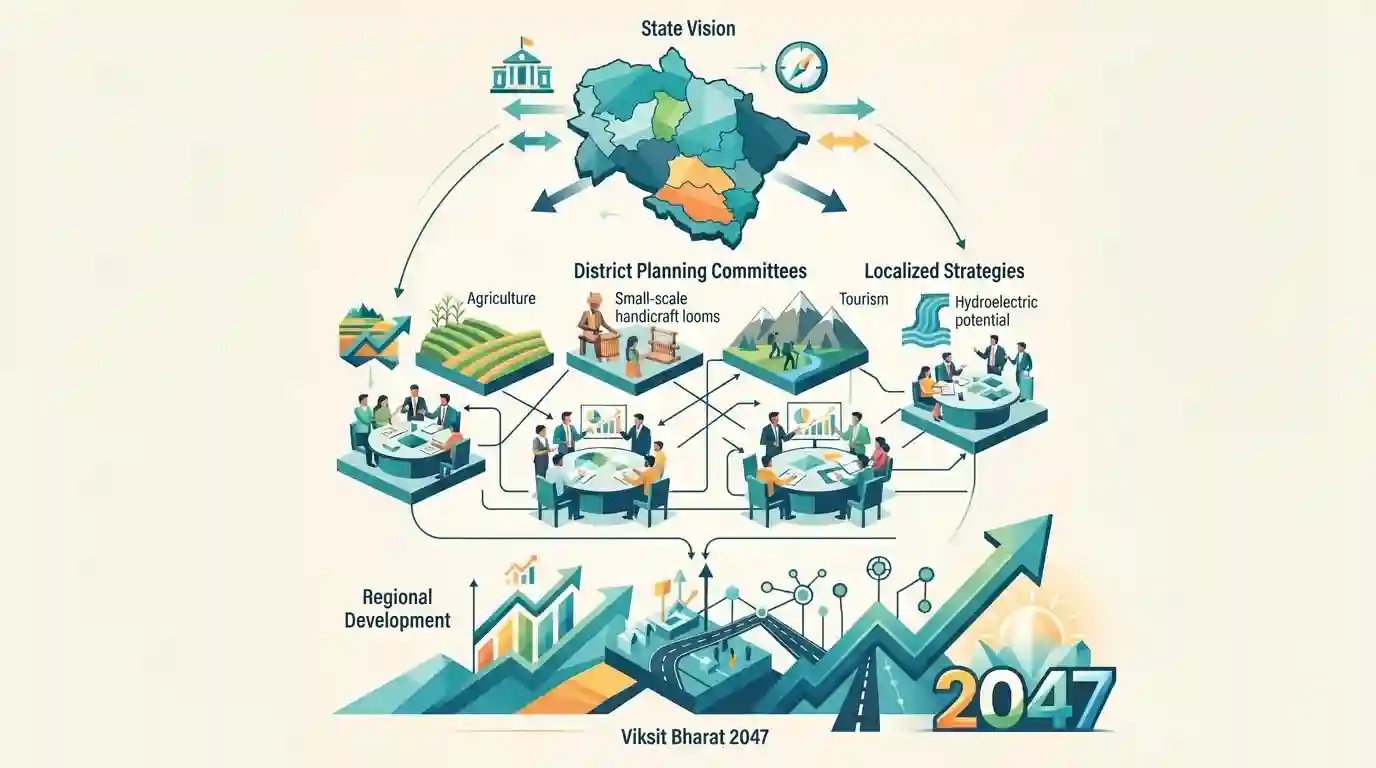
The Uttarakhand government is formulating comprehensive district-level development plans as part of the broader 'Uttarakhand Vision 2047' initiative. By focusing on localized economic strategies, the state aims to leverage regional strengths and address disparities across districts. This decentralized approach aligns with the national 'Viksit Bharat 2047' vision and emphasizes the active involvement of local administrative bodies, including District Planning Committees, in shaping the long-term economic roadmap.
Key Points
- Uttarakhand is developing localized district-level master plans under the larger Uttarakhand Vision 2047 framework.
- The goal is to decentralize economic planning and prioritize regional strengths, addressing inter-district disparities.
- District Planning Committees play a crucial role in formulating and consolidating these local development plans.
- The initiative aligns with national goals set by NITI Aayog for Viksit Bharat 2047, focusing on long-term inclusive growth.
Important Terms
Uttarakhand Vision 2047

A state-specific strategic roadmap aimed at transforming Uttarakhand's economy by 2047. It mandates decentralized, district-level action plans to leverage regional strengths, optimize resources, and ensure sustainable, inclusive growth aligned with national goals.
UPSC context
Relevant to GS 2 and 3. Tests sub-national execution of national visions, cooperative federalism, and localized economic planning.
District Planning Committee
A constitutional body established under Article 243ZD of the 74th Amendment Act. It consolidates plans from panchayats and municipalities to prepare a single, integrated draft development plan for an entire district.
UPSC context
Highly critical for GS 2 (Polity). Tests the mechanics of democratic decentralization, local self-government, and bottom-up planning.
NITI Aayog
India's premier public policy think tank. It fosters cooperative federalism and designs strategic, long-term frameworks, including actively assisting state governments in drafting their specific "Vision 2047" roadmaps for national integration.
UPSC context
Important for GS 2 and GS 3 (Planning). Tests institutional frameworks driving cooperative federalism and state-centre policy alignment.
Viksit Bharat 2047
The Government of India's overarching vision to transform India into a fully developed nation by the 100th anniversary of independence. It targets economic competitiveness, zero poverty, social equity, and sustainable development.
UPSC context
Core theme for GS 2, GS 3, and Essay. Evaluates understanding of long-term national macroeconomic policies and developmental milestones.
74th Constitutional Amendment Act
A 1992 constitutional reform that institutionalized Urban Local Bodies (Municipalities) as the third tier of government. It added Part IXA and the 12th Schedule, mandating democratic urban decentralization and integrated district planning.
UPSC context
Essential for GS 2 (Polity). Frequently tested regarding urban governance, devolution of powers, and the efficacy of local institutions.
Prelims Trap
"District Planning Committees (DPCs) were established under the 73rd Amendment to consolidate plans prepared solely by Panchayats."
DPCs were inserted by the 74th Amendment Act (Article 243ZD), not the 73rd, and they consolidate plans from BOTH Panchayats and Municipalities.
Static Concepts Connected
What is the constitutional mandate of the District Planning Committee (DPC)?
- Article 243ZD: Inserted by the 74th Amendment, it mandates every state to constitute a DPC at the district level.
- Core Function: DPCs consolidate local plans prepared by both Panchayats and Municipalities into a unified draft development plan for the district.
- Elected Composition: Four-fifths of its members are elected by and from amongst elected members of the district panchayat and municipalities.
How does NITI Aayog's planning approach differ from the erstwhile Planning Commission?
- Bottom-Up Approach: NITI Aayog emphasizes decentralized, participatory planning starting from the village level, replacing the PC's centralized model.
- Cooperative Federalism: States act as equal partners in vision-setting (e.g., Vision 2047), replacing the previous top-down, one-size-fits-all directives.
- Financial Powers: NITI Aayog is purely an advisory think tank and lacks the power to allocate funds to states, unlike the Planning Commission.
Cross-Topic Patterns
Decentralization in Hilly/Border States
District plans in states like Uttarakhand often integrate Border Area Development Programme (BADP) funds and localized disaster resilience strategies directly into their long-term economic models.
Vision 2047 & Cooperative Federalism
State-level 'Vision 2047' documents exemplify cooperative and competitive federalism, where NITI Aayog acts as a facilitator merging state-led, bottom-up economic strategies into the national $30 trillion target.

Expect a 2026 multi-statement question linking DPC constitutional provisions (Art 243ZD) with NITI Aayog's bottom-up planning mandate.
Linked PYQs · 3
Linked PYQs · 3
- 2025UKPSC_PRELIMSGS1
Consider the following statements about NITI Aayog : 1. It was established on January 1, 2014. 2. It was created by a resolution of Union Cabinet. 3. President of India is the Chairman of NITI Aayog. Which of the above statements is/are true ?
- 2025UKPSC_PRELIMSGS1
Which five year plan was focused on inclusive growth?
- 2016UKPSC_PRELIMSGS1
Which one of the following Articles provides reservation of seats for the Scheduled Castes and Scheduled Tribes in the Panchayats?
