Tourism Council Approves Budget for Adventure and Skill Development
Source:indian-masterminds ↗
Why It Matters
Tourism is a primary driver of Uttarakhand's GDP and rural employment. For the UKPSC PCS Prelims, understanding the budgetary allocations, statutory bodies like UTDC/UTDB, key religious/adventure circuits (such as Kainchi Dham, Triyuginarayan, and trekking initiatives), and state-level skill development policies is highly essential as regional geography, administration, and economy are heavily tested.
Summary
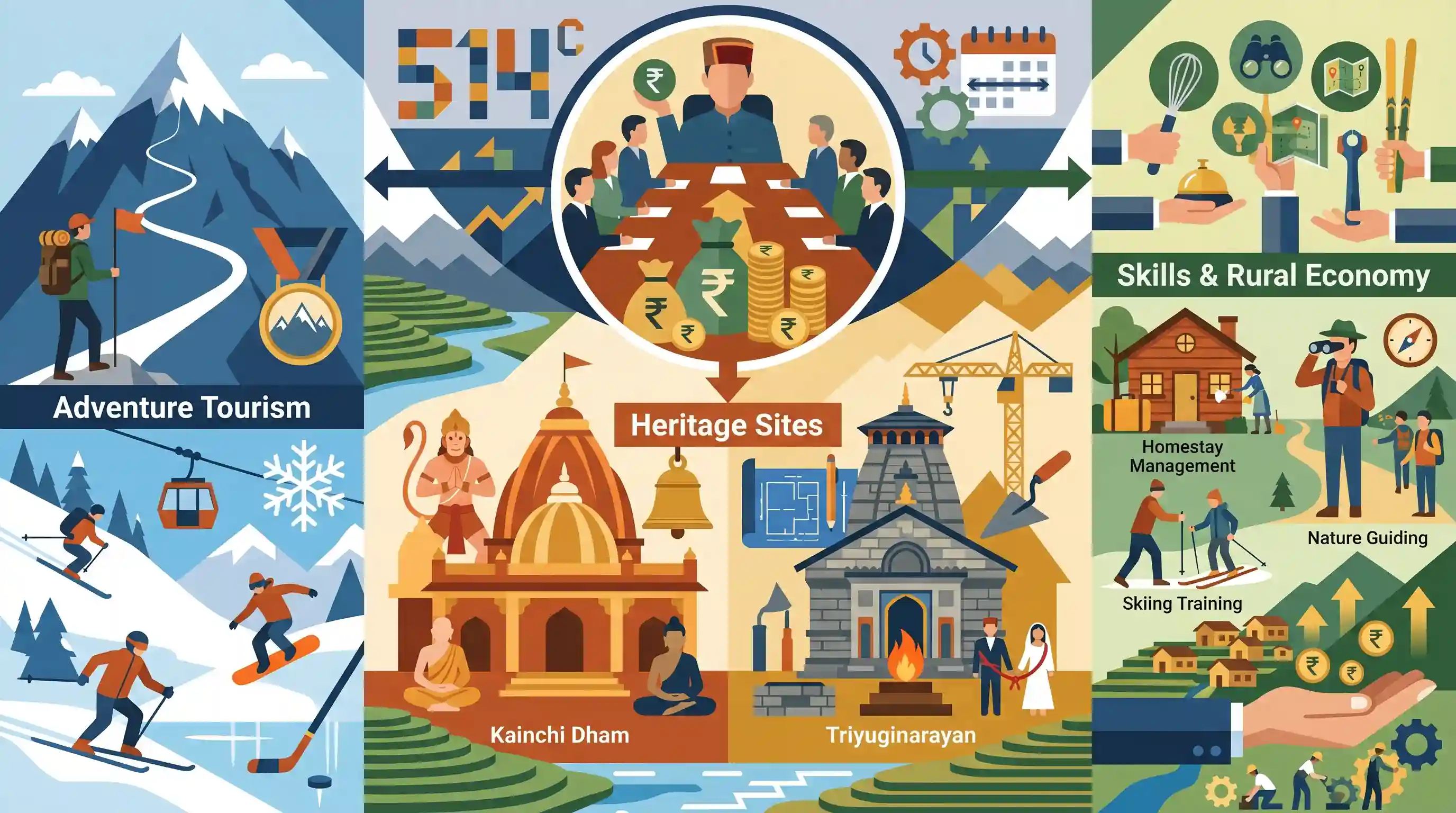
The Uttarakhand Tourism Development Council (UTDC), under State Tourism Minister Satpal Maharaj, approved a ₹514 crore budget for FY 2026–27. The council's core strategy centers on boosting adventure tourism (including the 'Trek of the Year' and winter sports), creating dedicated development plans for heritage sites like Kainchi Dham and Triyuginarayan, and training local youth in homestay management, nature guiding, and skiing to stimulate the rural economy.
Key Points
- The 24th board meeting of the Uttarakhand Tourism Development Council (UTDC) held in Dehradun approved a budget of ₹514 crore for the financial year 2026–27.
- Integrated and comprehensive destination development plans are to be prepared for spiritually and culturally significant locations: Triyuginarayan, Kainchi Dham, and Kartik Swami Temple.
- An extensive 2026–27 adventure sports calendar was approved, featuring high-profile initiatives like the 'Trek of the Year', Winter Carnival, high-altitude mountaineering expeditions, ultra-marathons, river rafting, and paragliding competitions.
- Skill development and job creation for local youth will focus on training programs in homestay management, trekking operations, adventure sports, nature guiding, river rafting, and skiing.
- Long-vacant administrative and technical posts in the tourism department will be filled via outsourcing and contract hiring, coupled with departmental capacity-building in IT, accounting, and management.
- The council emphasized boosting the rural economy and local employment through community participation, upgrading trekking schemes, and attracting larger tourism investments.
Important Terms
Uttarakhand Tourism Development Board (UTDB)

A statutory government board and the highest advisory body in Uttarakhand for tourism, chaired by the state Tourism Minister, responsible for tourism policy, infrastructure development, and private sector coordination.
UPSC context
GS Paper II/III: Government policies and infrastructure; tests knowledge of state-led planning and statutory bodies for regional economic development.
Uttarakhand Tourism Development Council (UTDC)
An executive state body responsible for implementing tourism policies, managing budget allocations, developing tourist facilities, and executing skill training programs to boost the local rural economy.
UPSC context
GS Paper II: Welfare schemes and policy implementation; tests understanding of state machinery promoting rural livelihoods and sustainable tourism.
Trek of the Year initiative
A promotional campaign by Uttarakhand to declare specific offbeat Himalayan trails as featured treks, aiming to popularize winter tourism, decentralize tourist density, and create community-based livelihoods.
UPSC context
GS Paper III: Environmental conservation and sustainable development; tests awareness of ecological tourism models and mountain-region economics.
Trekking and trekking center schemes
State-funded programs focused on developing safe trekking routes, building local facilities, and training rural youth to run professional trekking and adventure activities.
UPSC context
GS Paper III: Employment and rural infrastructure; tests strategies utilizing regional geography to generate sustainable rural livelihoods.
Kainchi Dham
A revered spiritual ashram located near Nainital, Uttarakhand, founded by Neem Karoli Baba, currently undergoing targeted state-led development to enhance spiritual tourism facilities.
UPSC context
GS Paper I/III: Indian heritage, culture, and tourism infrastructure; tests understanding of regional pilgrimage centers and cultural-tourism linkages.
Triyuginarayan Temple
A historic Hindu temple in Rudraprayag, Uttarakhand, revered as the venue of Lord Shiva and Goddess Parvati’s celestial wedding, marked for heritage tourism infrastructure development.
UPSC context
GS Paper I/III: Indian temple architecture, heritage, and tourism development; tests knowledge of ancient religious sites and regional tourism policies.
Prelims Trap
Triyuginarayan Temple, being the celestial wedding venue of Shiva and Parvati, is primarily dedicated to Lord Shiva.
Despite being mythologically famous as the celestial wedding site of Lord Shiva and Goddess Parvati, the Triyuginarayan Temple is dedicated to Lord Vishnu. UPSC often tests deity mismatches in temple architecture.
Static Concepts Connected
What are the architectural and cultural characteristics of the Katyuri and Nagara-style temples in Uttarakhand?
- Architectural lineage: Temples like Triyuginarayan exhibit a classic Nagara-derived style, often displaying features of medieval Katyuri architecture.
- Key features: Constructed with massive grey stone slabs, featuring a curvilinear shikhara, pillared mandapas, and persistent sacred water springs.
- Deity syncretism: They often blend Shaiva and Vaishnava legends, uniting diverse sectarian traditions under single localized architectural complexes.
What is 'Carrying Capacity' in mountain tourism, and why is it critical for the Indian Himalayan Region?
- Core concept: The maximum population or tourist visitation an ecosystem can support without degrading the physical, economic, and socio-cultural environment.
- IHR vulnerability: Himalayan ecosystems face high seismic risks (Zones IV and V), acute water stress, and rapid slope destabilization under heavy tourist footprints.
- Policy response: Requires implementing structural carrying-capacity assessments and dispersing tourist flows to offbeat, eco-tourism alternative routes.
Cross-Topic Patterns
Himalayan Ecology vs. Spiritual Tourism
The push for massive spiritual tourism corridors like Kainchi Dham highlights the critical policy tension between religious-economic growth and the ecological fragility of the Outer and Lesser Himalayas.
Kartikeya Worship: North-South Synthesis
Kartik Swami temple on Kronch Parvat bridges North Indian Shaivism with South India's Murugan worship tradition, demonstrating deep-seated subcontinental cultural integration.

Himalayan temple architecture and ecological carrying capacity of pilgrim sites are prime candidates for GS-1 and GS-3 integration in 2026.
Linked PYQs · 1
Linked PYQs · 1
- 2024UKPSC_PRELIMSGS1
UTDB is established in Uttarakhand to promote:
