Uttarakhand tops national ranking in new criminal laws implementation
Source:newindianexpress ↗
Why It Matters
Highlights Uttarakhand's governance performance in a critical national legal reform area, bridging administrative rankings with ground reality challenges in law enforcement.
Summary
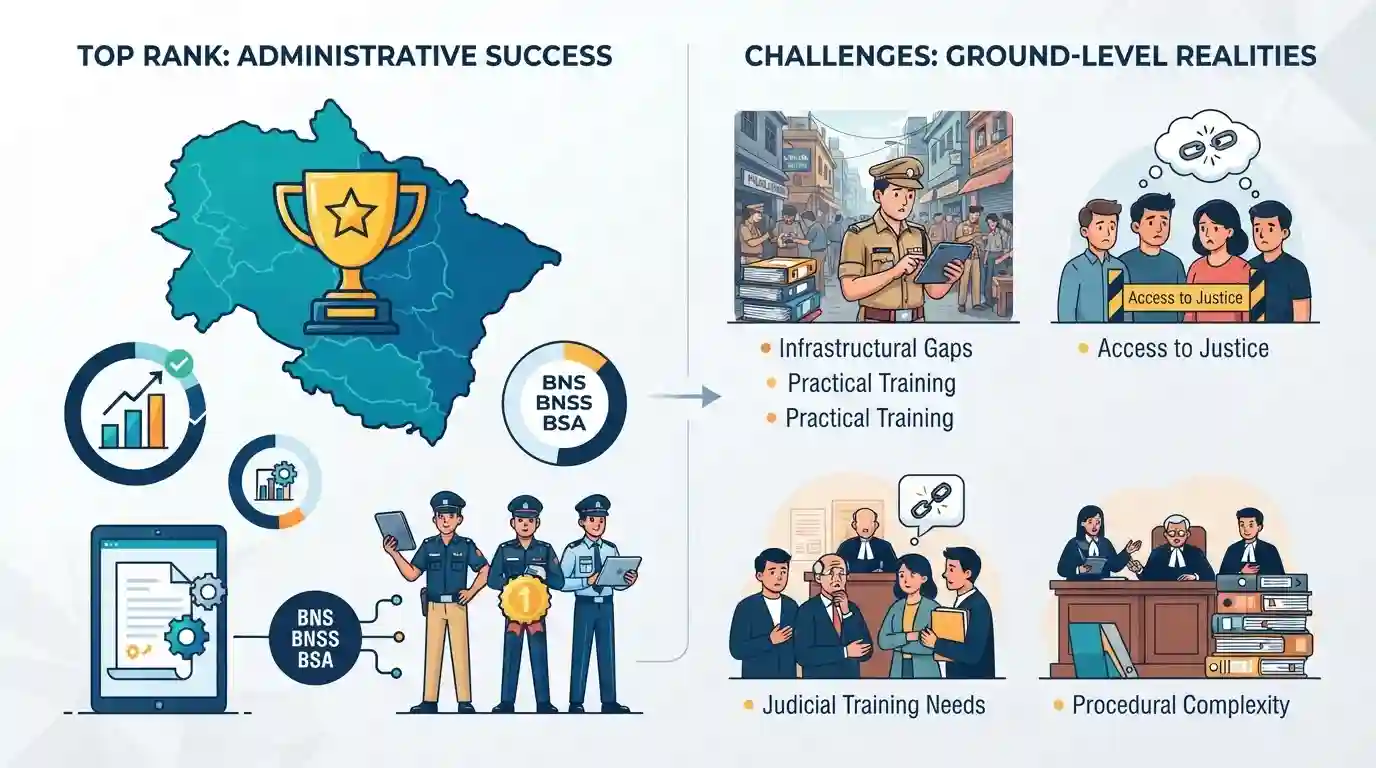
Uttarakhand has secured the top rank nationally in the rollout of India's new criminal laws (BNS, BNSS, and BSA). While administrative metrics showcase exemplary digital compliance and execution by state agencies, legal experts have urged policymakers to address ground-level bottlenecks, infrastructural gaps, and practical training needs for police and judicial personnel to ensure true delivery of justice.
Key Points
- Uttarakhand secured the top national ranking in the implementation and rollout of the three new criminal laws (BNS, BNSS, and BSA).
- Experts and analysts emphasize the need to look beyond administrative rankings and digital metrics, urging a greater focus on ground-level realities, capacity building of law enforcement personnel, and procedural efficiency.
- The rollout involves technology integration such as CCTNS and ICJS to digitize criminal justice administration in the state.
Important Terms
Bharatiya Nyaya Sanhita (BNS)

Bharatiya Nyaya Sanhita (BNS) is India's updated substantive criminal code that replaced the colonial-era Indian Penal Code (IPC), introducing modernized offenses, digitized reporting, and alternative punishments like community service.
UPSC context
Crucial for UKPSC GS Paper II (Polity & Governance) and Mains criminal justice reforms, testing understanding of legal framework updates.
Bharatiya Nagarik Suraksha Sanhita (BNSS)
Bharatiya Nagarik Suraksha Sanhita (BNSS) is the procedural criminal law replacing the Code of Criminal Procedure (CrPC), aimed at speeding up investigations, trials, and incorporating mandatory forensic procedures.
UPSC context
Important for UKPSC Mains (Governance & Judiciary), assessing knowledge of procedural reforms and criminal justice efficiency in India.
Bharatiya Sakshya Adhiniyam (BSA)
Bharatiya Sakshya Adhiniyam (BSA) is the updated legislation governing evidence law in India, replacing the Indian Evidence Act to accommodate electronic records, digital footprints, and modern forensic evidence as primary proofs.
UPSC context
Relevant for UKPSC GS Paper II and Law optional topics, evaluating awareness of digital evidence integration in judicial processes.
National Crime Records Bureau
The National Crime Records Bureau (NCRB) is an Indian government agency under the Ministry of Home Affairs responsible for collecting and analyzing crime data, including tracking national digital criminal justice metrics.
UPSC context
Important for UKPSC Prelims and Mains (Internal Security and Governance), testing knowledge of premier data-collecting bodies in India.
Static Concepts Connected
What are the core components and pillars of the Inter-Operable Criminal Justice System (ICJS) in India?
- Data Sharing: Facilitates seamless transfer of data and information among different pillars of the criminal justice system like courts, police, jails, and forensic labs.
- Nodal Agency: Implemented as a centrally sponsored scheme under the Ministry of Home Affairs, managed by the National Crime Records Bureau (NCRB).
Cross-Topic Patterns
Criminal Justice Reforms & State Governance
Uttarakhand's top rank in BNS/BNSS rollout intersects with the state's pioneering role in uniform civil code drafting and police modernization grants.

Uttarakhand ranking first in BNS rollout + CCTNS integration is high-yield for UKPSC Mains GS-2/GS-5 governance and state current affairs.
Linked PYQs · 3
Linked PYQs · 3
- 2025UKPSC_PRELIMSGS1
Consider the following statements about mobile courts in Uttarakhand and choose the correct answer from the options given below : 1. Under mobile e-courts project, mobile vans having facilities of court rooms, computer, printer and internet connectivity will visit villages. 2. The idea is to deliver justice at the door steps of the public living particularly in remote areas.
- 2025UKPSC_PRELIMSGS1
Consider the following statements about Uttarakhand Human Rights Commission and choose the correct option from the options given below: 1. Uttarakhand Human Rights Commission came into existence on May 13, 2013. 2. The objectives of UHRC was to bring about greater accountability and transparency in governance.
- 2025UKPSC_PRELIMSGS1
What is the objective of 'DigiLocker' service?
