Uttarakhand Initiates Study On High Altitude Wildfires
Source:newindianexpress ↗
Why It Matters
Crucial for understanding state-level environmental policy, disaster management of forest fires in fragile Himalayan terrains, and protection of alpine ecology (bugyals) in Uttarakhand.
Summary
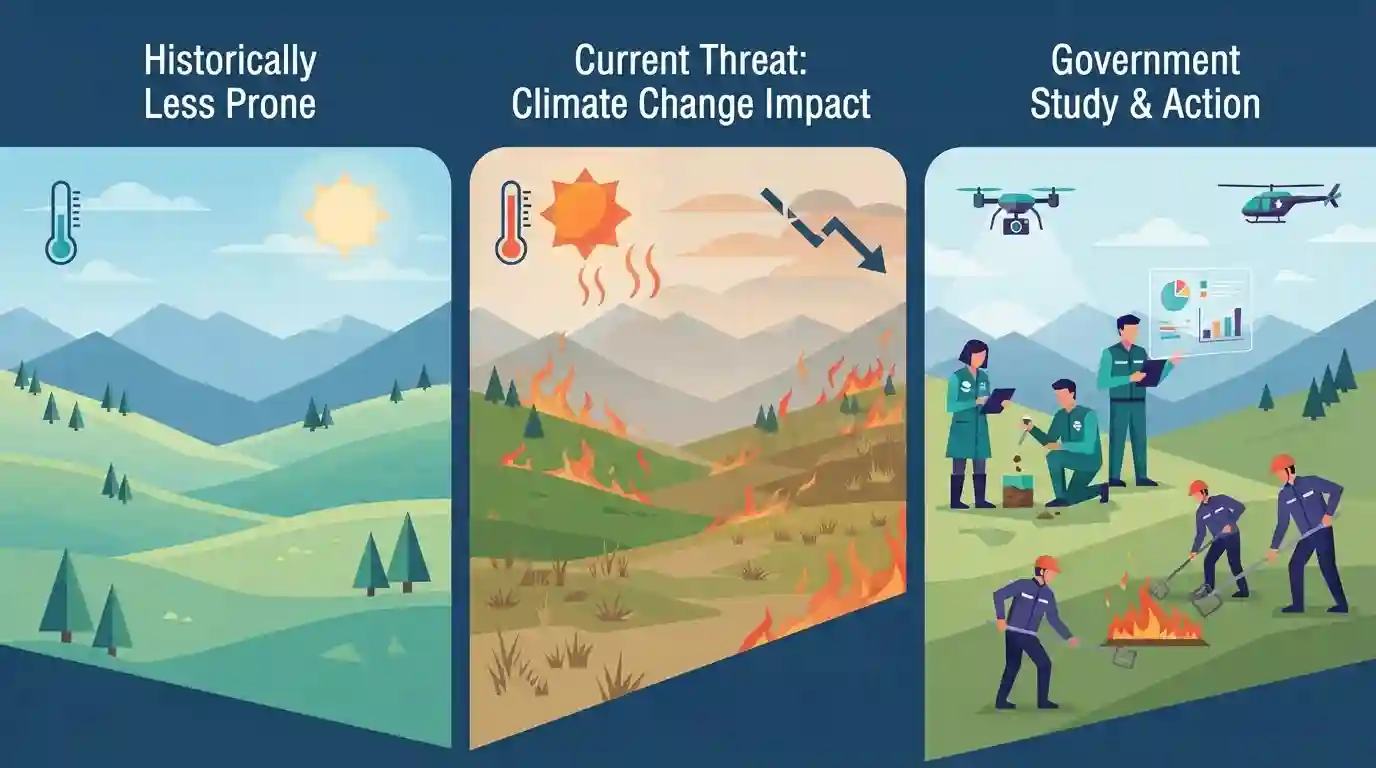
The Uttarakhand government has launched a study to understand and tackle the increasing threat of wildfires in high-altitude ecosystems, such as alpine meadows and bugyals, which were historically less prone to fires but are now facing severe risks due to climate change and changing weather patterns.
Key Points
- Uttarakhand has initiated a comprehensive study to assess the rising threat of wildfires in high-altitude ecosystems (alpine meadows/bugyals).
- Traditionally, forest fires were mostly restricted to lower and mid-altitudinal pine forests, but changing climatic patterns have expanded the risk zone upwards.
- High-altitude ecosystems hold unique flora, fauna, and fragile biodiversity that are vulnerable to fire incidents and slow to regenerate.
Important Terms
Bugyals

Vibrant alpine meadows situated in the higher Himalayan regions of Uttarakhand, serving as crucial grazing grounds and biodiversity hotspots that are increasingly threatened by climate change-induced wildfires.
UPSC context
UKPSC Paper V (Geography & Environment of Uttarakhand); tests understanding of sensitive Himalayan ecosystems, flora-fauna, and vulnerability to anthropogenic and climate pressures.
Uttarakhand Forest Department
State government body responsible for protecting, managing, and conserving forest resources, wildlife, and tackling environmental hazards such as forest fires across Uttarakhand's mountainous terrain.
UPSC context
UKPSC Paper V (Administration & State Policies); tests institutional frameworks governing forest conservation, disaster response, and environmental governance.
Pirul Lao-Paise Pao Campaign
An anti-wildfire campaign launched by the Uttarakhand government incentivizing villagers to collect dry pine needles (pirul) for monetary rewards to reduce highly flammable forest fuel loads.
UPSC context
UKPSC Paper V (Disaster Management & Environment); tests knowledge of state-specific mitigation measures and community participation in wildfire management.
Prelims Trap
Forest fires in Uttarakhand are strictly confined to lower-altitude chir pine forests due to high resin content.
Forest fires in Uttarakhand are no longer restricted to chir pine forests at lower altitudes; climate change has extended the vulnerability zone upwards to fragile high-altitude alpine meadows (bugyals).
Static Concepts Connected
What are the key ecological and geographical features of Himalayan Bugyals in Uttarakhand?
- Altitude Range:: High-altitude alpine grasslands situated above the tree line, typically between 3,000 and 4,000 meters in the Himalayas.
- Seasonal Dynamics:: Covered with snow during winter and blanketed by vibrant alpine flora and medicinal herbs during summer.
- Ecological Role:: Act as natural water recharge zones and fragile carbon sinks, supporting endangered fauna like the snow leopard and Himalayan ibex.
Cross-Topic Patterns
Bugyals Climate Vulnerability + Pastoral Livelihoods
Alpine pastures face dual pressures from unseasonal summer fires and intensive nomadic livestock grazing, disrupting both carbon sinks and traditional pastoral livelihoods in the Greater Himalayas.
High-Altitude Wildfires + NDMA Disaster Frameworks
Shifting fire regimes in Uttarakhand require integrating remote sensing data with National Disaster Management Authority (NDMA) guidelines for high-altitude hazard mitigation.

High-altitude bugyal wildfires + climate change impact on Himalayan ecology likely to be tested via assertion-reason or statement-based MCQs.
Linked PYQs · 3
Linked PYQs · 3
- 2024UKPSC_PRELIMSGS1
Which district of Uttarakhand has highest forest cover share percentage to its total geographical area ?
- 2025UKPSC_PRELIMSGS1
Consider the following statements with reference to animal husbandry in Uttarakhand. Select the correct answer from the codes given below : 1. Animal husbandry is a supplementary occupation of agriculture. 2. Sheep rearing in the mountainous areas has been affected by environmental degradation.
- 2024UKPSC_PRELIMSGS1
Temporary habitats in the high altitude pastures of Garhwal Himalayas are called as
