Uttarakhand Study on High Altitude Wildfire Threats
Source:newindianexpress ↗
Why It Matters
High-altitude wildfires in Uttarakhand represent a shifting ecological crisis driven by climate change, directly impacting alpine biodiversity (bugyals), water security, and disaster management protocols in the Himalayan region.
Summary
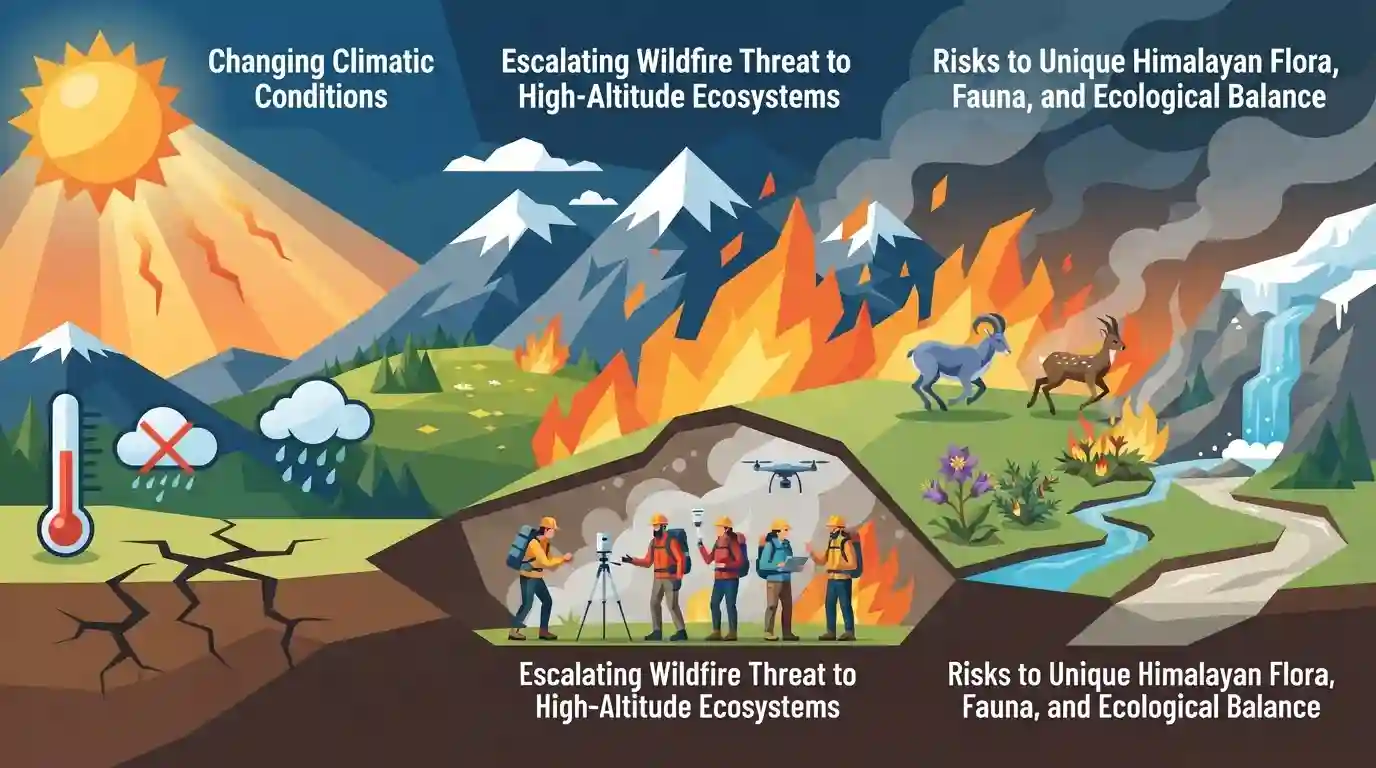
The Uttarakhand government has initiated a specialized scientific study to investigate the escalating wildfire threat to high-altitude ecosystems, such as alpine meadows and higher Himalayan regions, which were previously less vulnerable to fires. Driven by changing climatic conditions and dry spells, this emerging trend poses serious risks to unique Himalayan flora, fauna, and local ecological balance.
Key Points
- Uttarakhand is launching a comprehensive scientific study to understand the rising threat of wildfires in high-altitude ecosystems, including alpine meadows (bugyals).
- Historically perceived as restricted to mid-altitude pine forests, wildfires have increasingly crept into high-altitude zones due to changing climatic patterns, lower winter snowfalls, and drying conditions.
- The study aims to map vulnerability zones, assess damage to fragile alpine flora and fauna, and design localized mitigation strategies for high-altitude protection.
Important Terms
Uttarakhand Forest Department

The state government body in Uttarakhand responsible for the protection, conservation, and scientific management of the state's forests, wildlife, and fragile Himalayan ecosystems.
UPSC context
Relevant for UKPSC Paper V (Environment, Forestry & Disaster Management) and state-specific governance questions regarding environmental protection and wildlife conservation.
Static Concepts Connected
What are alpine meadows (Bugyals) in Uttarakhand and what is their ecological significance?
- Definition: High-altitude pasture lands located above the tree line in the Himalayan region, typically between 3,000 and 4,000 meters.
- Significance: Act as vital carbon sinks, support endemic Himalayan flora and fauna, and sustain pastoral livelihoods through seasonal grazing.
- Vulnerability: Increasingly threatened by climate change, invasive species, and unprecedented high-altitude wildfires.
What is the Pine Pirul Collection Scheme and how does it aid disaster management in Uttarakhand?
- Initiative: An initiative by the Uttarakhand government incentivizing local communities to collect dry chir pine needles (pirul) from forest floors.
- Fire Mitigation: Reduces the fuel load of highly flammable pine needles during peak summer months to prevent devastating surface fires.
- Biomass Utilization: Collected pirul is utilized for biomass briquetting, power generation, and alternative rural livelihood creation.
Cross-Topic Patterns
Himalayan Wildfires & NAPCC Mission on Sustaining Himalayan Ecosystem
Uttarakhand's high-altitude fires intersect with the National Action Plan on Climate Change (NAPCC) Himalayan Eco-system mission, testing adaptive governance.

High-altitude forest fires + bugyal vulnerability + Pirul scheme likely to feature as a multi-statement environment question in UKPSC PCS.
Linked PYQs · 2
Linked PYQs · 2
- 2025UKPSC_PRELIMSGS1
Consider the following statements with reference to animal husbandry in Uttarakhand. Select the correct answer from the codes given below : 1. Animal husbandry is a supplementary occupation of agriculture. 2. Sheep rearing in the mountainous areas has been affected by environmental degradation.
- 2024UKPSC_PRELIMSGS1
Which district of Uttarakhand has highest forest cover share percentage to its total geographical area ?
