Uttarakhand establishes India first Agniveer employment cell
Source:indiatvnews ↗
Why It Matters
This is a first-of-its-kind state initiative aimed at rehabilitation and employment generation for defense personnel exiting the Agnipath scheme, setting a precedent for other states.
Summary
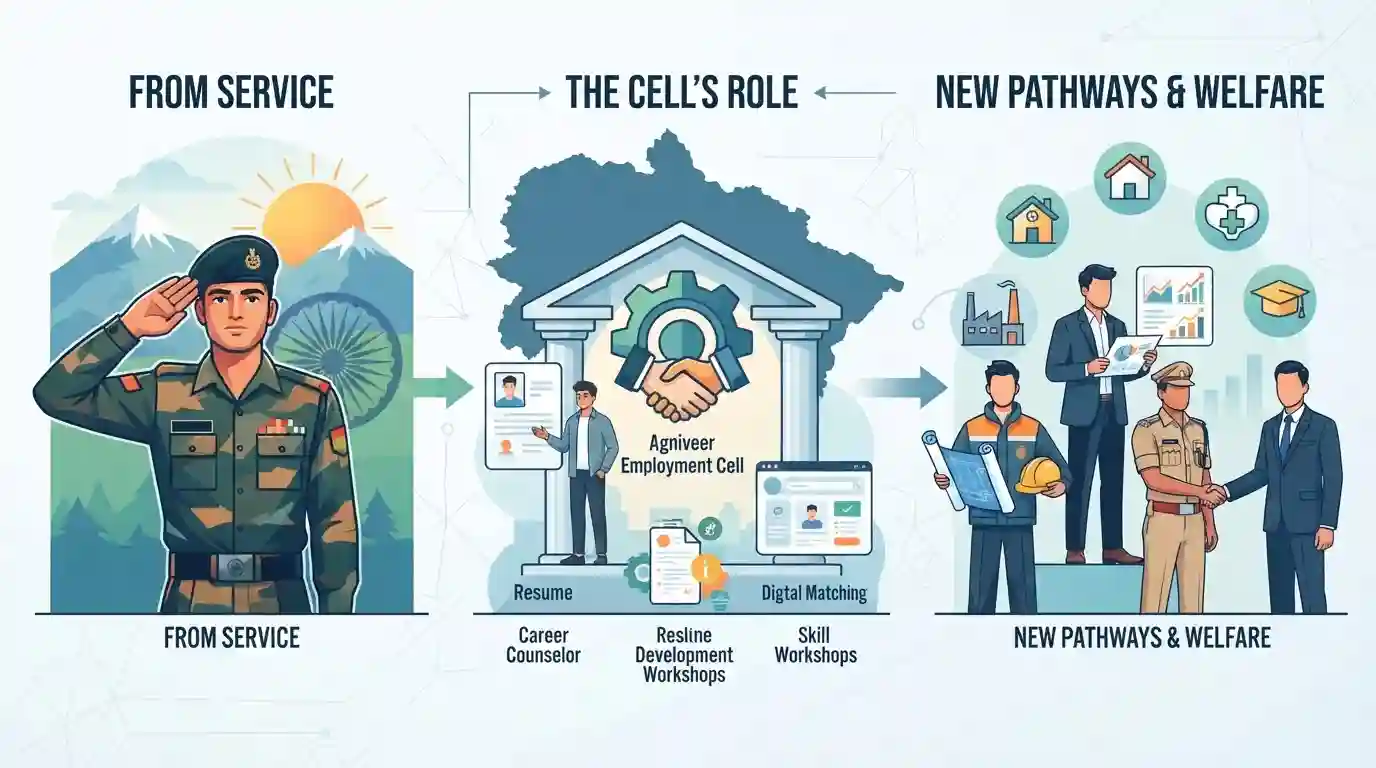
Uttarakhand has set up India's first Agniveer Employment Cell, a pioneering state initiative aimed at facilitating career transitions, jobs, and access to government schemes for Agniveers completing their service under the Agnipath military recruitment scheme.
Key Points
- Uttarakhand became the first state in India to establish an Agniveer Employment Cell to assist demobilized Agniveers with jobs and government welfare schemes.
- The specialized cell aims to streamline re-employment opportunities, ensuring career transition support for youth completing their tenure under the Agnipath military recruitment scheme.
- The state government emphasized prioritizing disciplined and trained personnel for various state-level administrative and security services.
Important Terms
Agnipath Scheme

A central government military recruitment scheme introduced in 2022 where youth are enrolled in the armed forces for a short-term contract of four years.
UPSC context
Relevant for UPSC Prelims and Mains (GS Paper II/III) regarding defense policy, recruitment reforms, and youth employment trends.
Agniveer Employment Cell Initiative
A pioneering state initiative launched by Uttarakhand to assist former Agniveers in career transitions, civilian jobs, and access to government welfare schemes.
UPSC context
Important for UKPSC Prelims and Mains (State Governance and Public Policy), testing state-specific implementation of national defense welfare frameworks.
Uttarakhand Government
The provincial administration of Uttarakhand that enacted policy measures including a 10 percent quota and a dedicated employment cell for demobilized soldiers.
UPSC context
Crucial for UKPSC exams covering regional state governance, administrative decisions, and ex-servicemen welfare policies.
Static Concepts Connected
What are the key provisions and eligibility criteria of the Agnipath military recruitment scheme in India?
- Tenure & Entry: Recruits soldiers called Agniveers into the Army, Navy, and Air Force for a contractual tenure of four years.
- Age & Criteria: Open to youth aged 17.5 to 21 years (subsequently relaxed during initial rollouts) meeting medical standards.
- Retention Clause: At the end of four years, up to 25% of each batch are retained in regular service based on merit and organizational requirements.
- Seva Nidhi Package: Provides a non-contributory Seva Nidhi exit package along with skill certificates recognized nationally.
Cross-Topic Patterns
Defence Recruitment + State Demography Linkages
Uttarakhand's heavy martial representation connects state-level welfare and employment guarantees with national defence recruitment policies like Agnipath.
Horizontal Reservation + Public Employment Policy
Horizontal reservations for demobilized personnel intersect with constitutional provisions on reservations and state administrative recruitment rules.

Uttarakhand's pioneering Agniveer cell + 10% horizontal quota likely to feature in state PCS questions on welfare schemes.
Linked PYQs · 3
Linked PYQs · 3
- 2025UKPSC_PRELIMSGS1
Which programme was approved by the Union Cabinet in April, 2025 to develop border villages ?
- 2025UKPSC_PRELIMSGS1
Arrange the following social welfare schemes in chronological order: i. Integrated Rural Development Programme (IRDP) ii. Rural Employment Generation Programme (REGP) iii. Prime Minister Rojgar Yojana (PMRY) iv. Rural Landless Employment Guarantee Programme (RLEGP)
- 2025UKPSC_PRELIMSGS1
Consider the following statements with reference to Uttarakhand and choose the correct answer: 1. The executive of Uttarakhand includes Governor as the head of the state. 2. It also includes the Chief Minister and his/her council of ministers.
