AIIA Proposed Near Satellite AIIMS in Kichha Udham Singh Nagar
Source:medicaldialogues ↗
Why It Matters
Health infrastructure projects in Uttarakhand, state health policies, and geographic indicators of major districts like Udham Singh Nagar are frequently tested in the UKPSC PCS Prelims exam. This development bridges national AYUSH initiatives with local administrative governance.
Summary
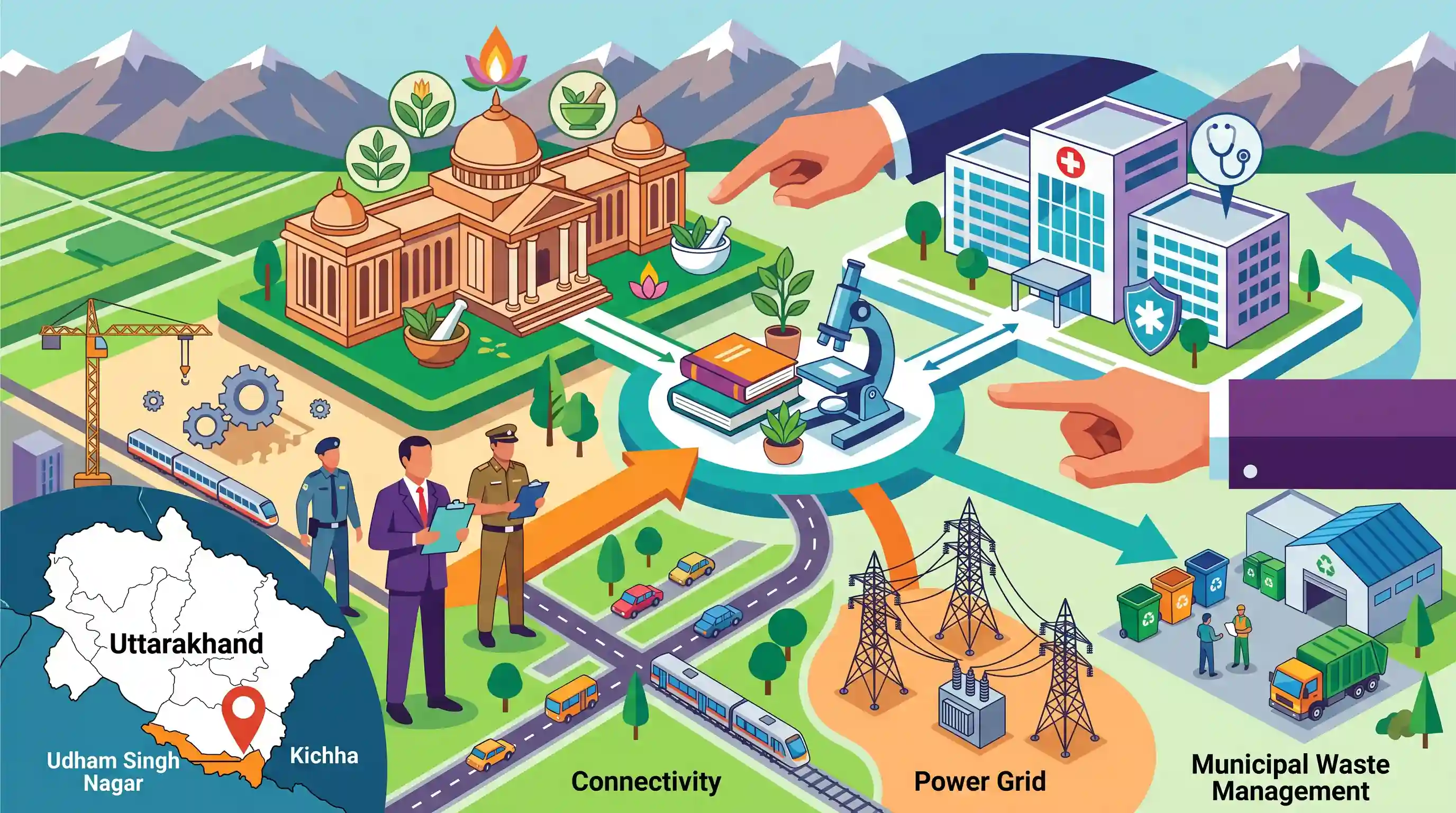
The Government of Uttarakhand has initiated preliminary planning and site evaluation to establish an All India Institute of Ayurveda (AIIA) in Kichha, Udham Singh Nagar district. The apex institution will be built near the proposed Satellite AIIMS, establishing an integrated healthcare and AYUSH research cluster. Additional Secretary of the AYUSH Department, Shri Vijay Kumar Jogdande, led inspections with district administrative officials to assess connectivity, power grid requirements, and municipal waste management capabilities.
Key Points
- Proposed Location & Synergy: Uttarakhand is planning to establish an All India Institute of Ayurveda (AIIA) near the proposed Satellite AIIMS in Kichha, Udham Singh Nagar district, creating a major integrated healthcare node in the Tarai region.
- Administrative Site Inspection: Additional Secretary of the state's AYUSH Department, Shri Vijay Kumar Jogdande, inspected the identified site and conducted a high-level review meeting to finalize preliminary infrastructure requirements.
- Multi-departmental Assessments: The Public Works Department (PWD) is tasked with preparing reports on connectivity to national highways, airports, bus stations, and railways. The electricity department is studying the feasibility of a dedicated power substation, and municipal authorities are evaluating local solid waste management schemes.
- Significance of AIIA: The All India Institute of Ayurveda is an apex institution (modeled on AIIMS) established under the Ministry of AYUSH. Setting it up in Uttarakhand leverages the state's natural resource base of medicinal herbs and elevates national traditional healthcare infrastructure.
Important Terms
National AYUSH Mission

A Centrally Sponsored Scheme launched in 2014 to promote cost-effective and equitable AYUSH healthcare services across India, upgrade institutional infrastructure, and support medicinal plant cultivation.
UPSC context
GS Paper II (Government Schemes) and Health; tests knowledge of schemes integrating traditional medicine with public health.
All India Institute of Ayurveda
An apex autonomous public research and tertiary-care institution under the Ministry of AYUSH, modeled on AIIMS to merge traditional Ayurvedic wisdom with modern diagnostic and clinical tools.
UPSC context
GS Paper II (Social Sector/Health); tests knowledge of institutions advancing scientific research in traditional medicine.
Ministry of AYUSH
A Union Government ministry established in 2014 to oversee education, research, propagation, and regulation of traditional and alternative medicine systems, including Ayurveda and Homoeopathy.
UPSC context
GS Paper II (Governance and Health Administration); tests understanding of the institutional framework regulating traditional health systems.
All India Institute of Medical Sciences
A group of autonomous public medical universities and super-specialty tertiary care hospitals declared as Institutes of National Importance under the Ministry of Health and Family Welfare.
UPSC context
GS Paper II (Social Sector/Health); tests knowledge of India's premier public health infrastructure and tertiary healthcare.
AYUSH Department, Government of Uttarakhand
A dedicated state department in Uttarakhand responsible for expanding traditional healthcare infrastructure, promoting wellness tourism, and executing national and state-level AYUSH policies.
UPSC context
GS Paper II (State Government Policies/Health); tests awareness of regional wellness tourism and health administration.
Prelims Trap
The National AYUSH Mission is a Central Sector Scheme fully funded by the Central Government across all States.
It is a Centrally Sponsored Scheme, not a Central Sector Scheme. Funding is shared 60:40 with general states and 90:10 with Himalayan states like Uttarakhand.
Static Concepts Connected
What is 'Integrative Medicine' under the National Health Policy 2017?
- Core Philosophy: Combining traditional AYUSH systems with modern allopathy to provide pluralistic, holistic healthcare choices.
- Co-location Strategy: Establishing AYUSH facilities within existing modern healthcare centers like District Hospitals and AIIMS.
- Cross-Referrals: Creating institutional channels for evidence-based reciprocal referrals between traditional and allopathic practitioners.
How is the National AYUSH Mission funded?
- Scheme Type: It operates as a Centrally Sponsored Scheme (CSS) launched to upgrade AYUSH hospitals and wellness systems.
- Funding Ratios: Shared 60:40 for general states, 90:10 for Himalayan/Northeastern states, and 100% central funding for UTs.
Cross-Topic Patterns
Traditional knowledge + Intellectual Property
Linking Himalayan medicinal plant cultivation to the Traditional Knowledge Digital Library (TKDL) protects indigenous resources from global biopiracy.
Health infrastructure + Fiscal federalism
Differential funding patterns under the National AYUSH Mission highlight how fiscal federalism supports ecologically fragile, resource-rich Himalayan states.

UPSC may frame a 2026 question linking the National Health Policy 2017's 'Integrative Medicine' mandate with AYUSH-AIIMS co-location.
Linked PYQs · 3
Linked PYQs · 3
- 2025UKPSC_PRELIMSGS1
Which of the following records is not maintained by the Panchayats in Uttarakhand?
- 2024UKPSC_PRELIMSGS1
Districts are arranged in ascending order in terms of female literacy rate. Choose the correct option :
- 2025UKPSC_PRELIMSGS1
What is total score obtained by Uttarakhand in 6ᵗʰ Food Security Index, 2024?
