Tehri Garhwal Caste Violence Standoff Resolution and Legal Action
Source:hindustantimes ↗
Why It Matters
This development emphasizes the persistent social challenge of caste-based discrimination and violence in rural/hilly pockets of India. For civil services aspirants, it illustrates the crucial role of administrative crisis resolution, the application of special legislation (SC/ST Act), and the function of State Scheduled Castes Commissions in enforcing social justice and maintaining public order.
Summary
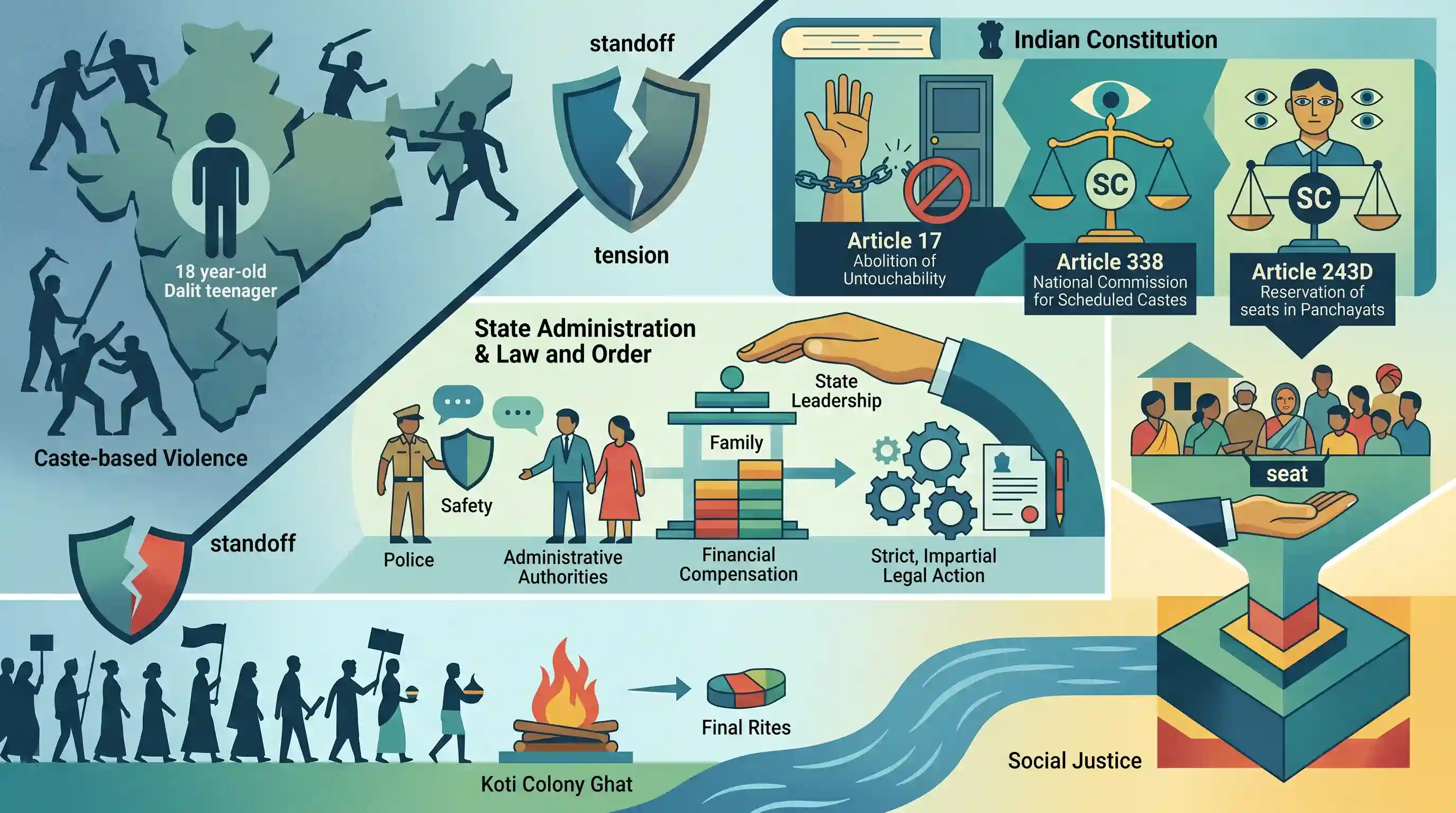
A tense standoff in Tehri Garhwal, Uttarakhand, following the murder of an 18-year-old Dalit teenager, Ketan Lal, ended after the family performed his final rites. The family agreed to take custody of the body and conduct the cremation at Koti Colony Ghat after receiving assurances of safety, financial compensation, and strict, impartial legal action from police, administrative authorities, and state leadership.
Key Points
- An 18-year-old Dalit teenager, Ketan Lal, was brutally assaulted and murdered along with his friend, Diwakar Dimri, in Kholgarh village, Tehri Garhwal district.
- The main accused, including Yashveer Singh Panwar, allegedly locked them in a room and beat them with sticks over a personal relationship/dispute.
- The victim's family and local villagers staged a protest and initially refused to perform the final rites, demanding a ₹1 crore compensation, police protection, a government job for a family member, and the death penalty for the accused.
- The standoff ended after assurances from senior police officials (SSP Shweta Choubey, ASP Deepak Kumar), local public representatives, and political figures, including State Social Welfare Minister Khajan Das and State Scheduled Castes Commission Chairman Mukesh Kumar.
- Two accused have been arrested and sent to judicial custody, and a specialized forensic team has inspected the crime scene in Kholgarh village to gather scientific evidence for an impartial investigation.
Important Terms
Scheduled Castes and Scheduled Tribes (Prevention of Atrocities) Act, 1989

A landmark Indian legislation enacted to prevent caste-based discrimination, violence, and humiliation against marginalized communities, establishing special courts for speedy justice.
UPSC context
GS Paper II: Social Justice & Polity; tests legal frameworks safeguarding vulnerable sections.
Article 17 of the Indian Constitution
A fundamental right that abolishes the practice of "untouchability" in any form, declaring the enforcement of any resulting disability as a punishable criminal offense.
UPSC context
GS Paper II: Indian Constitution; tests fundamental rights and social equality.
Article 338 of the Indian Constitution
A constitutional provision that establishes the National Commission for Scheduled Castes (NCSC) to investigate safeguards, inquire into rights violations, and advise on SC development.
UPSC context
GS Paper II: Constitutional Bodies; tests institutional safeguards protecting vulnerable communities.
Uttarakhand State Scheduled Castes Commission
A state-level statutory body in Uttarakhand responsible for monitoring constitutional safeguards, investigating caste-based grievances, and ensuring justice for Scheduled Castes.
UPSC context
GS Paper II: Welfare Mechanisms; tests state-level institutions protecting vulnerable populations.
Uttarakhand Social Welfare Department
A state department responsible for executing socio-economic welfare schemes, scholarships, and pensions designed to uplift marginalized sections, including Scheduled Castes and Scheduled Tribes.
UPSC context
GS Paper II: Welfare Schemes; tests administration and policy implementation for vulnerable groups.
Prelims Trap
Section 4 of the SC/ST Act penalizes any public servant for willful neglect of duty, regardless of their own social/caste background.
The penal provision for willful neglect of duty under Section 4 applies strictly to public servants who are NOT members of a Scheduled Caste or Scheduled Tribe.
Static Concepts Connected
What is the mandate and constitutional status of the National Commission for Scheduled Castes (NCSC)?
- Constitutional Status: Established under Article 338; separated from STs via the 89th Amendment Act, 2003, to ensure focused implementation of safeguards.
- Inquiry Powers: Vested with the powers of a civil court while investigating complaints of rights violations and atrocities against Scheduled Castes.
- Consultative Mandate: Requires Union and State governments to consult the Commission on all major policy decisions affecting the SC community.
What is the significance of Section 4 of the SC/ST (PoA) Act, 1989?
- Targeted Accountability: Penalizes public servants (who are not members of SC/ST) for willful neglect of duties prescribed under the Act.
- Penal Term: Prescribes a mandatory minimum imprisonment of six months, extendable up to one year, for proven administrative lapses.
Cross-Topic Patterns
Social marginalization & hill-state out-migration
Intersectional vulnerability, combining economic distress (negative decadal growth) with caste-based violence, forces marginalized communities in rugged terrains to migrate to safer urban plains.
Statutory compensation & administrative conflict resolution
State-led immediate financial compensation and employment assurances during caste standoffs reflect a pivot from purely penal enforcement to restorative social justice mechanisms.

Mains 2026 may analyze how administrative apathy under Section 4 of the SC/ST Act acts as a structural bottleneck in preventing rural atrocities.
Linked PYQs · 2
Linked PYQs · 2
- 2016UKPSC_PRELIMSGS1
Under which Article of the Constitution the Separate Scheduled Tribe Commission was established?
- 2016UKPSC_PRELIMSGS1
Which one of the following Articles provides reservation of seats for the Scheduled Castes and Scheduled Tribes in the Panchayats?
