Uttarakhand Sanskrit Commission Proposed for Language Preservation
Source:indianmasterminds ↗
Why It Matters
The article highlights state-level initiatives to promote ancient languages and integrate them with modern technology. This is relevant for UKPSC PCS Prelims questions regarding Uttarakhand's official languages, cultural policies, and the establishment of new state commissions.
Summary
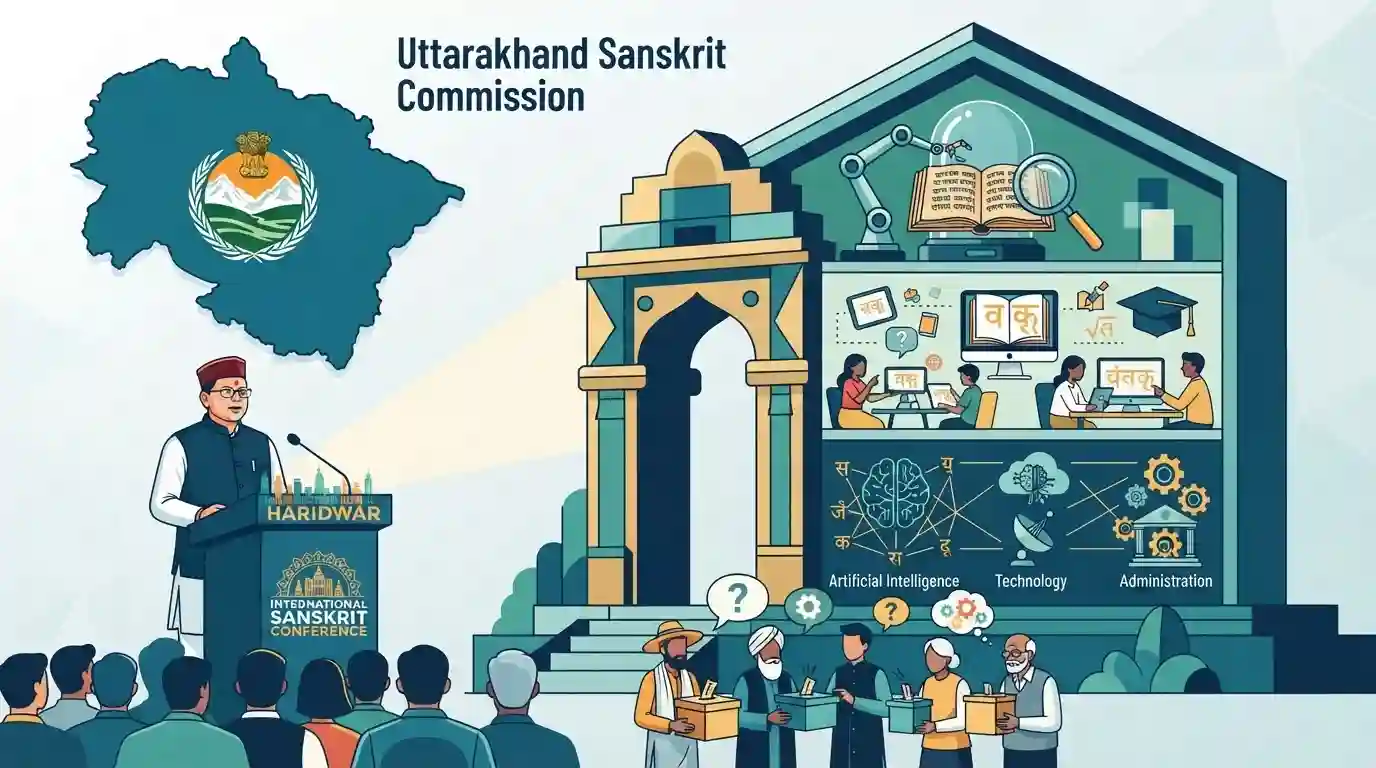
The Uttarakhand government is setting up the 'Uttarakhand Sanskrit Commission' to preserve, promote, and expand the modern application of the Sanskrit language. Building on its status as the state's second official language since 2010, the new commission will focus on safeguarding ancient manuscripts, improving Sanskrit education, and integrating the language with contemporary fields such as Artificial Intelligence, technology, and administration. The initiative gained momentum following Chief Minister Pushkar Singh Dhami's push at the December 2025 International Sanskrit Conference in Haridwar, with the state now inviting stakeholder suggestions on the commission's structure and goals.
Key Points
- The Uttarakhand government has initiated the process of establishing the 'Uttarakhand Sanskrit Commission' to promote, protect, and modernize the use of the Sanskrit language.
- Sanskrit was officially designated as the second official language of Uttarakhand in the year 2010.
- The commission aims to integrate traditional Sanskrit knowledge with modern domains, including Artificial Intelligence, technology, and administration.
- Chief Minister Pushkar Singh Dhami emphasized the necessity of a high-level commission during the International Sanskrit Conference held in Haridwar in December 2025.
- Stakeholders have been invited to provide suggestions regarding the structure, rights, and objectives of the upcoming commission to ensure comprehensive language preservation.
Important Terms
Uttarakhand Sanskrit Commission

A proposed state-level body in Uttarakhand focused on promoting Sanskrit education, digitizing ancient manuscripts, and integrating the language with modern technologies like Artificial Intelligence and digital media.
UPSC context
Relevant to GS-1 (Culture) and GS-2 (Government Policies). Shows state-level institutional efforts to preserve classical languages.
Sanskrit Academy
A state-backed institution in Uttarakhand dedicated to researching and promoting Sanskrit literature, which notably hosted the December 2025 International Sanskrit Conference in Haridwar.
UPSC context
GS-1 (Indian Heritage and Culture). Illustrates the role of dedicated state academies in organizing global linguistic platforms.
Gurukul Kangri
A deemed university in Haridwar rooted in the Arya Samaj's educational revivalist movement. It serves as a major stakeholder and historic center for Sanskrit and Vedic studies in Uttarakhand.
UPSC context
GS-1 (Modern History & Culture). Tests knowledge of colonial-era indigenous education reform and its modern relevance.
Prelims Trap
Article 351 of the Indian Constitution directs the Union to promote and develop the Sanskrit language as a national medium.
Article 351 specifically directs the development of Hindi, directing that it draw its vocabulary primarily from Sanskrit. It does not mandate Sanskrit's promotion as a national medium.
Static Concepts Connected
What are the core constitutional provisions regarding State Official Languages and language directives?
- Article 345: Allows state legislatures to adopt any language in use in the state, or Hindi, as its official language.
- Article 351: Directs the Union to spread and develop Hindi, drawing vocabulary primarily from Sanskrit and secondarily from others.
- Eighth Schedule: Contains 22 languages; inclusion provides representation on the Official Languages Commission but does not mandate official state-use.
What is the 'Classical Language' status and its benefits in India?
- Eligibility Criteria: Requires high antiquity of texts (1500–2000 years), original literary tradition, and a heritage of ancient literature.
- Sanskrit's Status: Declared as India's second Classical Language in 2005, shortly after Tamil became the first in 2004.
- Key Benefits: Includes funding for Centers of Excellence and the creation of professional academic chairs in Central Universities.
Cross-Topic Patterns
AI translation + Indigenous heritage preservation
Using the National Language Translation Mission (Bhashini) to decode and digitize Sanskrit manuscripts bridges the gap between frontier Artificial Intelligence and Indology.
Article 345 + Federal cultural autonomy
States leveraging official language provisions to elevate non-dominant or classical languages reflects constitutional space for regional cultural assertion.

Constitutional distinctions between Articles 345, 348, and 351 alongside Classical Language criteria are highly probable areas for a 2026 MCQ.
Linked PYQs · 1
Linked PYQs · 1
- 2016UKPSC_PRELIMSGS1
Which of the following was given the classical language status in 2014?
