Uttarakhand Integrated Tourism City and Spiritual Economic Zone
Source:indianmasterminds ↗
Why It Matters
Uttarakhand relies heavily on tourism for revenue and employment. Understanding infrastructure initiatives like Integrated Tourism Cities, Spiritual Economic Zones, and hub-and-spoke models is crucial for PCS Prelims (State Specific Economy/Infrastructure) and GS3 (Investment Models, Infrastructure).
Summary
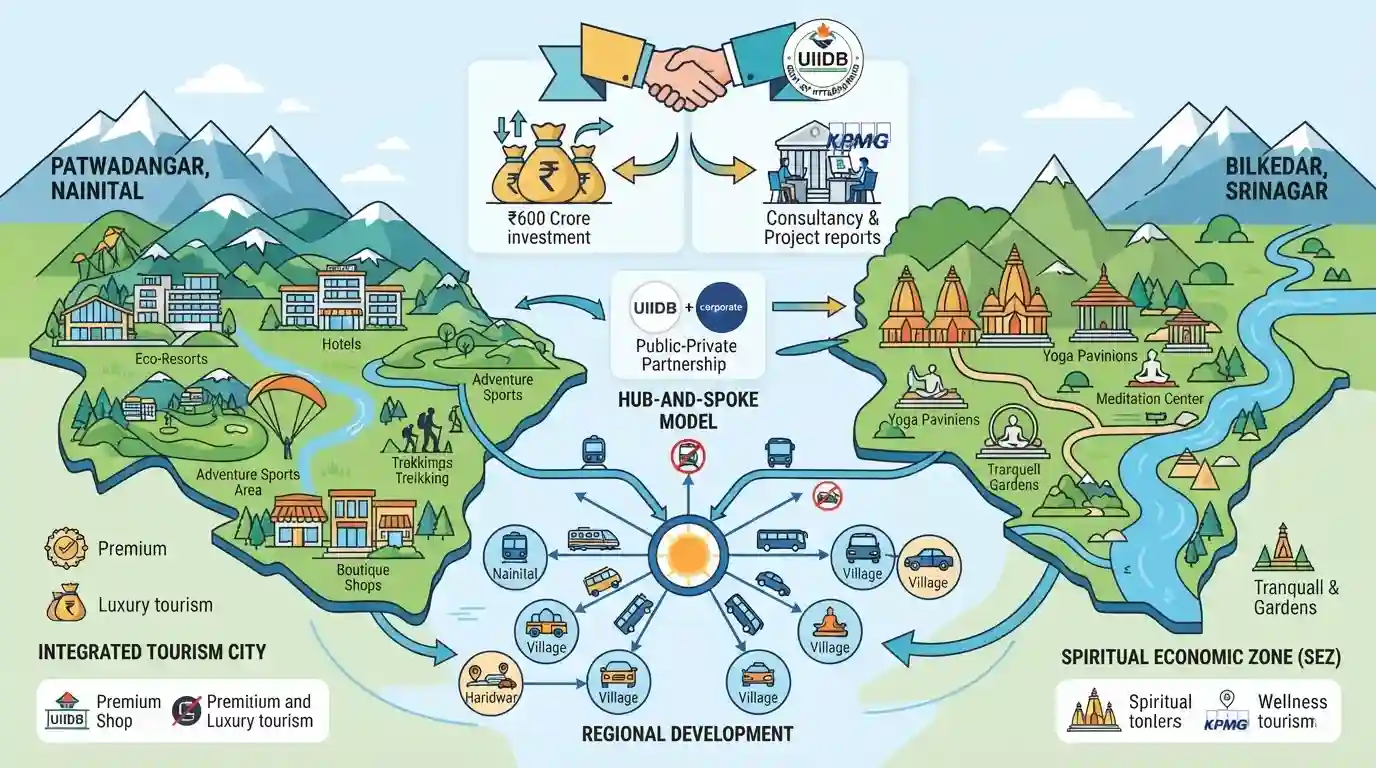
The Uttarakhand government, through the UIIDB, is investing ₹600 crore to develop an Integrated Tourism City in Patwadangar, Nainital, and a Spiritual Economic Zone (SEZ) in Bilkedar, Srinagar. Aimed at premium and spiritual tourists, these projects will utilize a public-private partnership and follow a hub-and-spoke model to reduce congestion in traditional tourist spots and promote balanced regional development. Global consultancy KPMG is preparing the Detailed Project Report for the initiatives.
Key Points
- The Uttarakhand Infrastructure Investment Development Board (UIIDB) has approved ₹600 crore to develop an Integrated Tourism City in Patwadangar (Nainital) and a Spiritual Economic Zone in Bilkedar (Srinagar tehsil).
- The project will follow a hub-and-spoke model, aiming to decentralize tourism by connecting prominent hubs to newer, lesser-known locations.
- The Integrated Tourism City will feature eco-tourism resorts, wellness centers, and a golf course across 109 acres, focusing on high-spending premium tourists.
- The Spiritual Economic Zone in Bilkedar will cover 87 hectares and include meditation centers, Ayurvedic retreats, and cultural pavilions.
- Global consultancy firm KPMG has been selected as the transactional advisor to prepare the Detailed Project Report (DPR) and finalize private sector partnerships within 9 months.
Important Terms
Integrated Tourism City

A comprehensive, master-planned destination offering diverse hospitality, wellness, and leisure infrastructure. In Uttarakhand, it aims to attract private investment and position the state as a premium tourism hub.
UPSC context
Relevant to GS-3 (Infrastructure/Investment Models). Highlights targeted infrastructure development and public-private partnerships to boost the regional tourism economy.
Spiritual Economic Zone (SEZ)
A specialized zone that integrates religious tourism with local economic sectors such as wellness, Ayurveda, handicrafts, and agriculture to promote sustainable, holistic regional growth.
UPSC context
Covers GS-3 (Economic Development) and GS-1 (Culture). Showcases innovative approaches linking spiritual circuits with local employment and heritage economies.
Hub-and-Spoke Model
A spatial management strategy where a central hub acts as a base for visitors who take day trips to surrounding attractions, ensuring balanced regional development and decongesting popular sites.
UPSC context
Essential for GS-1 (Geography) and GS-3 (Infrastructure). Tests knowledge of sustainable spatial planning and carrying capacity management in eco-sensitive zones.
Uttarakhand Investment and Infrastructure Development Board (UIIDB)
A nodal state agency created to catalyze transformative infrastructure, implement large-scale development projects, and promote public-private partnerships (PPPs) across Uttarakhand.
UPSC context
Connects to GS-2 (State Governance) and GS-3 (Investment Models). Tests understanding of specialized statutory bodies created for economic progress.
Prelims Trap
Uttarakhand's new SEZ in Bilkedar is a duty-free enclave designed to boost manufacturing exports.
In this context, SEZ stands for 'Spiritual Economic Zone' aimed at wellness tourism, not a conventional trade/export-oriented Special Economic Zone.
Static Concepts Connected
What is the Hub-and-Spoke model in infrastructure?
- Network Design: A system where a centralized 'hub' routes traffic, tourists, or resources to smaller, distributed 'spokes' (emerging nodes).
- De-congestion: It eases pressure on primary tourist hubs by geographically dispersing activity, preventing ecological and infrastructural bottlenecks.
What drives the 'Ghost Villages' phenomenon in Himalayan states?
- Economic Out-migration: A lack of local livelihood and modern infrastructure drives the working-age population to migrate to the plains.
- Remittance Trap: High reliance on money sent back by migrants, while local agrarian and traditional mountain economies steadily collapse.
Cross-Topic Patterns
Hill Tourism & Carrying Capacity
Dispersing tourist footfall from Nainital to emerging hubs addresses the critical ecological carrying capacity issue highlighted by the recent Joshimath land subsidence crisis.
Wellness Economy & Soft Power
Establishing 'Spiritual Economic Zones' institutionalizes India's soft power, bridging local state economic revitalization (curbing out-migration) with the Union's broader AYUSH and wellness export strategy.

Himalayan carrying capacity linked to decentralized tourism models (Hub-and-Spoke) is highly probable for a GS3 Mains question in 2026.
Linked PYQs · 2
Linked PYQs · 2
- 2024UKPSC_PRELIMSGS1
UTDB is established in Uttarakhand to promote:
- 2025UKPSC_PRELIMSGS1
As per Uttarakhand Budget 2025-26, the amount allocated for Char Dham Road network improvement is
