Centre Grants Special Assistance for Uttarakhand Infrastructure
Source:indianmasterminds ↗
Why It Matters
Understanding center-state fiscal transfers and capital investment mechanisms is crucial for analyzing India's cooperative federalism and regional infrastructure development strategies, especially relevant for state-specific economic growth.
Summary
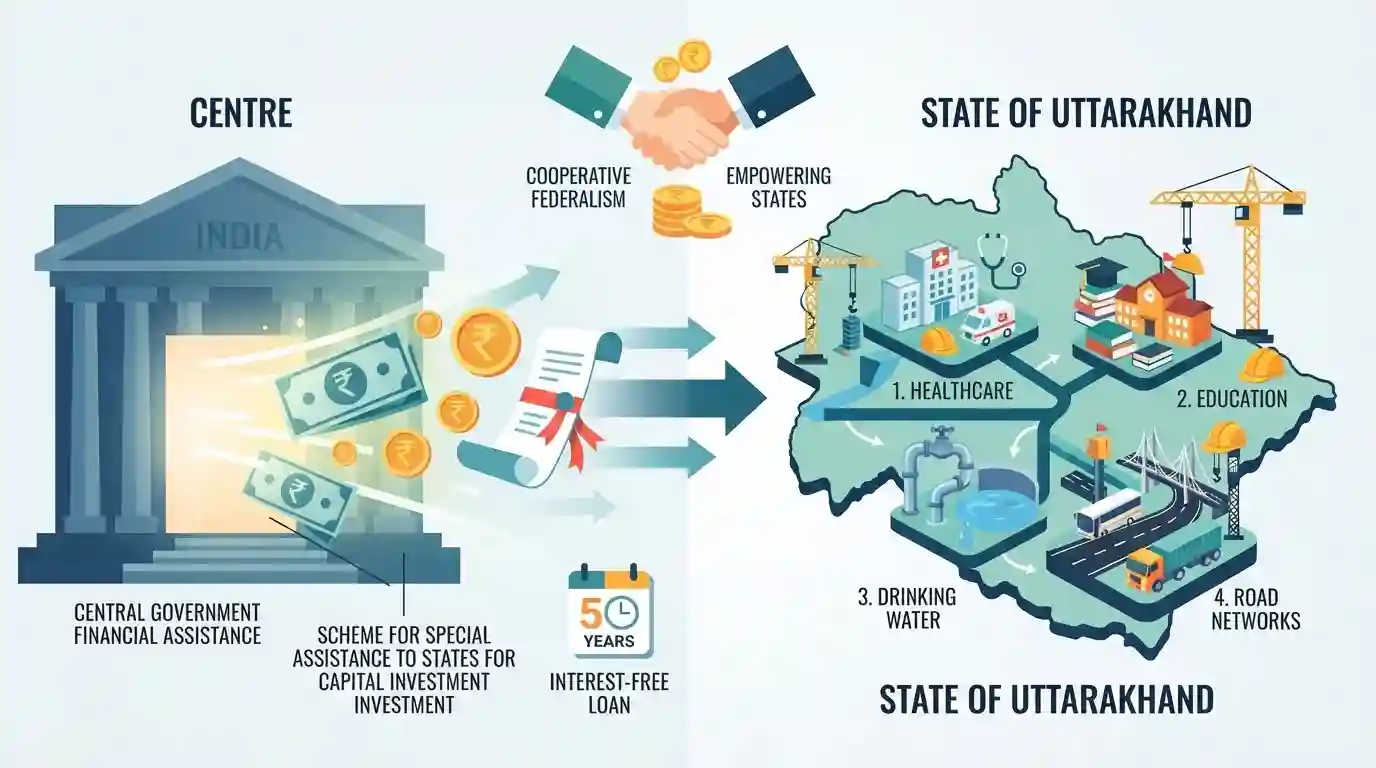
Uttarakhand has secured an untied financial allocation of ₹451.63 crore from the Central Government under the 'Scheme for Special Assistance to States for Capital Investment 2024-25'. Provided as a 50-year interest-free loan, the funds offer the state administration complete flexibility to accelerate capital expenditure and fund critical infrastructure projects across diverse sectors such as healthcare, education, drinking water, and road networks. This financial support highlights cooperative federalism by empowering states to address their specific developmental priorities.
Key Points
- Uttarakhand has received ₹451.63 crore as special assistance from the Union Ministry of Finance.
- The financial aid is disbursed under the 'Scheme for Special Assistance to States for Capital Investment 2024-25'.
- The funds are provided as a 50-year interest-free loan to augment capital expenditure by the state.
- The allocation is entirely 'untied', allowing the state government full flexibility to invest across various sectors like health, education, irrigation, and roads.
- Chief Minister Pushkar Singh Dhami stated that this will significantly accelerate comprehensive infrastructure development in the state.
Important Terms
Scheme for Special Assistance to States for Capital Investment (2024-25)

A Central government initiative providing 50-year interest-free loans to state governments for capital investment and infrastructure projects, helping boost long-term economic growth over and above normal borrowing limits.
UPSC context
GS Paper III (Economy & Budgeting); tests understanding of government schemes, capital expenditure incentives, and fiscal devolution.
Capital Expenditure (Capex)
Government spending on acquiring, constructing, or upgrading physical and social assets like roads, schools, and hospitals that build productive capacity and generate long-term economic revenue.
UPSC context
GS Paper III (Economic Development); tests knowledge of public finance, budgeting, and the macroeconomic multiplier effect of government spending.
Fiscal Federalism
The constitutional division of financial powers, tax authority, expenditure responsibilities, and resource allocation between different levels of government, particularly between the Centre and the States.
UPSC context
GS Paper II (Polity & Governance); tests understanding of Indian federalism, Centre-State financial relations, and devolution mechanisms like the Finance Commission.
Cooperative Federalism
A governance model where central, state, and local governments collaborate and work together through dialogue and shared responsibilities to solve national problems and implement development plans.
UPSC context
GS Paper II (Polity); tests core federal features, collaborative governance, and the functioning of intergovernmental bodies like NITI Aayog.
Ministry of Finance
A key central ministry responsible for the formulation of India's Union Budget, administration of taxation, financial regulations, capital expenditure schemes, and overall macroeconomic policy.
UPSC context
GS Paper III (Government Budgeting); tests understanding of financial administration, public policy formulation, and fiscal management.
Prelims Trap
Funds under the 'Special Assistance to States for Capital Investment' are non-repayable grants-in-aid.
It is a 50-year interest-free loan, meaning it ultimately adds to the state's debt obligations. Aspirants often confuse this discretionary aid with non-repayable statutory grants under Article 275.
Static Concepts Connected
What are the constitutional provisions governing borrowings by State governments?
- Internal borrowing only: States are prohibited from raising loans directly from foreign governments or international institutions; they can only borrow within the territory of India.
- Centre's prior consent: Under Article 293, a state needs the Centre's explicit consent to raise fresh loans if it has any outstanding debt owed to the Government of India.
Why does macroeconomic policy heavily favor Capital Expenditure (CapEx)?
- High multiplier effect: Every ₹1 spent on CapEx generates ₹2.25 to ₹3 in economic output, creating a stronger cascading impact on job creation and allied industries.
- Productive asset creation: Unlike revenue expenditure which is consumed in day-to-day administration, CapEx focuses on physical asset creation or liability reduction, drastically improving long-term productivity.
Cross-Topic Patterns
Untied loans vs. Reform-linked borrowing
While this specific allocation is untied, the Centre often links extra state borrowing space (under FRBM limits) to specific sectoral reforms, such as power distribution or citizen-centric governance.
CapEx push vs. Himalayan Ecological Vulnerability
Unfettered infrastructure spending (roads, irrigation) in Himalayan states like Uttarakhand constantly intersects with GS3 disaster management, specifically concerning carrying capacity and landslide susceptibility.

Expect a 2026 Prelims question conflating Article 293 state borrowing constraints with 50-year interest-free loans and statutory grants.
Linked PYQs · 3
Linked PYQs · 3
- 2016UKPSC_PRELIMSGS1
According to the 14th Finance Commission, the percentage share of States in the net proceeds of the shareable Central tax revenue should be
- 2024UKPSC_PRELIMSGS1
UTDB is established in Uttarakhand to promote:
- 2025UKPSC_PRELIMSGS1
As per Uttarakhand Budget 2025-26, the amount allocated for Char Dham Road network improvement is
