Uttarakhand executes major administrative reshuffle of senior officers
Source:socialnews ↗
Why It Matters
Understanding state-level administrative machinery and the deployment of All India Services (IAS, IFS) is crucial for topics concerning the State Executive, Governance, and Public Administration under the GS-2 syllabus of UKPSC PCS Prelims.
Summary
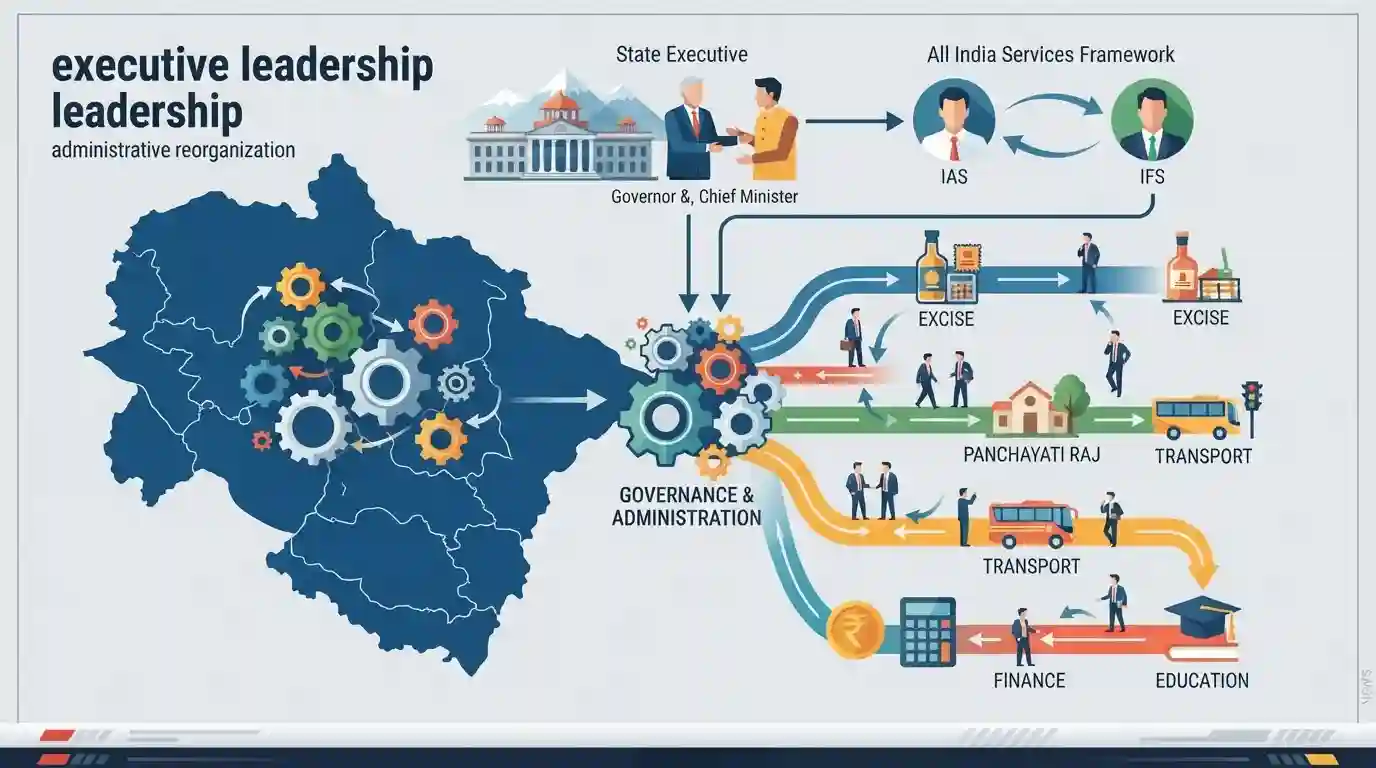
The Uttarakhand state government has executed a significant bureaucratic reshuffle, transferring numerous senior Indian Administrative Service (IAS) and Indian Forest Service (IFS) officers across vital departments. Important reassignments include structural shifts in the Excise, Panchayati Raj, Transport, Finance, and Education departments. Such administrative reorganizations are fundamental to state governance, as they dictate the executive leadership of various governmental wings operating under the purview of the State Executive and All India Services framework.
Key Points
- The Uttarakhand government carried out a major administrative reshuffle involving several senior IAS and IFS officers.
- Key changes include Nitesh Kumar Jha taking charge of Panchayati Raj, and Ravinaath Raman being assigned the Transport Department.
- The transfers span critical state departments including Excise, Finance, School Education, and IT & Science and Technology, aiming to streamline governance.
Important Terms
Indian Administrative Service (IAS)

The premier All-India civil service responsible for shaping policies, managing district administration, and implementing government directives across both state and central governments.
UPSC context
Central to GS Paper 2 (Role of Civil Services in a Democracy) and understanding India's federal administrative architecture.
Indian Forest Service (IFS)
One of the three All India Services, established in its modern form in 1966, dedicated to managing, conserving, and protecting India's forests and wildlife.
UPSC context
Essential for GS Paper 2 (All India Services) and GS Paper 3 (Environmental Conservation and Natural Resource Management).
Excise Department
A state executive department responsible for regulating the manufacture, sale, transport, and taxation of alcohol and intoxicating drugs, while managing major state revenues.
UPSC context
Relevant for GS Paper 2 (Functions of State Executive) and GS Paper 3 (State Revenues and Resource Mobilisation).
Panchayati Raj Department
The state administrative unit overseeing decentralized rural self-governance via the three-tier system of Gram, Block, and District Panchayats.
UPSC context
Highly relevant for GS Paper 2 (Devolution of Powers, Local Administration, and the 73rd Constitutional Amendment Act).
Finance Department
A core state government department that controls fiscal policy, budget preparation, taxation, expenditure, and the overarching management of state financial resources.
UPSC context
Important for GS Paper 2 (State Administration) and GS Paper 3 (Government Budgeting and Mobilisation of Resources).
Prelims Trap
State governments have the absolute power to dismiss or remove All India Services officers serving in their cadre.
While states handle immediate postings, transfers, and can suspend an AIS officer, ultimate disciplinary authority—including dismissal or removal—lies exclusively with the President of India.
Static Concepts Connected
How is control exercised over All India Services (AIS) under the Constitution?
- Dual Control: Immediate control lies with the State government where the officer serves, while ultimate control remains with the Union government.
- Disciplinary Action: States can suspend an officer, but severe penalties like dismissal or removal can only be imposed by the President of India.
- Creation Power: Rajya Sabha can authorize the creation of a new AIS via a resolution supported by a two-thirds majority under Article 312.
What is the constitutional composition of the State Executive?
- Core Components: It consists of the Governor, Chief Minister, Council of Ministers, and Advocate General of the State (Articles 153-167).
- Executive Power: Executive power is formally vested in the Governor, who relies on the state bureaucratic machinery (including IAS officers) to implement policies and laws.
Cross-Topic Patterns
AIS and Centre-State Friction
Dual control over IAS/IPS officers frequently sparks disputes regarding deputation rules and disciplinary jurisdiction, making it a persistent theme in federalism and Centre-State relations.
Bureaucracy vs. Decentralization
Assigning senior IAS officers to manage Panchayati Raj departments highlights the ongoing tension between top-down bureaucratic administration and grassroots democratic decentralization under the 73rd Amendment.

Expect Prelims statements linking Article 312 to Centre-State friction, specifically targeting the nuances of 'dual control' over AIS.
Linked PYQs · 3
Linked PYQs · 3
- 2016UKPSC_PRELIMSGS1
Which of the following institutes are considered necessary to promote 'Unity among diversity' in the Indian Federalism?
- 2025UKPSC_PRELIMSGS1
Which of the following records is not maintained by the Panchayats in Uttarakhand?
- 2025UKPSC_PRELIMSGS1
Consider the following statements with reference to Uttarakhand and choose the correct answer: 1. The executive of Uttarakhand includes Governor as the head of the state. 2. It also includes the Chief Minister and his/her council of ministers.
