Uttarakhand Science and Technology Policy 2026 for Regional Growth
Source:drishtiias ↗
Why It Matters
This policy sets the foundational framework for leveraging science and technology for sustainable growth, disaster resilience, and innovation in Uttarakhand, making it critical for state-level civil services preparation.
Summary
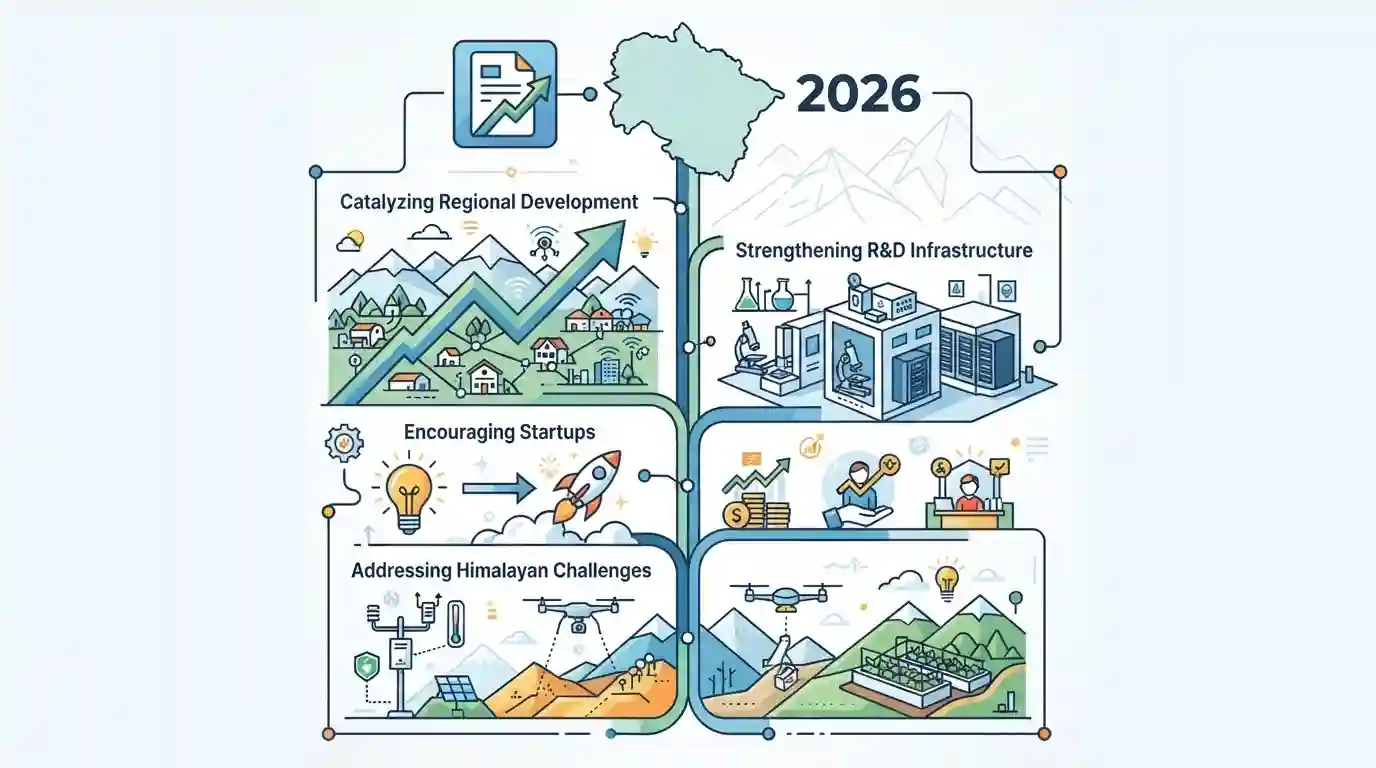
The Uttarakhand government has released the Science, Technology, and Innovation Policy 2026 to catalyze regional development, strengthen research and development infrastructure, encourage startups, and address environmental and socio-economic challenges unique to the Himalayan state through technological interventions.
Key Points
- Uttarakhand has officially released its Science, Technology, and Innovation Policy 2026 to foster research, development, and technological advancements within the state.
- The policy aims to build a robust ecosystem bridging academia, industry, and government to tackle regional development challenges and climate vulnerability.
- It focuses on promoting startup culture, innovation hubs, biotechnology, and green technology tailored to the Himalayan ecology.
Important Terms
Uttarakhand Science Technology and Innovation Policy 2026

A strategic initiative launched by the state government to catalyze regional development, strengthen research infrastructure, and address Himalayan socio-environmental challenges through technological interventions and innovation.
UPSC context
Relevant for UKPSC Mains (State-Specific Policies and S&T Innovations for Himalayan Development). Tests knowledge of regional policy frameworks and sustainable growth strategies.
Uttarakhand State Council for Science and Technology (UCOST)
The nodal agency acting as an autonomous body under the state government to promote science and technology, foster research, and support technology-driven developmental programs across Uttarakhand.
UPSC context
Important for UKPSC Prelims and Mains (Scientific Institutions in Uttarakhand). Tests awareness of key implementation bodies for state scientific initiatives.
Prelims Trap
Science, technology, and innovation policies in India are exclusively formulated by the Union Department of Science and Technology without state-specific frameworks.
Aspirants often assume state-level STI policies are formulated solely by central bodies like the DST, whereas hill states draft independent contextual policies targeting regional vulnerabilities like glaciology and disaster management.
Static Concepts Connected
What are the key institutional bodies driving science and technology policy and research in Uttarakhand?
- Nodal Agency: UCOST (Uttarakhand Council for Science and Technology) acts as the nodal agency for promoting STI initiatives across the state.
- Premier Institutes: Wadia Institute of Himalayan Geology (Dehradun) provides crucial research support for glaciology and seismic studies in the region.
- Technical Anchor: IIT Roorkee serves as the primary technical and academic anchor for engineering, disaster mitigation, and industrial innovation.
Cross-Topic Patterns
Himalayan Climate Vulnerability & State Innovation Policies
Uttarakhand's focus on disaster management and glaciology links state innovation policy with national disaster frameworks under the NDMA and IPCC Himalayan assessments.
Traditional Knowledge Integration in Hill States
Integrating traditional hill knowledge with modern biotechnology connects state-level STI policies with national initiatives like the National Mission on Himalayan Studies (NMHS).

Uttarakhand STI Policy 2026 priorities like glaciology and green tech will likely feature in Uttarakhand-specific mains or prelims questions.
Linked PYQs · 2
Linked PYQs · 2
- 2025UKPSC_PRELIMSGS1
Consider the following statements and select the correct answer from the options given below : Statement 1 : Uttarakhand is highly vulnerable to climate change. Statement 2 : Climate change is causing water stress and depleting biodiversity in Uttarakhand.
- 2025UKPSC_PRELIMSGS1
Where is the Herbal Research and Development Institute of Uttarakhand situated?
