Uttarakhand Tops In Implementing New Criminal Laws
Source:timesofindia-indiatimes ↗
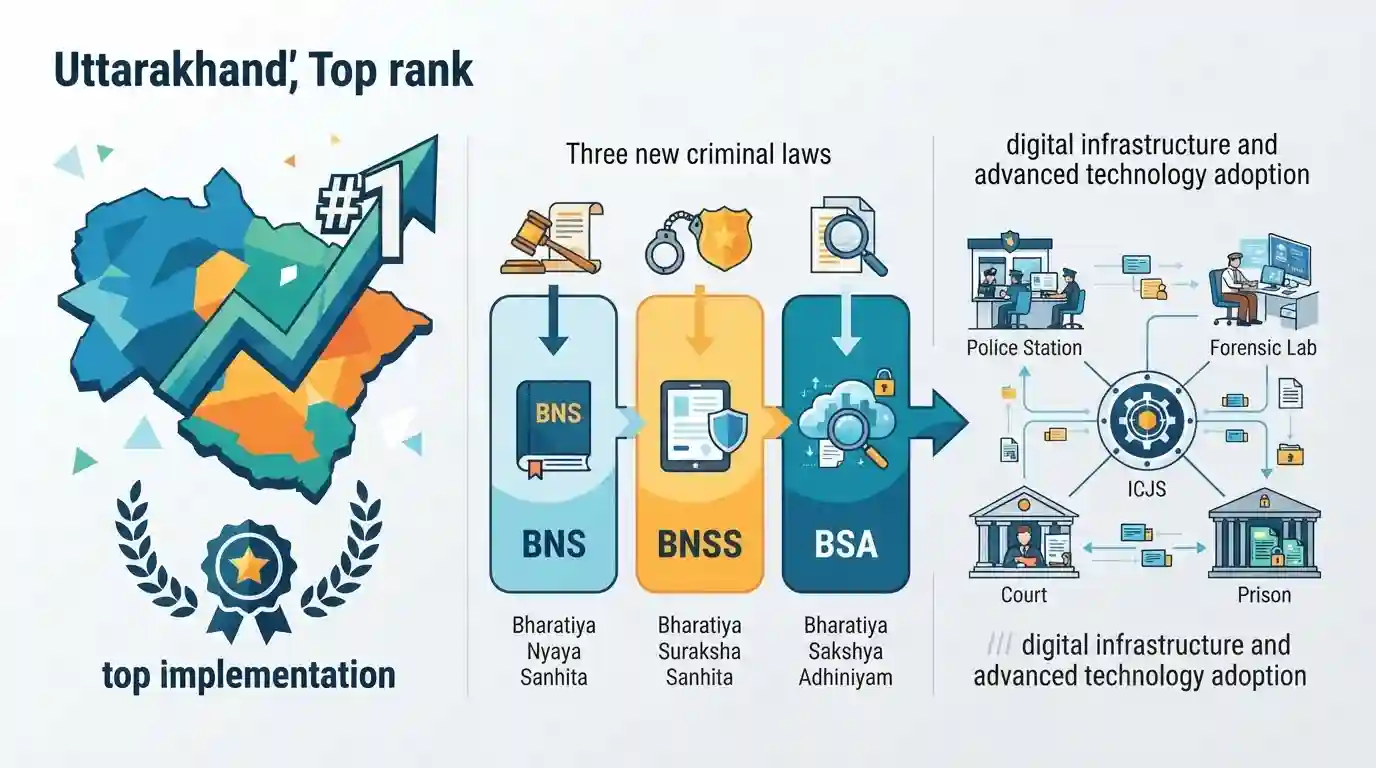
Why It Matters
Highlights Uttarakhand's pioneering role in judicial and criminal law reforms at the national level, making it a crucial topic for state-level civil services examinations.
Summary
Uttarakhand has achieved the top rank in India for the effective implementation of the new criminal laws—Bharatiya Nyaya Sanhita (BNS), Bharatiya Nagarik Suraksha Sanhita (BNSS), and Bharatiya Sakshya Adhiniyam (BSA)—bolstered by digital infrastructure and advanced technology adoption like the ICJS.
Key Points
- Uttarakhand secured the first rank nationwide in the effective implementation of the three new criminal laws (BNS, BNSS, and BSA).
- The successful implementation is attributed to robust digital integration, capacity building, and training of police and judicial personnel.
- The state utilized advanced technological frameworks like the Inter-Operable Criminal Justice System (ICJS) to streamline investigation, prosecution, and trial processes.
Important Terms
Bharatiya Nyaya Sanhita (BNS)

The new principal criminal code of India that replaced the colonial-era Indian Penal Code (IPC) from July 2024, redefining offenses and punishments.
UPSC context
Important for UKPSC Mains GS Paper (Polity/Governance/Internal Security), testing knowledge of landmark criminal law reforms in India.
Bharatiya Nagarik Suraksha Sanhita (BNSS)
The updated procedural law replacing the Code of Criminal Procedure (CrPC), modernizing investigation, trial procedures, and timelines in criminal justice delivery.
UPSC context
Crucial for UKPSC exam preparation under governance and criminal justice system reforms, focusing on procedural updates.
Bharatiya Sakshya Adhiniyam (BSA)
The new legislation replacing the Indian Evidence Act, governing the admissibility of digital and electronic evidence in Indian courts.
UPSC context
Relevant for UKPSC Law and Governance syllabus, testing understanding of modern evidentiary standards and legal reforms.
Inter-Operable Criminal Justice System (ICJS)
A national platform integrating five pillars of the criminal justice system—police, courts, prisons, forensics, and prosecution—for seamless data sharing.
UPSC context
Important for UKPSC e-governance, IT integration in law enforcement, and internal security topics.
Static Concepts Connected
What are the key pillars of the Inter-Operable Criminal Justice System (ICJS) in India?
- Core Objective: Enables seamless transfer of data and information among various pillars of the criminal justice system like courts, police, jails, and forensic labs.
- Data Principle: Operates on the 'One Data, One Entry' principle where data is entered only once at the source and shared across all systems.
- Implementation: A centrally sponsored scheme implemented by the Ministry of Home Affairs to modernize policing and reduce trial delays.
Cross-Topic Patterns
E-Governance in Criminal Justice Infrastructure
Uttarakhand's top rank in ICJS implementation connects state-level e-governance initiatives with national digital public infrastructure targets under Digital India.
Criminal Law Reforms & Federalism
The adoption of BNSS and BNS reflects wider federal shifts in criminal justice reform, impacting center-state judicial administration and policing standards.

Uttarakhand's rank 1 in ICJS/new criminal laws will likely feature as a factual match or statement-based question in UKPSC prelims.
Linked PYQs · 1
Linked PYQs · 1
- 2025UKPSC_PRELIMSGS1
According to NITI Aayog's SDG India Index 2023-24, which state/states has the highest SDG index score? 1. Kerala 2. Uttarakhand 3. Goa 4. Tamil Nadu
