CM Dhami Pushes Rani Bagh Bhimtal Ropeway to Boost Kumaon Tourism
Source:indianmasterminds ↗
Why It Matters
Infrastructure-led tourism development in Himalayan states requires balancing ecological fragility with regional connectivity. Understanding state-level initiatives like ropeway projects (under concepts like the Parvatmala initiative) and the role of statutory bodies like the Uttarakhand Tourism Development Board (UTDB) is crucial for UKPSC exams.
Summary
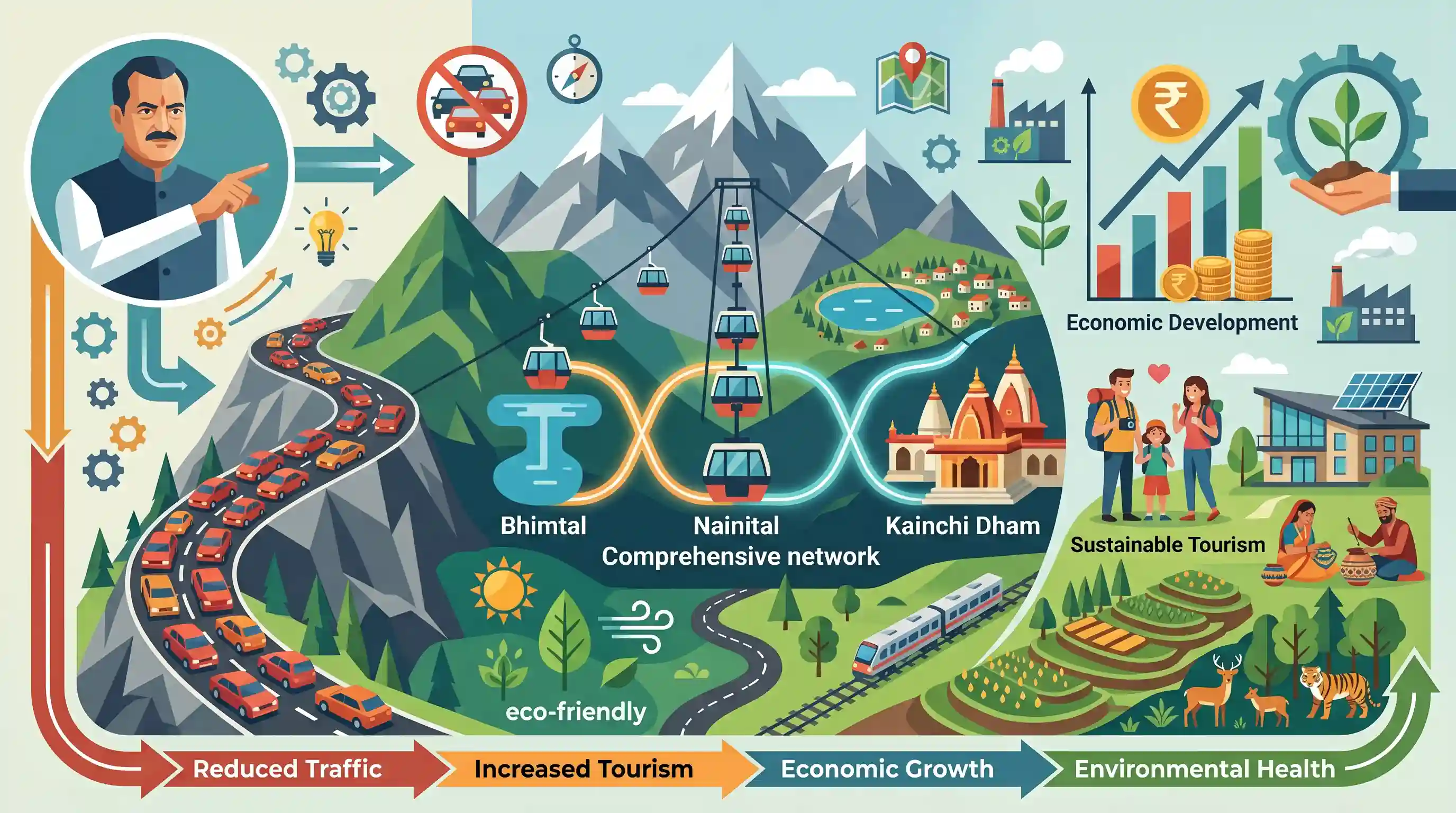
Uttarakhand Chief Minister Pushkar Singh Dhami has instructed authorities to fast-track the Rani Bagh-Bhimtal Ropeway Project. Designed to significantly ease traffic congestion on the Haldwani-Bhimtal route, the project aims to boost tourism and economic growth in the Kumaon region. The state is also considering additional ropeways connecting popular destinations such as Nainital and Kainchi Dham to establish a comprehensive, eco-friendly transport network.
Key Points
- Uttarakhand Chief Minister Pushkar Singh Dhami has directed officials to expedite the proposed Rani Bagh-Bhimtal Ropeway Project in the Kumaon region.
- The primary objective of the ropeway is to boost regional tourism, improve travel convenience, and dramatically reduce travel times and traffic congestion on the Haldwani-Bhimtal route, especially during peak tourist seasons.
- Bhavna Mehra, Vice-Chairperson of the Housing Advisory Council, submitted a representation letter to the Chief Minister, urging for early action and hassle-free initiation of the project.
- The state government is also exploring other potential ropeway projects in the Kumaon region, including connections to Nainital and the popular spiritual center Kainchi Dham.
- The development aligns with the state's focus on building sustainable, eco-friendly transit alternatives in the ecologically sensitive Himalayan terrain.
Important Terms
National Ropeways Development Programme (Parvatmala Scheme)

A Union Government initiative announced in the 2022-23 Budget to construct ecologically sustainable ropeways in difficult hilly and congested urban areas through Public-Private Partnerships, improving last-mile connectivity.
UPSC context
GS Paper III (Infrastructure), testing knowledge of sustainable alternative transit systems and connectivity initiatives in hilly terrains.
Uttarakhand Tourism Development Board (UTDB)
The highest statutory body advising the Uttarakhand government on tourism, responsible for developing and promoting tourism-related resources in an eco-friendly manner with private and local participation.
UPSC context
GS Paper II & III (State Governance and Infrastructure), testing institutional frameworks driving regional economic and sustainable development.
Uttarakhand Housing Advisory Council
A state-level advisory body in Uttarakhand that advises the state government on housing policies, urban infrastructure, and regional development initiatives to improve connectivity and living standards.
UPSC context
GS Paper II (Governance), testing knowledge of state-level advisory bodies in infrastructure planning and local governance.
Uttarakhand Metro Rail Corporation (UKMRCL)
A Special Purpose Vehicle of the Government of Uttarakhand responsible for planning, designing, constructing, and maintaining mass rapid transit systems, urban infrastructure, and ropeways in the state.
UPSC context
GS Paper III (Infrastructure), testing understanding of state-level corporations executing modern urban transit and mountain transport networks.
Prelims Trap
The Parvatmala Pariyojana (National Ropeways Development Programme) is administered and funded by the Ministry of Tourism.
Aspirants assume ropeway connectivity projects fall under the Ministry of Tourism or Urban Affairs, whereas the nodal ministry is actually the Ministry of Road Transport and Highways (MoRTH).
Static Concepts Connected
What is the Parvatmala Pariyojana and its implementing agency?
- Nodal Agency: Implemented by the Ministry of Road Transport and Highways (MoRTH) through its SPV, National Highway Logistics Management Limited.
- Target Areas: Focuses on difficult hilly terrains, congested urban spaces, and ecologically sensitive zones where conventional highways are unviable.
- Execution Mode: Executed primarily via the Public-Private Partnership (PPP) model to leverage private sector efficiency and funding.
How do the Kumaon tectonic lakes differ geographically?
- Geological Origin: Formed by tectonic movements and geological faulting in the Lesser Himalayas, unlike high-altitude glacial moraine-dammed lakes.
- Hydrological Basin: Bhimtal is situated in the Gaula River basin, a key spring-fed river network feeding the Ramganga-Ganges system.
- Ecological Status: These lakes act as crucial freshwater reservoirs but face high siltation, pollution, and tourism-induced eutrophication risks.
Cross-Topic Patterns
Himalayan Infrastructure vs Carrying Capacity
Ropeways offer low-carbon transport, but escalating tourist footfalls threaten the fragile carrying capacity of seismic-prone, landslide-susceptible Lesser Himalayan valley towns.
Medieval History and Modern Pilgrimage
Linking Katyuri dynasty historical sites (Rani Bagh) and spiritual hubs (Kainchi Dham) illustrates infrastructure-led conservation of regional heritage and tourism economics.

A 2026 GS-3 question may assess 'Parvatmala' as an eco-friendly transit solution versus the carrying capacity of the fragile Himalayas.
Linked PYQs · 3
Linked PYQs · 3
- 2024UKPSC_PRELIMSGS1
UTDB is established in Uttarakhand to promote:
- 2024UKPSC_PRELIMSGS1
Durmital is located in which of the following district of Uttarakhand ?
- 2025UKPSC_PRELIMSGS1
Which of the following is the correct order of rivers from west to east in Uttarakhand?
