Uttarakhand Launches Devbhoomi AI Summit to Foster Tech Innovation
Source:einpresswire ↗
Why It Matters
Highlights the application of emerging technologies (AI) in regional governance and disaster resilience, an important sub-topic under GS3 (Science & Technology and Disaster Management) for State PCS.
Summary
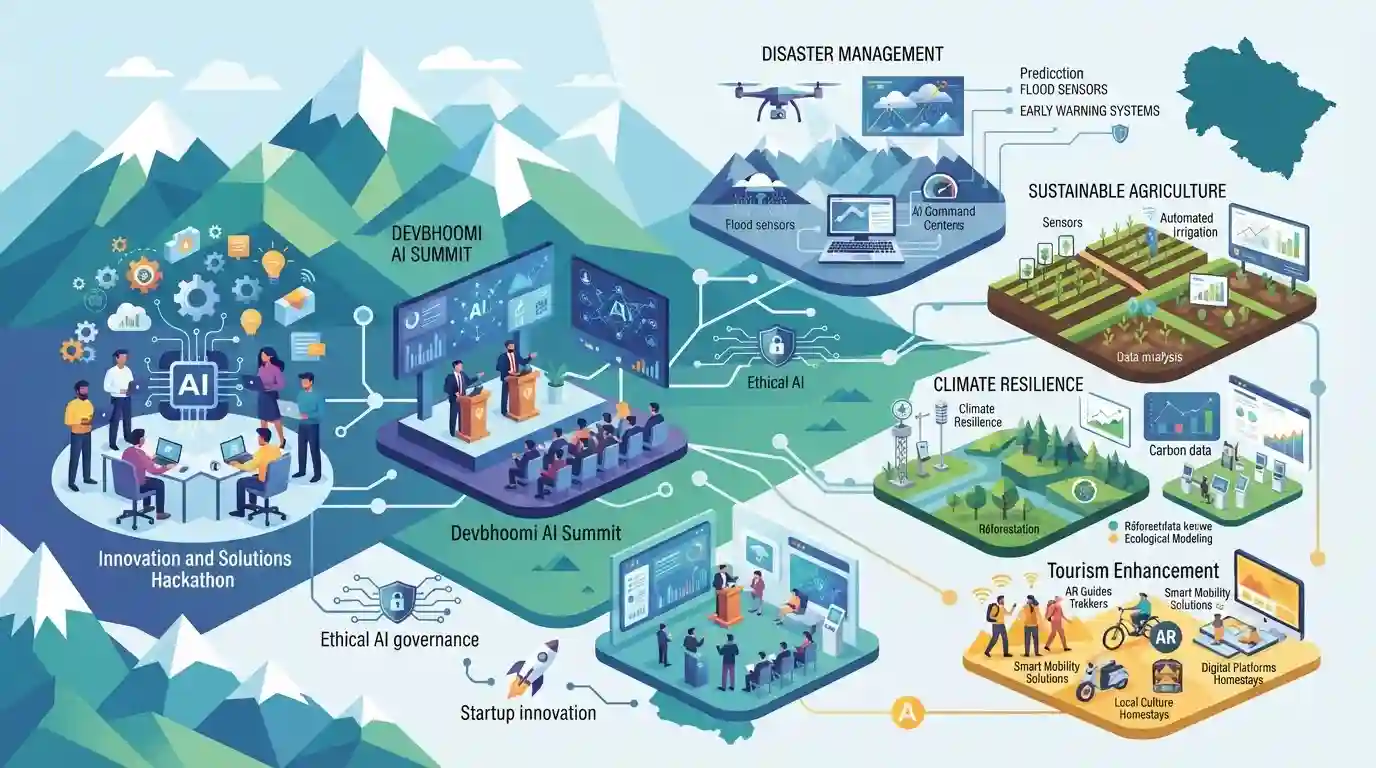
Uttarakhand is advancing its technological ecosystem by launching the Uttarakhand Innovation and Solutions Hackathon 2026 and the Devbhoomi AI Summit 2026. Backed by the state's Information Technology Development Agency (ITDA), these initiatives aim to deploy Artificial Intelligence to solve critical state-specific challenges, including disaster management, sustainable agriculture, climate resilience, and tourism enhancement. The events reflect a strong policy push towards ethical AI governance, startup innovation, and modernization of public services in the Himalayan state.
Key Points
- Uttarakhand is positioning itself as an AI hub through the launch of the Uttarakhand Innovation and Solutions Hackathon 2026 and Devbhoomi AI Summit 2026.
- The events aim to leverage Artificial Intelligence to address regional challenges in sectors like disaster resilience, sustainable agriculture, smart mobility, climate action, and tourism.
- The initiatives underscore the state government's commitment to integrating advanced technologies in governance and public service delivery, supported by ITDA.
- The summit will provide a roadmap for ethical AI governance, encourage startup innovation, and facilitate collaboration between tech leaders, academia, and policymakers.
Important Terms
Devbhoomi AI Summit 2026

A global artificial intelligence conference scheduled for October 2026 in Dehradun, positioning Uttarakhand as a leader in responsible, citizen-centric AI governance and tech ecosystem development in the Himalayas.
UPSC context
GS Paper 2 & 3 (Governance/S&T). Highlights state-led AI adoption, ethical tech governance, and sub-national technology diplomacy.
Uttarakhand Innovation and Solutions Hackathon 2026
A state-wide technology competition organized by ITDA Uttarakhand to encourage youth and startups to develop scalable digital solutions for governance, disaster resilience, agriculture, and tourism.
UPSC context
GS Paper 3 (S&T/Disaster Management). Showcases bottom-up innovation, e-governance problem-solving, and tech integration in public administration.
Information Technology Development Agency (ITDA)
The autonomous nodal agency of the Government of Uttarakhand responsible for implementing e-governance initiatives, cyber security, and statewide IT capacity building under the National e-Governance Plan.
UPSC context
GS Paper 2 (E-Governance). Relevant for understanding institutional frameworks that implement digital infrastructure and citizen-centric public service delivery.
Government of Uttarakhand
The sub-national administrative authority of Uttarakhand, currently focusing on policies that integrate ecological preservation with digital innovation and artificial intelligence in state governance.
UPSC context
GS Paper 2 (State Governance). Useful as a case study for proactive state-level policy formulation in emerging technologies and sustainability.
Prelims Trap
"The Devbhoomi AI Summit is a flagship initiative launched by NITI Aayog for Himalayan states."
It is exclusively a state-level initiative led by Uttarakhand's Information Technology Development Agency (ITDA), not a central government program.
Static Concepts Connected
How is Artificial Intelligence utilized in disaster management?
- Predictive modeling: Analyzing meteorological data, satellite imagery, and seismic patterns to build robust early warning systems.
- Damage assessment: Using drone footage and computer vision to map post-disaster infrastructure damage and stranded populations rapidly.
- Resource allocation: Algorithms optimizing rescue routes and supply chain logistics for relief materials during active crises.
What are the core principles of Ethical AI in public governance?
- Transparency: Ensuring AI decision-making processes (e.g., determining welfare eligibility) are explainable and not "black-box" systems.
- Accountability: Establishing clear human oversight and legal responsibility for automated governance and predictive policing systems.
- Bias mitigation: Preventing algorithmic discrimination by ensuring training data represents diverse demographics equitably.
Cross-Topic Patterns
AI & Himalayan Disaster Resilience
Merging S&T with Geography, highlighting how localized AI predictive models combat specific topological threats like Glacial Lake Outburst Floods (GLOFs) and landslides in fragile ecosystems.
Competitive Federalism in Emerging Tech
Shift from top-down central IT policies to states acting as tech incubators, pushing competitive federalism into AI regulation, public service modernization, and localized tech hackathons.

AI in localized disaster management (e.g., Himalayan landslides/GLOFs) is a high-probability GS-3 mains question linking tech & ecology.
Linked PYQs · 4
Linked PYQs · 4
- 2025UKPSC_PRELIMSGS1
What is the objective of 'DigiLocker' service?
- 2025UKPSC_PRELIMSGS1
The United Nations has designated the year 2025 as the international year of which scientific field?
- 2025UKPSC_PRELIMSGS1
Consider the following statements and select the correct answer from the options given below : Statement 1 : Uttarakhand is highly vulnerable to climate change. Statement 2 : Climate change is causing water stress and depleting biodiversity in Uttarakhand.
- 2024UKPSC_PRELIMSGS1
UTDB is established in Uttarakhand to promote:
