Uttarakhand plans long-term strategy for Himalayan challenges
Source:hindustantimes ↗
Why It Matters
Extremely relevant for UKPSC aspirants studying state-specific geographic constraints, disaster vulnerability, and sustainable governance frameworks in the Himalayan context.
Summary
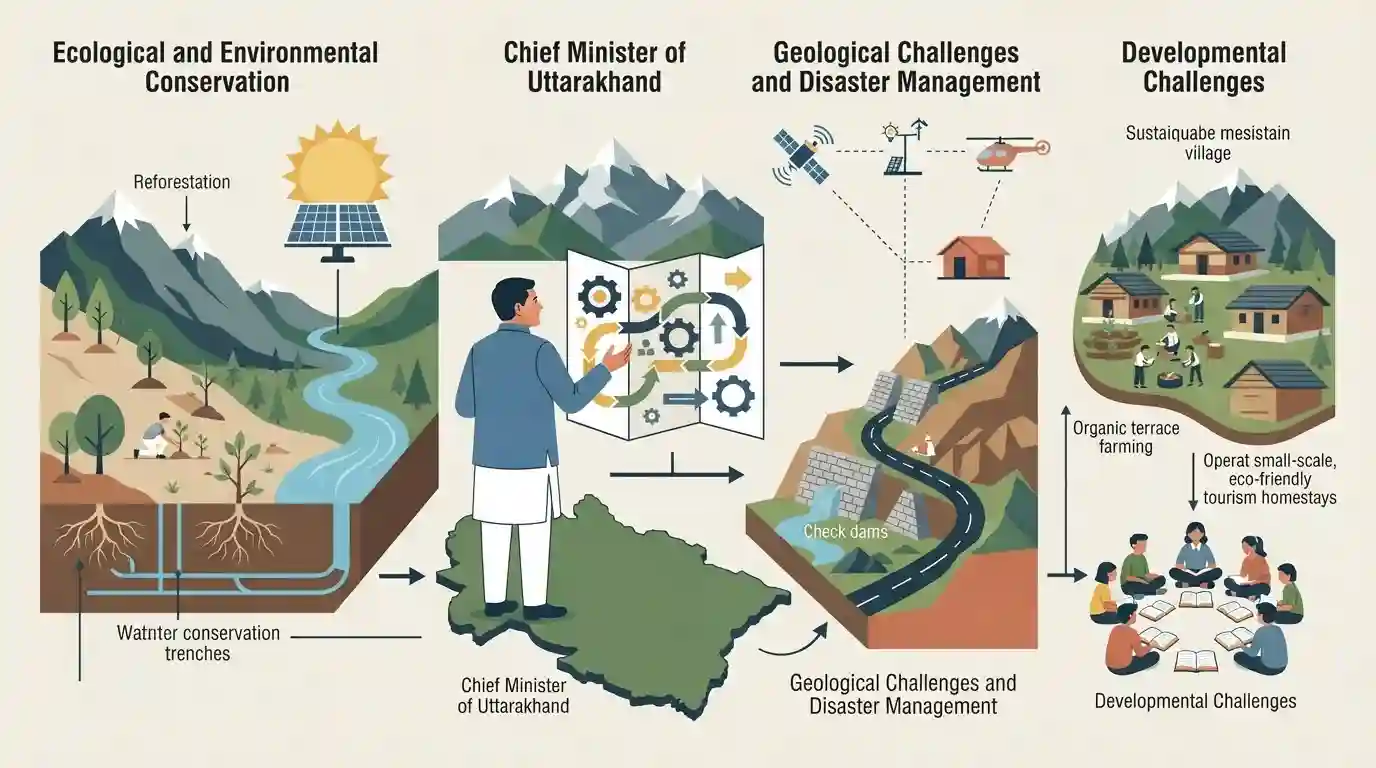
Uttarakhand Chief Minister Pushkar Singh Dhami highlighted the necessity of a dedicated long-term roadmap to address the complex ecological, geological, and developmental challenges facing the Himalayan state.
Key Points
- Chief Minister Pushkar Singh Dhami emphasized the need for a long-term, comprehensive strategy tailored to the unique geographical and ecological challenges of the Himalayan region.
- Focus areas include sustainable development, disaster management, climate resilience, and preserving the ecological balance of Uttarakhand.
- The state government aims to balance infrastructure growth with environmental protection to mitigate vulnerabilities such as landslides and climate shocks.
Important Terms
Uttarakhand Government

The executive branch of the state of Uttarakhand, led by the Chief Minister, responsible for formulating policies, administering laws, and steering the socio-economic and infrastructural development of the Himalayan region.
UPSC context
UKPSC GS Papers (Polity and Governance); tests knowledge of state executive functioning, administrative machinery, and policy-making in hilly terrain.
Carrying Capacity
The maximum population, tourist influx, and infrastructure load an ecologically sensitive region can sustainably support without causing permanent environmental degradation.
UPSC context
UKPSC GS Paper (Geography & Disaster Management); tests understanding of ecological limits, fragile Himalayan ecosystems, and sustainable development.
Centre for Public Policy and Good Governance
An autonomous think tank under the Department of Planning, Uttarakhand, tasked with supporting policy reforms, good governance frameworks, and Sustainable Development Goals (SDGs) implementation.
UPSC context
UKPSC GS Paper (Governance & Public Policy); tests awareness of state-level planning bodies, data-driven policymaking, and SDG tracking in Uttarakhand.
Static Concepts Connected
What are the primary institutional frameworks and disaster mitigation measures for Glacial Lake Outburst Floods (GLOFs) in India?
- NGRMP Initiative: National GLOF Risk Mitigation Project (NGRMP) focuses on installing early warning systems and sensor networks in high-risk glacial lakes.
- NDMA Guidelines: NDMA guidelines emphasize hazard zonation mapping, artificial lowering of lake water levels, and community-based disaster response.
- CWC Monitoring: Central Water Commission (CWC) monitors glacial lakes and water bodies using satellite remote sensing and meteorological data.
Cross-Topic Patterns
Himalayan Infrastructure vs Carrying Capacity
Infrastructure expansion in fragile eco-zones frequently triggers land subsidence and slope destabilization, echoing lessons from the Joshimath crisis.
Disaster Economics & Green Federalism
Himalayan states face severe revenue vs resilience trade-offs, demanding dedicated green federalism transfers from the Finance Commission.

Expect a mains question linking Himalayan carrying capacity assessment, GLOF mitigation, and sustainable developmental paradigms.
Linked PYQs · 2
Linked PYQs · 2
- 2025UKPSC_PRELIMSGS1
Which of the following is the correct order of the following physiographic regions of Uttarakhand from south to north direction?
- 2025UKPSC_PRELIMSGS1
Consider the following statements with reference to animal husbandry in Uttarakhand. Select the correct answer from the codes given below : 1. Animal husbandry is a supplementary occupation of agriculture. 2. Sheep rearing in the mountainous areas has been affected by environmental degradation.
